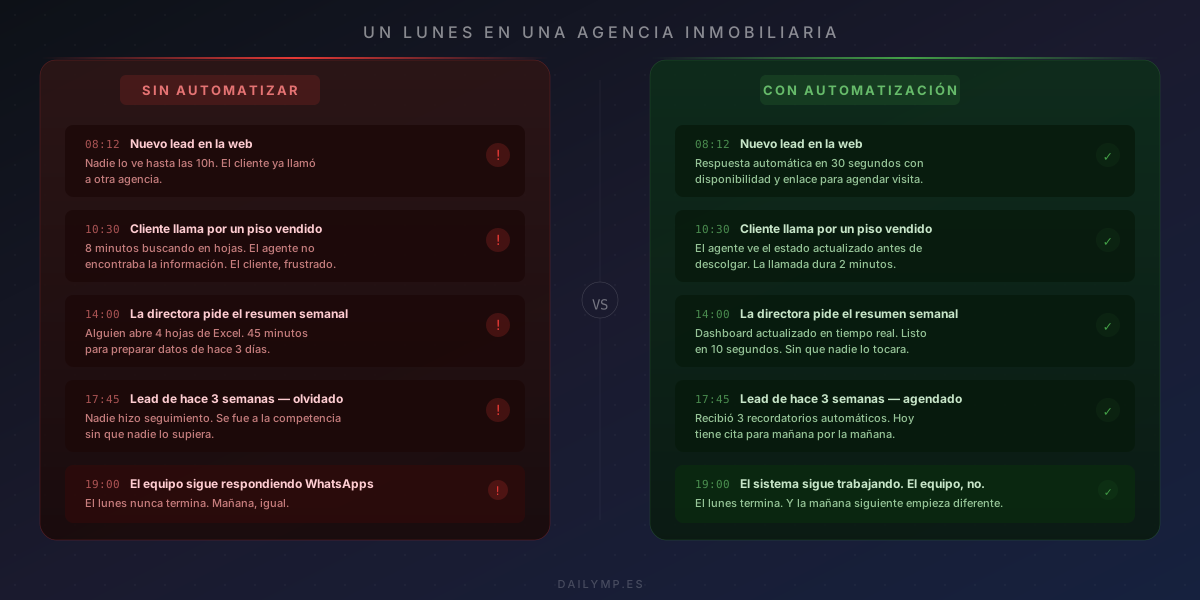
A Monday at a Real Estate Agency: Before and After Automation
It's 8:12 on a Monday morning.
At a twelve-person real estate agency, a contact form just came in. Someone is looking for information about a three-bedroom flat in the city centre. They left their name, email address and a phone number.
Two different things are about to happen — depending on whether that agency runs with automation or without it.
This is the story of that Monday. Told from the inside, scene by scene. No code. No technical jargon. Just what actually happens.
8:12am — A lead comes in through the website
Without automation:
The form hits the agency's general inbox. Sarah, the office coordinator, checks that inbox when she arrives. Today she has a 9am meeting with a property owner, then a backlog of Friday emails to clear. She sees the new form at 10:20.
By then, the person who sent it has had an hour and a half to lose interest, call a competitor, or simply move on.
Sarah writes to them. They don't respond that day.
With automation:
Twenty-eight seconds after submitting the form, the lead receives a message. It thanks them for their interest, tells them someone from the team will be in touch that morning, and offers a link to book a 15-minute call directly.
Twenty minutes later, the most available sales agent gets a notification with all the contact details and a note that the first message has already been sent.
The lead already feels attended to. The agency hasn't even opened its inbox yet.
10:30am — A client calls about a property that's already been sold
Without automation:
James calls. He saw a listing that caught his eye. He wants to know if it's still available.
Anna, the agent who picks up, doesn't manage that property. She doesn't know its current status. She searches the system, her colleague's notes, a WhatsApp group. Six minutes pass. She finds out it sold two weeks ago but the listing was never updated.
She explains the situation to James. He says fine, he'll have a look around. He hangs up.
The call lasted eight minutes and left a feeling of disorganisation.
With automation:
James calls. Anna picks up.
While James is explaining which property he means, her screen already shows the updated status of that listing, the full contact history, and three similar properties available in the same area — with prices and features.
Anna responds in ten seconds: "That one closed recently, but I've got three very similar options you might like." The call lasts two minutes. James books viewings for two of them on Thursday.
The difference between an organised agency and a disorganised one isn't the number of properties. It's how fast you can give accurate information when someone asks for it.
2:00pm — The director asks for the week's lead summary
Without automation:
Elena, the director, walks into the meeting room and asks how many leads came in this week, how many are active and how many have been lost.
A five-second silence.
"Hold on, let me check." Someone opens the tracking spreadsheet. Someone else opens email to count the forms received. There are discrepancies between the two. Some leads are in the spreadsheet but not in the CRM. Others appear in email but weren't registered anywhere.
Forty minutes later they have an approximation. Not actual data. An approximation.
Elena can't make decisions about what happened this week because this week's data doesn't exist in a consolidated form anywhere.
With automation:
Elena walks into the meeting room and, as everyone sits down, opens the dashboard on her screen.
There it is: 23 leads this week. 14 active. 6 with a call booked. 3 with no response yet — all with an automatic reminder scheduled for 5pm today. 4 disqualified, with the reason logged.
The data is from right now. Not yesterday. Not three days ago. This moment.
The meeting can focus on what to do with that information. Not on how to find it.
5:45pm — A lead from three weeks ago
Without automation:
Michael sent a form twenty-one days ago. He expressed interest in a property. Someone from the team called him, had a brief conversation, and left it that Michael would look into his financing options and call back.
Michael didn't call back.
No one from the team called him either. Not through negligence — simply because between the new leads arriving every week and the active deals, that contact got buried in a list nobody reviewed.
Today, Michael is signing a contract with another agency.
With automation:
Michael sent the form twenty-one days ago. On day three with no response from him, he received a message: "Hi Michael, did you get a chance to look into the financing? No rush at all — if you need more time or have any questions, we're here."
Michael replied that he was still looking into it. On day ten he received another message: "Michael, two new properties have just come in that match exactly what you were looking for. Would you like to see them this week?"
Today at 5:45pm, Michael has a viewing booked for tomorrow at 10:30am.
Nobody on the team remembered to do the follow-up. It just happened.
7:00pm — End of the working day
Without automation:
It's 7pm and three members of the team are still on their phones. There are unanswered WhatsApp messages from clients, two forms from today that haven't been processed, and the feeling that tomorrow will start exactly like today.
Monday was a Monday. Like any other.
With automation:
It's 7pm. The team has gone home.
But right now, four clients are receiving follow-up messages. Two forms from today have been responded to with appointments booked. The system has logged every day's contacts in the CRM, updated the status of active leads, and prepared a summary ready for tomorrow morning.
Tuesday will start with Monday's data already in order. Nothing to search for. Nothing to reconstruct.
The day's work didn't disappear when the team left. It kept going.
This isn't just about real estate agencies
The real estate agency is the example in this article. But if you run a clinic, an accounting firm, a consultancy, a marketing agency or any service business where there are clients, quotes, follow-ups and data to manage, this Monday is your Monday.
The problems are the same:
- Contacts come in and wait hours before anyone responds
- Information scattered across systems no one can find when they need it
- Follow-ups that slip through the cracks because there's no system to remember them
- Data that lives in spreadsheets instead of somewhere actually useful
- Teams that end the day feeling like they ran hard and got nowhere
It's not an attitude problem. It's a design problem. Your team works well. The system they work within, doesn't.
What changes when the process runs itself
With the automation agents we build at DAILYMP, the processes that used to depend on someone remembering start happening on their own.
No need to change the tools you already use. No need for your team to learn anything new. No need to understand how it works under the hood.
Here's what we do:
- We map how your current processes actually work: how leads come in, how follow-up gets done, where information lives, where opportunities get lost
- We identify the exact points where the process breaks down or depends on someone's memory
- We design the flow so those moments happen automatically, consistently, without manual intervention
- We connect it to the tools you already use: your CRM, email, management system, WhatsApp Business — whatever you've got
- We leave it running. You see the results. You only step in when something genuinely needs your judgement
With the systems integration work we do at DAILYMP, information flows between your tools without anyone having to move it. A lead that comes in through the website appears in the CRM, creates a task for the sales team and triggers the welcome message — all at the same moment.
Real results
The businesses that implement these processes don't hire more people. They don't change what they do. They don't go through a six-month digital transformation.
What changes is concrete: leads get a response before anyone has to look for them. Follow-ups happen even when there's no time to do them manually. Information is available when it's needed, without anyone having prepared it. And the team focuses their energy on what requires judgement — not on what could happen on its own.
On average, the businesses we work with recover between eight and fifteen hours per week of work that used to go into tasks that now happen automatically. Hours that go back to the team to use on what actually matters.
The only difference between the two businesses in this article
This isn't science fiction. It's what already happens at businesses that work with us.
The two agencies in this article have the same number of people. The same type of clients. The same products. The same city.
The only difference between them is a decision.
If you want to see what this would look like in your business, in 30 minutes I can walk you through exactly which processes can be automated right now, what would change and what wouldn't. No commitment. No technology pitch. Just a conversation about your business.