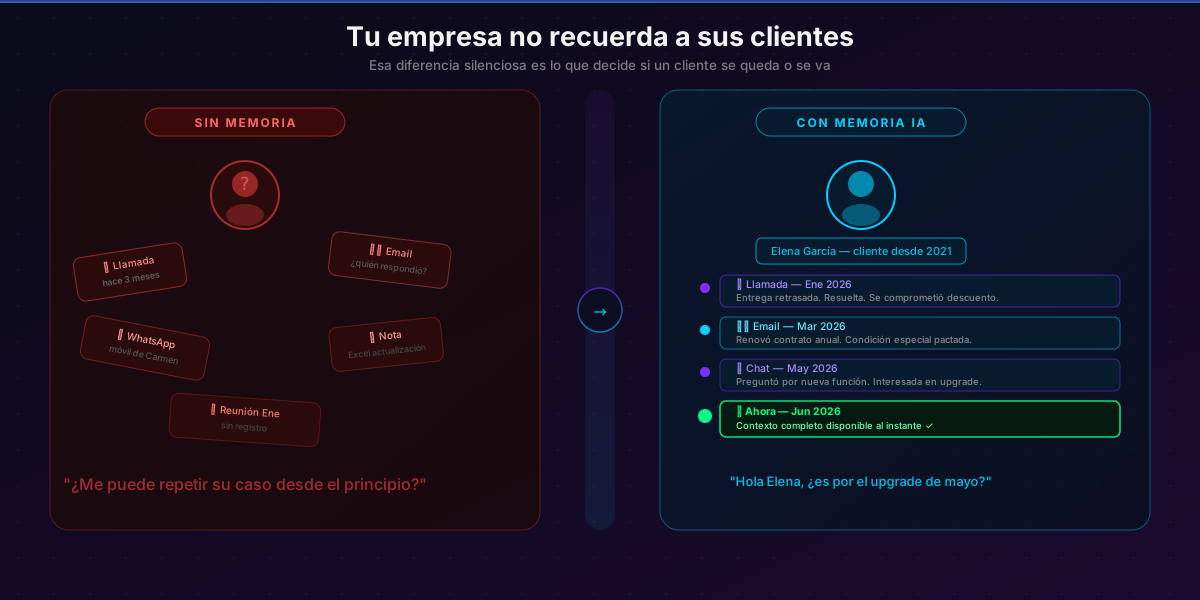
Your Best Client Calls. You Start From Zero.
Sarah has been a client of your business for three years. You have history together — or at least, she thinks you do.
This morning she called. A straightforward question about the service she hired last month. The person who picked up asked for her name. Then her client number. Then what the issue was about and when it had happened.
Sarah explained it. For the fourth time in two years.
Nobody was rude. Nothing dramatic happened. But Sarah hung up with a very specific feeling: that this company doesn't really know who she is.
Three days later, she receives a proposal from a competitor.
The problem that happens inside every call
Most businesses think they know their clients. They have their email, their purchase history, maybe a field in a management system with the date of their last order.
What very few have is real context at the moment the client needs help.
What happened the last time that client called? What was the problem you solved? What did you promise? What makes their situation different from the other two hundred clients on your list?
If the honest answer is "we'd have to look it up" — in emails, scattered notes, a spreadsheet someone updated three weeks ago — then your business doesn't have memory of its clients.
It has data. Not memory.
And that difference, which seems small, is what decides whether a client renews or quietly leaves.
What your business loses when it starts from zero every time
There's an obvious cost: call time. The person handling the call takes longer because they have no context. The client takes longer because they have to explain everything again. Five minutes here, ten minutes there — multiplied across every interaction with every client over the course of a year.
But the biggest cost isn't time. It's what happens in the client's mind while they're explaining their situation for the third time.
The client feels like they don't matter.
Not dramatically. Subtly. That feeling of being just another account. Of the effort they put in — coming back, recommending you to others, sticking with you when things go wrong — not matching the effort the company makes to actually know them.
That feeling, accumulated across three or four interactions, always produces the same outcome: the client stays with you as long as there's no better option. The moment one appears, they leave. No complaints. No warning. They just stop renewing.
Most businesses never find out why.
The illusion of the CRM nobody updates
"We have a CRM" is the standard reply when this problem comes up.
The CRM exists. It has client records. It has purchase history.
What it doesn't have is what actually matters:
- The voice note your sales rep recorded on the way back from a meeting and never transferred anywhere
- The email where the client explained their situation had changed
- The conversation where you agreed to push a deadline back by a month
- The complaint handled by someone who no longer works there
- The real reason that client nearly left six months ago
None of that is in any CRM because entering it manually requires a discipline that almost nobody maintains in practice. Not because they don't want to. Because it's extra work that always arrives at the worst moment.
The result: the CRM has the skeleton of the client relationship. The flesh — what actually lets you treat someone like a person rather than a number — is scattered across emails, calls, handwritten notes, and individual memories that disappear when someone leaves the team.
We wrote about what happens when that information walks out the door with a departing employee in this article about company information trapped on employees' phones.
What changes when your business actually remembers
I'm not talking about your team needing to remember more things or work harder. I'm talking about information existing in the system, available at the moment it's needed.
When that works:
Anyone can take a client call and know, within ten seconds, who that person is and what history you have with them. Without asking them to re-explain. Without searching. With real context available.
The sales team knows when it makes sense to reach out and with what message. Not generic "follow-up" — because the system knows that this client had a problem in January, asked about a new feature in March, and hasn't expanded their contract in two years.
When someone on your team leaves, the client doesn't notice. The next person to help them has the same context. The relationship doesn't start from scratch. It continues.
The client feels like they're known. That feeling — simple, but increasingly rare — is one of the most direct drivers of retention that exists.
At DAILYMP we build agents that connect your business's communication channels — email, calls, forms, project history — and centralize the real context of each client. Not the official CRM version, but what actually matters before you open your mouth: what was agreed, what went wrong, what's pending, what they care about.
Integration with your existing tools — Odoo, HubSpot, Notion, or whatever you use — means nobody has to enter any of this by hand. The system captures what matters and organizes it automatically.
Real results
Businesses that implement a real client memory system see results in two concrete areas from the first month.
Retention. Clients who feel that a business knows them renew more often. Not out of abstract emotional loyalty — but because switching providers has a cost, and that cost goes up when the relationship has history. A business that remembers lowers the client's willingness to leave.
Handling time. When the person answering has real context, interactions are 30% to 50% shorter. The client doesn't repeat themselves. The agent doesn't search. The conversation gets to the point.
And there's a third effect nobody anticipates: your team's experience improves. When the people handling calls have the information they need, they work without that constant tension of having to improvise or ask the client to hold while they search. The work flows.
If you have an active client base and team members managing those relationships, this is the work with the highest impact on your bottom line: building the infrastructure that turns isolated interactions into a relationship that compounds over time.
Let's talk about building that memory system for your business →