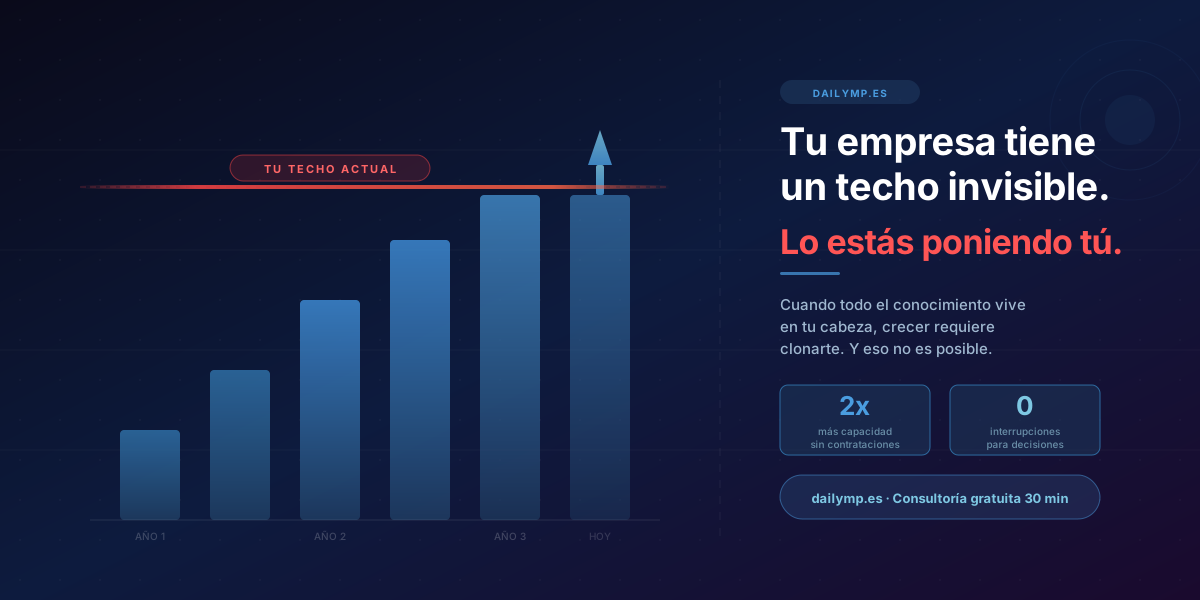
Your Business Has a Ceiling. You're the One Setting It.
Three years ago, your business was growing. Not dramatically, but consistently. Every month a little better. Every quarter a little further ahead.
And then something strange happened: it plateaued. No major client left. No critical mistake. No market crash. Just... a limit. As if your business had reached its maximum size and didn't know how to push past it.
You've questioned why. You've looked at market conditions, competition, pricing. But here's the truth no one tells you: the ceiling isn't outside your business. It's inside it. And you're the one holding it in place.
Why Your Business Stopped Growing When the Market Didn't
There's a pattern that repeats across nearly every SME that reaches a certain size: at some point, growth stops depending on market conditions and starts depending on the operational capacity of the team. And in most businesses, that operational capacity is, in practice, the capacity of one single person.
Yours.
Not because you're incompetent — but because that's what happens when a business grows without building systems: all the knowledge accumulates in the most involved person, which is usually whoever founded or runs the company.
You know how everything gets done. You know what to say to each client. You know how to solve the problems that come up. When your team doesn't know something, they ask you. When a decision needs to be made, it comes to you. When something breaks, you fix it.
That works perfectly up to a certain size. The problem is you've already reached that size. To grow further, you'd need to clone yourself. And that's not on the table.
The Signs That You Are the Ceiling
No complicated diagnosis needed. Here are the concrete signals:
Your team can't close projects without your sign-off. Not because they're incapable, but because final decisions always run through you. That means your response speed determines the speed of the entire company.
When someone on your team gets stuck, the solution is you. Whether they don't know how to do something, need information only you have, or a client conversation "is better handled by you." Every team member's blocker automatically becomes your task.
You've tried hiring to grow, and it didn't work the way you hoped. You brought someone on to offload work. By month two, they were asking you ten questions a day. By month three, you were just as busy as before. Because the problem wasn't a lack of hands — it was the absence of a system that told people how to do things without asking you.
There are projects you won't take because you know you can't handle them properly. Not a lack of capability. You know that adding one more client means adding more pressure on you. And you're already at the limit.
You've spent two years "about to get all this organized." You know you need to document processes, delegate more, build systems. But there's always something more urgent. And meanwhile, the ceiling stays right where it is.
The Cost Nobody Calculates
I'm not talking about the cost of being busy. You already know that one.
I'm talking about the cost of what you're not building while you remain your own business's bottleneck.
Every proposal you couldn't send because you didn't have time to prepare it properly. Every potential client who contacted you and waited a week for a response because you were overwhelmed. Every project you decided not to take because you knew you couldn't manage it. Every growth conversation you've postponed because you first need to "sort things out internally."
That's not stress. That's lost opportunity. And it accumulates quarter after quarter without appearing in any report.
The question isn't "how much work do you have?" The question is: how much could your business be generating if you weren't the constraint?
Why Hiring More People Doesn't Fix This
Here's the trap almost everyone falls into: believing the problem is a lack of people.
It isn't. The problem is a lack of systems.
When your business has no clear, documented processes, every new person you add needs to learn from you. Needs to ask you. Needs your validation. Instead of multiplying the company's capacity, you end up multiplying the demands on your time.
More people without systems don't free you. They complicate you.
What actually frees you is having the answers to common questions somewhere your team can access without asking you. Having repeating decisions follow a clear logic that doesn't require you to be available. Having processes run consistently without someone needing to coordinate them every time.
That's what AI automation agents and systems do: they transfer the knowledge that lives in your head into a system that runs without needing you at every step.
They don't replace people. They're not robots doing the work. They're the system that lets your team operate autonomously — without blocks, without waiting, without needing your constant presence to move forward.
What Having a System Actually Looks Like
I'm not talking about complicated technology. I'm talking about a very concrete change in how work flows through your business.
Before: a client asks something about their order. A team member doesn't know the answer. They message you. You respond when you can. The client waits.
After: the system has the answer. The team finds it in seconds. The client gets a response without you ever getting involved.
Before: a discount decision comes up. Nobody's sure when it applies and when it doesn't. They ask you. You decide. The team waits.
After: the criteria are defined in the system. The team applies the logic directly. Real exceptions come to you. Just those.
Before: a new project comes in. Someone has to coordinate it, assign it, track it. That someone is often you.
After: the project opening and tracking process runs automatically. Your team knows what's next at every stage. You see the status without having to ask.
The result isn't that you disappear from the equation. It's that your presence becomes necessary where you actually add value — in strategic decisions, in key relationships, in growth — rather than in the day-to-day management that should run without you.
What Changes When You Break the Ceiling
Businesses that build these systems don't suddenly explode in growth. They grow differently.
The first difference is that they can say yes more often. To projects they previously declined due to capacity. To clients they couldn't serve well before. To opportunities that used to pass them by.
The second difference is that growth doesn't hurt the same way. When a business has systems, adding volume doesn't mean adding chaos. The team can absorb more work without you having to step in at every additional step.
The third difference is that the owner or manager gets time to think again. Not to manage. To think. To talk to clients. To see what's coming. To make strategic decisions with a clear head instead of between emergencies.
If you've had a persistent feeling that your business could be bigger — that the potential is there but something is limiting it — it probably isn't the market. It's the structure. And that absolutely has a solution.
Real Results
Businesses that implement automation systems and AI agents to eliminate this type of bottleneck consistently achieve higher operational capacity without growing their headcount. The time owners or managers spend validating, responding, and unblocking drops between 40% and 60% within the first two months.
The most common thing we hear at three months: "Now I can think about growing. Before I was just thinking about surviving."
You can see how this works in more detail through our AI integration service.
The Question Worth Answering Today
How much could your business generate next year if you weren't the limiting factor?
It's not a rhetorical question. It's a number you can estimate. And the difference between that number and what you'll actually earn if nothing changes is the real cost of the ceiling you're creating.
If you want to know which part of that ceiling can be removed — and how quickly — I can give you a concrete answer in 30 minutes based on how your business actually works right now.
I want my business to work without everything running through me →