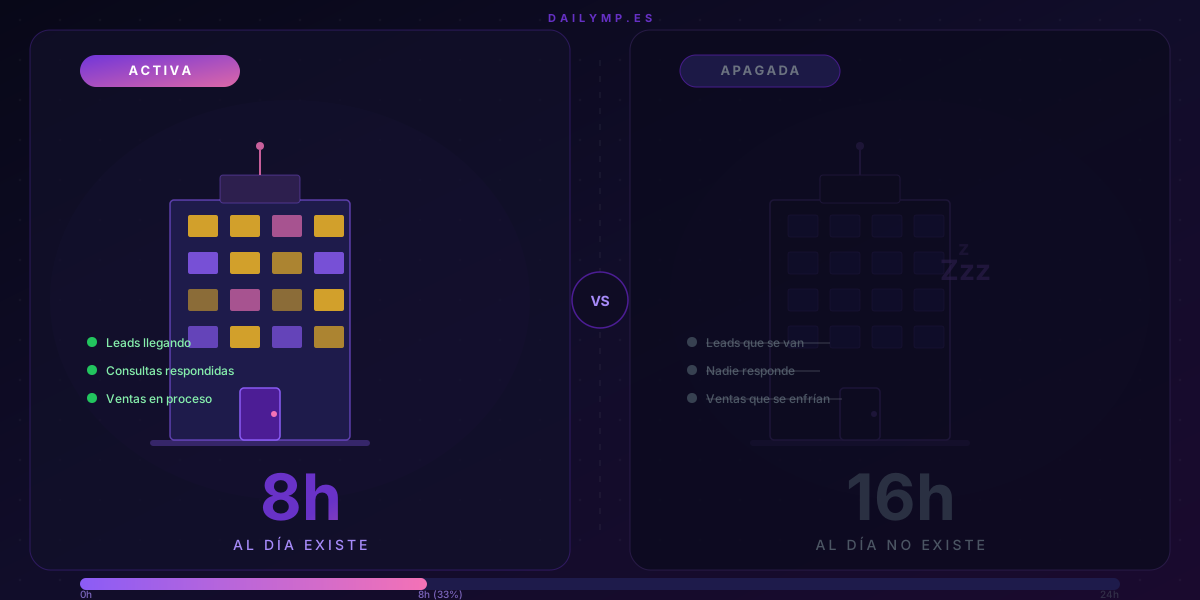
You Have a Business. But It Only Exists 8 Hours a Day.
It's Sunday afternoon.
Someone is searching for exactly what you offer. They land on your website. They read your services. They're convinced. They decide to reach out. They fill in the form or send a message.
And they wait.
Not because your business is bad. Not because your service doesn't fit. But because it's Sunday, and your business doesn't exist on Sundays.
The number nobody calculates
Let's do the math that almost no business owner does until they see it written down.
Your business works, say, Monday to Friday from 9 to 6. That's 8 hours a day, 5 days a week.
A year has 8,760 hours. Your business actively operates for 2,080 of them.
That means 76% of the time, your business doesn't exist.
Nobody's answering. Nobody's following up on quotes. Nobody's posting, managing or generating leads. The business you built with years of effort is, literally, switched off for three quarters of its life.
This isn't a motivation problem. It isn't that you're not working hard enough. It's that a business that depends on people has the same schedule as people. And people need to sleep, rest, and have a life.
That's not the problem. The problem is that potential customers have no schedule.
What happens while your business sleeps
In those 6,680 hours a year when your business is off, things still happen:
People visit your website and leave without a trace. Web traffic has no business hours. In fact, a significant portion of Google searches happen at night and on weekends, when people have time to research properly. They visit your site. They're interested. But there's nobody there to capture that interest. They leave.
Sent quotes that nobody follows up on. You sent a proposal on Thursday. The client needed a few days to decide. By Monday you've forgotten to follow up because three new urgencies arrived. The quote goes cold. The client goes with whoever called them on Friday.
Social media going silent. While your business sleeps, the LinkedIn, Instagram or wherever-you-have-a-presence algorithm keeps running. Other companies post. They appear. They position themselves. Your profile hasn't had activity in five days. Visibility fades without anyone noticing.
Each of these three situations has a real cost. Together, multiplied by 6,680 hours a year, the number is hard to ignore.
The business that never switches off
There are companies in your sector that have solved this. Not with more employees. Not with night shifts. With systems that run on their own.
What does a business that never switches off look like?
Someone visits the website at 11 pm. An assistant asks the three key questions to understand what they need. It sends the most relevant information. It schedules a call for the next day. When the team arrives the following morning, there's already a meeting booked with a qualified lead.
A quote goes out on Thursday. Friday afternoon, if there's no reply, the system sends a natural follow-up: "Do you have any questions about the proposal?" Monday, if still no reply, it sends another. The team doesn't have to remember anything. The lead doesn't go cold.
Social content is scheduled to go out at peak visibility times, regardless of whether anyone on the team is available. The business appears even on bank holidays.
None of this requires complex technology. It requires having the right systems properly set up.
The 3 things your business can do on its own today
Without getting technical, these are the three areas where a business like yours can run itself outside of office hours:
1. Respond and qualify new inquiries at any hour
Every time someone reaches out via website, WhatsApp or email, the system responds immediately with useful information and asks the necessary questions to understand whether it's a real opportunity. Not a generic "we'll get back to you" message — a concrete response that moves the conversation forward.
When the team arrives in the morning, there are no unanswered inquiries. There are conversations already underway and leads already qualified.
2. Follow up on quotes and open opportunities
Every quote sent, every lead that showed interest but didn't close, every client who asked you to call them "next week" — the system keeps track and acts at the right moment.
Without anyone having to remember. Without phone notes that get forgotten. Without leads that fall through the cracks between two busy weeks.
3. Keep your online presence active without anyone scheduling it
Planned posts that go out when your audience is active, not when someone "has a moment." Automatic replies to common comments. Weekly reports generated automatically with the data you need to make decisions.
Your business appears even on Sundays.
Real results
The businesses I work with at DAILYMP — SMBs of 10 to 50 people — typically identify the same pattern when analyzing their situation: they don't lack the human capacity to do the work. They lack a system that doesn't switch off when people go home.
The most common change they report after implementing these systems isn't "I'm getting more leads." It's: "I arrive in the morning and work is already done." Inquiries already answered, follow-ups already sent, appointments already booked.
The business worked while they slept.
Integrating these systems into your existing processes doesn't require changing how your team works or understanding how the technology works under the hood. It requires identifying which tasks make sense to automate first — and doing it properly from the start.
The question worth more than it seems
How many opportunities did your business lose this week because it was switched off?
You don't know exactly. Nobody does, because those opportunities don't show up in any report. They're visitors who left, leads that went cold, quotes nobody followed up on.
But they're there. And they'll keep being there as long as your business only exists 8 hours a day.
How many hours a day is your business really working for you?
In 30 minutes I'll tell you exactly what could run on its own in your case — and what it's costing you that it doesn't.