Why Your Business Keeps Making the Same Mistakes
The call comes in with a different tone than usual.
"Hi — we're calling because the contract you sent has another client's bank details in it."
Two seconds of silence. Someone sent a template from the previous week without clearing the old client's data.
It wasn't negligence. It was doing the same task, in a rush, twenty times that day. At some point the brain stopped consciously checking every field.
This type of mistake happens in every business that still manages its processes by hand. Not because the team isn't capable. But because it's what inevitably happens when people do machine work.
Mistakes You've Seen Before
There's a pattern. Companies across different industries, with different teams, making the same types of errors:
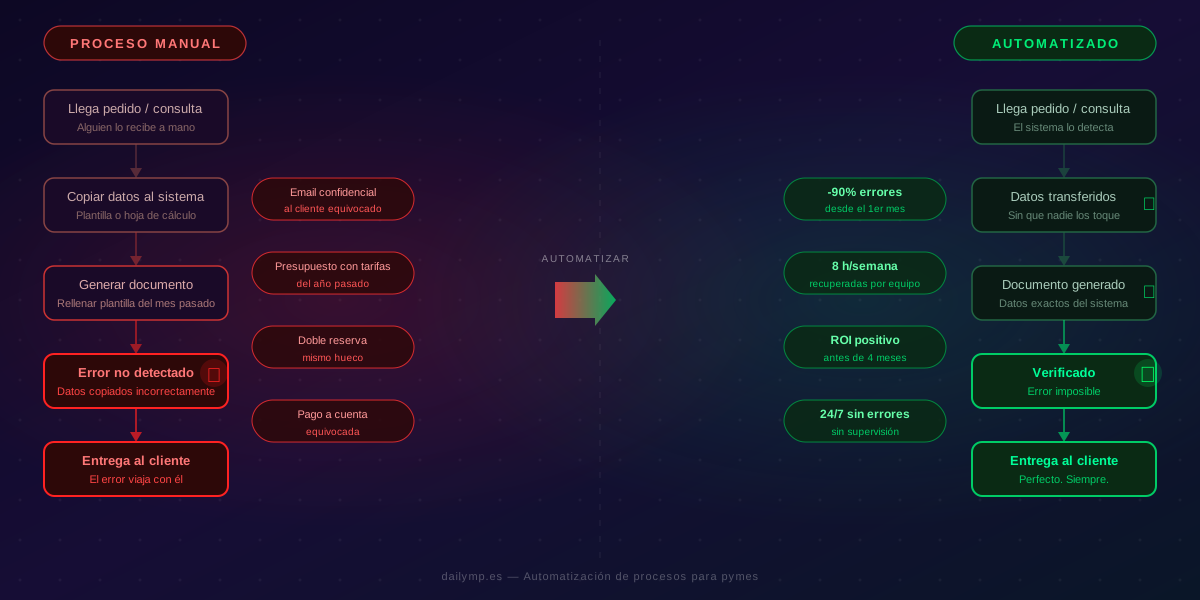
The email that went to the wrong client. A thread forwarded by mistake. Confidential information from client A that client B read. Nothing serious happened — that time. But the relationship shifted.
The proposal with last year's pricing. The team based a new quote on an old one. Rates had gone up. The client signed. By the time invoicing came around, there was no easy fix.
The double booking. Two clients scheduled for the same slot because the calendar was updated in one system but not the other. One arrived to find no appointment. They didn't come back.
The payment to the wrong account. Someone copied the bank details from the row above in the spreadsheet. Recovering that transfer took weeks and several uncomfortable calls.
None of these are unusual. They happen with a frequency that most businesses have simply normalised. And they all share the same root: a person had to copy, transfer, or fill in information by hand.
Why Mistakes Aren't Your Team's Fault
Here's the part that's hard to accept.
When someone makes a mistake in a repetitive task, the instinct is to think they weren't paying enough attention. But the human brain doesn't process the same action identically when it repeats dozens of times a day.
Attention on invoice number forty is not the same as on invoice number one. By the fifteenth, the brain has activated "autopilot" — an energy-saving mechanism that reduces conscious processing in predictable tasks. It works fine for driving a familiar road. It breaks down when every field in a document needs to be exactly right.
It's not a lack of capability or commitment. It's how human attention works under repetitive load.
Automated systems don't get tired. They don't have off days. They don't copy from the wrong row.
When information travels directly from one system to another — without a person touching it — there's simply nowhere for the error to occur.
The Cost That Never Shows Up in Your Reports
Visible errors are the ones that arrive as client complaints. But there's another cost that almost no business measures — and it's often larger:
- Detection time: in most cases, the client finds the error — not your team. By the time you know, the damage is already done.
- Correction time: identifying the mistake, understanding what happened, redoing the document, resending it, managing the fallout with the client. On average, two to four hours per incident.
- The errors nobody detected: how many proposals went out with incorrect margins? How many communications reached outdated contacts? Undetected errors also have a cost — you feel it in results without being able to trace the cause.
- Team burnout: people doing repetitive work under pressure know they can make mistakes. That accumulated tension generates frustration — and eventually, turnover. Replacing an employee costs two to six times their monthly salary.
Which Errors Automation Can Eliminate
Automation doesn't eliminate every possible mistake. It eliminates specifically those that happen when information travels from one point to another manually:
- Documents generated directly from system data — no one copies anything, no data can end up in the wrong field.
- Communications triggered automatically when a specific event occurs — no one needs to remember to send it or write it from scratch.
- Prices and terms updated in real time on quotes and proposals — no outdated templates that no one reviewed in time.
- Client assignments, bookings and resource allocation managed by a system that doesn't get distracted — no double bookings, no scheduling conflicts.
At DAILYMP we identify which processes in your business generate the most errors — or where a single error has the highest impact — and build the system that makes those errors impossible.
If you'd like to understand how AI integration into your existing business processes works in practice, we can walk through your specific situation in a 30-minute call.
Real Results
Results we consistently see in businesses like yours after automating their key processes:
- Over 90% reduction in operational errors from the first month of operation
- 3 to 8 hours recovered per week previously spent detecting mistakes, correcting them and managing the fallout with clients
- More reliable communications — arriving on time, with correct data, without anyone having to supervise them
- Calmer teams: when people stop doing mechanical tasks under pressure, work starts to feel meaningful again
The First Step
If you've read this far, there's a specific process in your business that came to mind while reading.
That process — the one generating periodic mistakes, the awkward calls, the last-minute reviews — is exactly where to start.
You don't need to understand any technology to fix it. You just need 30 minutes to describe how it works today. I'll tell you whether it can be automated, how, and what to expect.
No commitment. No jargon. An honest conversation about your business.