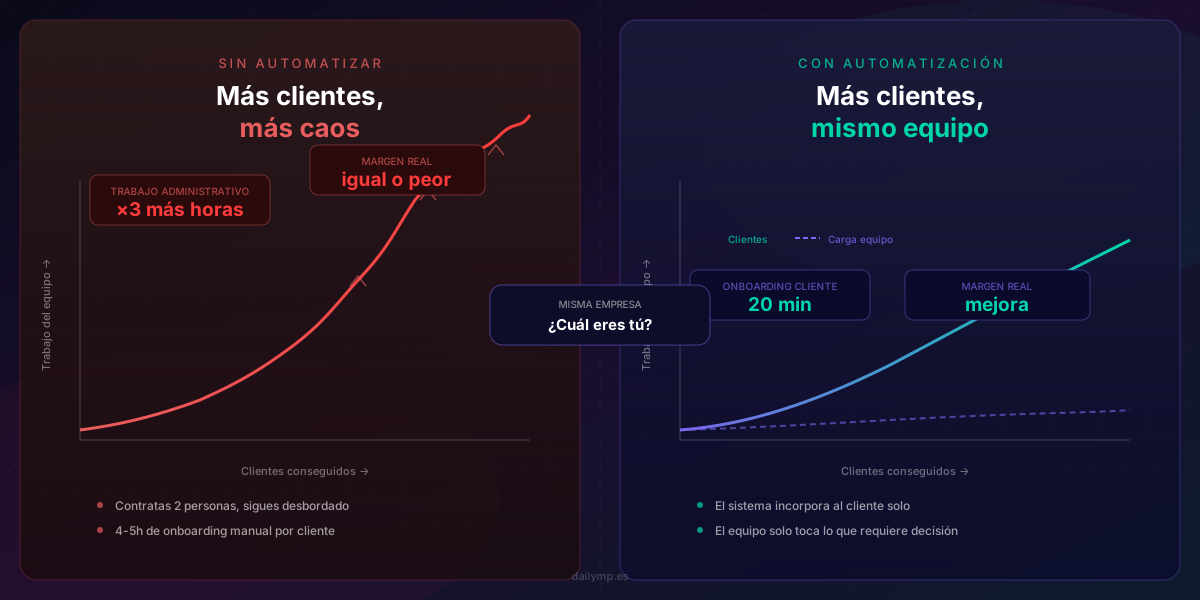
More Clients, More Work: The Growth Trap Explained
You just closed your best month ever.
More clients than ever before. Higher revenue. Your whole team running at full capacity.
And yet something doesn't add up. Margins are the same as always. Stress is higher. And you have the feeling that if you land two more clients, something is going to break.
Welcome to the growth trap without systems. Almost every SMB that starts scaling fast falls into it. And the fix is something very few discover in time.
The problem nobody warns you about
When a business starts winning more clients, the first instinct is to hire. More work, more people. The logic seems unbeatable.
But there's something that calculation misses: the administrative work each new client generates doesn't disappear on its own. It multiplies.
Every client you win adds hours to your team. Hours to onboard them into your system, create their folder, send their access credentials, write follow-up emails, prepare project reports, generate their invoice at the end of the month.
If onboarding a new client costs four hours of manual work in your business — and for most SMBs it's between three and six — every ten new clients means forty hours. One full person, for an entire week, doing nothing but that.
With two new clients a month, your team absorbs it without noticing. With ten, it stops fitting.
The math that crushes your margins
Here's the number very few businesses calculate before it's too late.
Imagine each active client generates, on average, five hours of administrative work per month: follow-up meetings, reports, invoices, coordination emails.
With twenty active clients, that's one hundred hours of purely administrative work every month. More than two full-time people handling tasks that produce nothing new — they only manage what already exists.
And the classic mistake is to hire to cover it.
New hire. Three months of training before they're independent. Salary, taxes, equipment. By the time they're fully productive, the business has grown a bit more and the bottleneck is back.
You're spending on headcount what you could be earning as margin. Revenue grows but profitability doesn't. And the pressure on your team doesn't ease either.
The difference between growing well and growing painfully
Companies that scale without burning out their teams share one thing: they built their systems before they needed them.
They didn't hire more people to do more manual tasks. They automated the manual tasks so people only did work that requires actual intelligence.
In practice, the difference looks like this:
Without automated systems: New client → someone creates the folder, sends the welcome email, adds them to the CRM, schedules the follow-up reminder, generates the invoice at month-end. 4–5 hours spread across multiple people.
With automated systems: New client → the system creates the folder, sends a personalised welcome email, updates the CRM, schedules follow-ups automatically, generates and sends the invoice. The team only steps in when there's a real decision to make.
With twenty clients, the difference is eighty to a hundred hours per month. The equivalent of one hired employee — but without salary, training time, or sick days.
The three areas where growth chokes SMBs
Not every business has the same bottlenecks. But there are three areas where the absence of systems destroys margin the moment volume increases:
New client onboarding The moment someone signs is when the most manual work concentrates. Documents, access credentials, kickoff calls, initial configuration. If this isn't automated, every new client is a multi-day sprint for someone on your team.
Follow-up and billing As active projects grow, the time needed to track and bill correctly grows proportionally. And every billing error creates more time to resolve it — we've seen cases where fixing an invoice mistake cost more than the invoice itself.
Internal reporting and visibility When a manager needs to know how a project is going, someone has to stop what they're doing, pull data from three different places, and put together a response. Ten times a week, across a ten-person team: the cumulative cost is enormous even if it never shows up in any report.
At DAILYMP we identify exactly where growth is going to create your next bottleneck — and we build the system that solves it before you feel it.
To understand how this applies in practice, you can see how AI integration works in a business like yours.
Real results
Businesses we've worked with have onboarded twice as many clients in a month without adding any administrative headcount — because they automated the complete onboarding process.
Time to onboard a new client went from four or five hours spread across three people to under twenty minutes of review by one person.
The difference isn't that they work harder. It's that the mechanical work is no longer theirs to do.
The question that changes everything
The next time you think "we need to hire someone", ask yourself this first:
How many hours a month is your team spending on tasks that are always exactly the same?
If the answer is more than twenty hours, there's real room to improve. Not with more people. With better systems.
Growth doesn't have to hurt. You just have to build the foundations before adding more floors.
In 30 minutes we'll look at your situation together: which processes generate the most load as volume grows, what can be automated first, and what real impact it would have on your margins.
No commitment. No jargon. An honest conversation about your business.