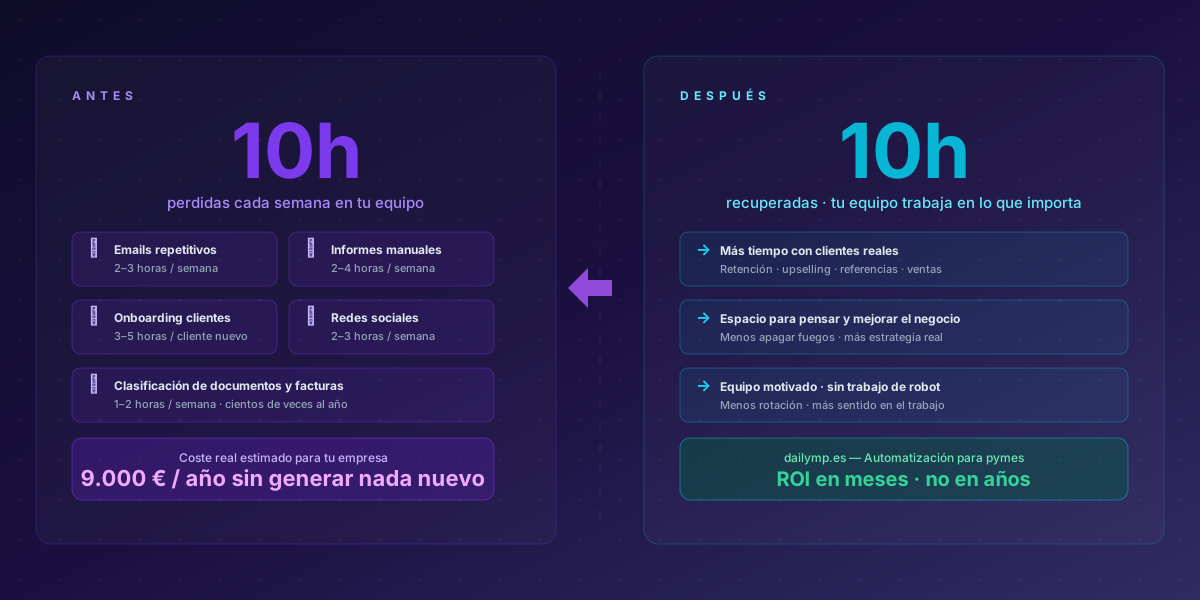
Your Team Wastes 10 Hours a Week Without Anyone Noticing
It's Monday morning and someone on your team has already spent forty minutes doing something they did last Monday. And the Monday before. And the one before that.
It's not urgent. It doesn't require their expertise or judgment. It's just... necessary. Someone has to do it. And that someone has been doing it since they joined the company, without anyone stopping to think whether it could work differently.
This isn't a rare case. It's the most common pattern in businesses with 10 to 50 people. And it has a real cost that almost nobody has calculated.
The hidden cost of tasks that "have always been done this way"
Let's look at the numbers.
If three people on your team spend an average of three hours per week on repetitive tasks — copying data, answering the same emails, preparing reports nobody changes, filing documents one by one — that's nine hours per week. Four hundred and fifty hours per year. Eleven full weeks of one person's work.
At an average cost of €20 per hour — being conservative — that's €9,000 per year in work that generates no new value for your business. No new clients. No improved product. No projects moved forward.
The strangest thing about this cost is that it doesn't appear in any report. Your employees are working — on paper, everything looks fine. But a significant part of that work could simply not exist if your processes were set up properly.
And what hurts most isn't the money. It's what those hours could be doing instead.
The 5 tasks that eat the most hours in businesses like yours
You don't need a complex analysis to find them. They're the same in almost every SME. You'll recognise them as soon as you read them:
1. Client email management
The same types of enquiries arrive every week. The same "when will it be ready?" email. The same response about hours, prices or availability. Someone on the team reads it, processes it and replies — over and over — even though the answer is almost always the same.
2. Weekly or monthly reports
Someone logs into three different systems, copies the relevant data, pastes it into a spreadsheet, formats it, adds the standard commentary and sends it. The process takes between two and four hours. The report takes ten minutes to read. And next week it happens exactly the same way.
3. New client onboarding and follow-up
Every time a new client comes on board, there's a sequence of steps that are always the same: send the welcome email, share the documents, schedule the intro call, create the record in the system. Steps that need attention but not judgment — and that someone has to execute every single time.
4. Social media content publishing
Write the copy, choose the image, format for each platform, schedule the post. A weekly task that takes between two and four hours and, at its core, follows very predictable patterns: a topic, a tone, a structure, a final message.
5. Document and invoice classification
Invoices arrive by email, get downloaded, renamed according to whatever convention is in use, uploaded to the right folder and recorded in the accounting system. A process that every business repeats hundreds of times a year, without exception.
How many of these five feel familiar?
What your team could do with those 10 hours
I'm not going to give you a list of technologies. I'm going to give you a list of real things.
Ten hours a week, well used, are:
- Follow-up calls with clients who haven't been active for months and could buy again
- Time for the team to improve a process, try something new or solve a problem they've been putting off for months
- Real space to think about the business — not just manage it
- Conversations with existing clients that generate upselling and referrals
- A Friday afternoon without last-minute fires that should have been handled days ago
Businesses that automate these tasks don't work less. They work on different things. And that difference shows in results: more clients retained, more opportunities spotted, teams that aren't exhausted by Friday.
The most common thing that happens when a team stops doing mechanical work is that they start feeling that their job makes sense again. That they're there for what they know — not for what they execute without thinking.
How this works in practice
You don't need to understand anything about technology to make it happen.
What we do at DAILYMP is exactly this: we identify together which tasks in your team are repetitive and predictable — the ones that don't require judgment, just execution — and we build the system that handles them automatically.
The team doesn't change how they work. They don't learn new tools. Those tasks simply disappear from their list. From day one.
Integrating these systems into your existing business processes takes, in most cases, between two and four weeks. The return on investment is typically measured in months, not years.
No in-house technical infrastructure needed. No new hires. Just knowing what to automate first — and doing it right.
Real results
Businesses we've worked with in sectors like consulting, professional services and retail have identified between 8 and 14 automatable hours per week in their teams. In every case, the most common reaction after a month isn't "we saved time" — it's "I can't believe we used to do this by hand".
The change isn't just about efficiency. It's about how it feels to work at the company.
The question that's worth more than it seems
What task does your team repeat every week that nobody has ever questioned?
That's the one most likely to disappear. Not because it's important — but precisely because it's not important enough for anyone to stop and think about doing it differently.
If you want to know how many hours your team wastes each week on tasks they no longer need to do, tell me what your business does. I'll give you a concrete answer in 30 minutes.