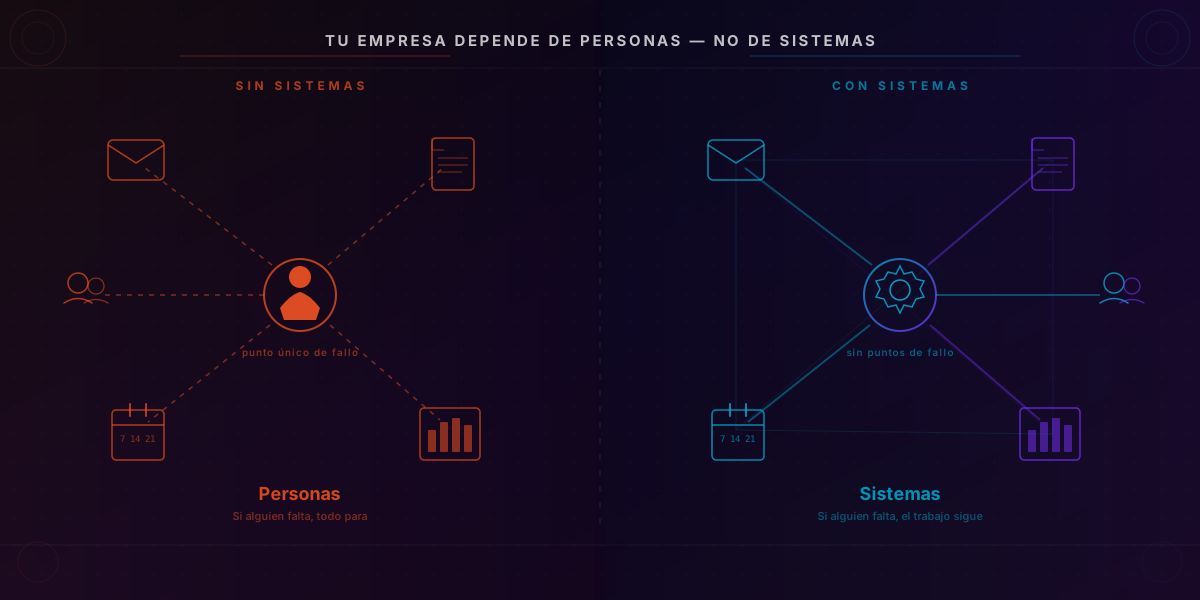
Your Business Runs on People, Not Systems
You took Friday off. Not a big deal — just one day to recharge.
By 11am you had answered 12 WhatsApp messages. By 2pm, you'd made three calls to sort things out because "only you knew" what needed to happen. By 4pm, you gave up trying to disconnect and opened your laptop.
That's not a people problem. That's a structure problem.
The Diagnosis Nobody Wants to Hear
Most businesses run well as long as the same people are in their usual places. The founder coordinating. The operations manager watching the details. The salesperson who knows every client's history from memory.
That's not a resilient business. It's a business that depends on specific individuals being present, at the right time, watching the right things.
The company grew. The processes didn't.
This isn't a criticism of the team. It's simply what happens in most businesses that go from five to twenty people without stopping to build the infrastructure that lets knowledge live in the system — not in people's heads.
4 Signs Your Business Depends Too Much on People
Sign 1: When a key person is out, everything slows down
Not because the work is hard. But because nobody knows exactly how it was done. Where the files are. What was agreed with the client in the last call. What the next step in the process is.
That information isn't in any system. It's in the head of the person who got sick, went on holiday, or decided to move on to another company.
When that happens, the rest of the team turns you into the instruction manual. And you stop doing your actual job to fill in for the person who isn't there.
Sign 2: Every new hire takes months to become productive
Your last new employee took four months to work independently. Not because they were slow — but because the only "company manual" that exists is the hours someone spent explaining things that should be readable in twenty minutes.
And when the person who did the explaining eventually leaves — and at some point, they will — the next one starts from zero. The knowledge didn't accumulate anywhere. It passed from mouth to mouth and is now gone.
Hiring will always take time. But if every new person costs months of your most experienced team members' attention, the problem isn't the new hire. It's that nothing is documented in a working system.
Sign 3: You have data but it doesn't tell you anything
CRM, spreadsheets, email. The information is there, somewhere, scattered across three tools that don't talk to each other.
If someone asked you right now "which clients haven't bought in the last ninety days?" or "how long does it take us on average to close a deal from first contact?" — could you answer in two minutes?
In most businesses, the answer is no. Not because the data doesn't exist, but because processing it manually takes hours. So nobody does it. Decisions are made on instinct, or you wait until someone has time to dig through the numbers.
The data is there. The answers are not.
Sign 4: The holiday test
This is the most telling one.
If you took two weeks off with your phone on airplane mode, what would happen to your business?
If the honest answer includes "a lot of things," "I'd rather not think about it," or "that's impossible right now" — your business depends on you more than it should.
Not because you're indispensable. But because you haven't yet built the structure that lets you choose when to be dispensable.
What Happens If You Don't Change Anything
I'm not talking about an imminent disaster. I'm talking about something slower and more expensive.
Every time a key person leaves the company, they take with them knowledge that was never documented. The next person starts from scratch. The learning curve starts over.
You remain the bottleneck. Not because you don't want to delegate — but because there's no system that truly lets you. Every time you try, someone needs your approval for something that should already run on its own.
And the company grows... but the dependency doesn't go down.
How Scaling Businesses Solve This
Companies that grow without breaking their teams have one thing in common: they built their processes before they needed them.
Not as documents in a Drive folder nobody reads. As systems that actually work:
When a new client comes in, the steps run automatically. The team only gets what they actually need to review. When someone needs to know the status of a project, the information is available without asking anyone. When a new employee joins, they have everything they need to be autonomous in days, not months.
Nobody is "watching." The system is working.
The difference isn't technology. It's structure. And that structure can be built — whatever sector your business is in.
This Is Exactly What We Do at DAILYMP
We identify which parts of your business depend on a specific person being in a specific place doing a specific thing — and build the system that makes that unnecessary.
It doesn't change how your team works. It doesn't require them to learn new tools. What changes is that knowledge stops living in people's heads and starts living in the system. Tasks stop depending on someone remembering to do them.
With the AI agents and process automation we implement, your most critical processes stop depending on someone supervising them. And with AI integration into your existing systems, the data you already have starts giving you answers without anyone having to search for them.
The result isn't just efficiency. It's that you can actually take a real holiday.
Real Results
The businesses we work with at DAILYMP share the same pattern: they didn't have a people problem. They had a structure problem.
After putting the systems in place, onboarding time for new employees drops from months to days. Internal questions that used to reach the operations manager — or the founder — drop dramatically. And the company's knowledge stops walking out the door when someone leaves.
The most common change they describe isn't "we're more efficient." It's: "I can actually switch off now."
The Question That Changes Everything
If you haven't been able to take a real holiday in over a year — phone off, email closed, no one calling about something that should already be resolved — that's not a sign that you're indispensable.
It's a sign that something in your company's structure needs fixing.
In 30 minutes we identify which people and processes your business depends on too heavily — and what the first concrete step would be to change it. No commitment. No technical jargon.