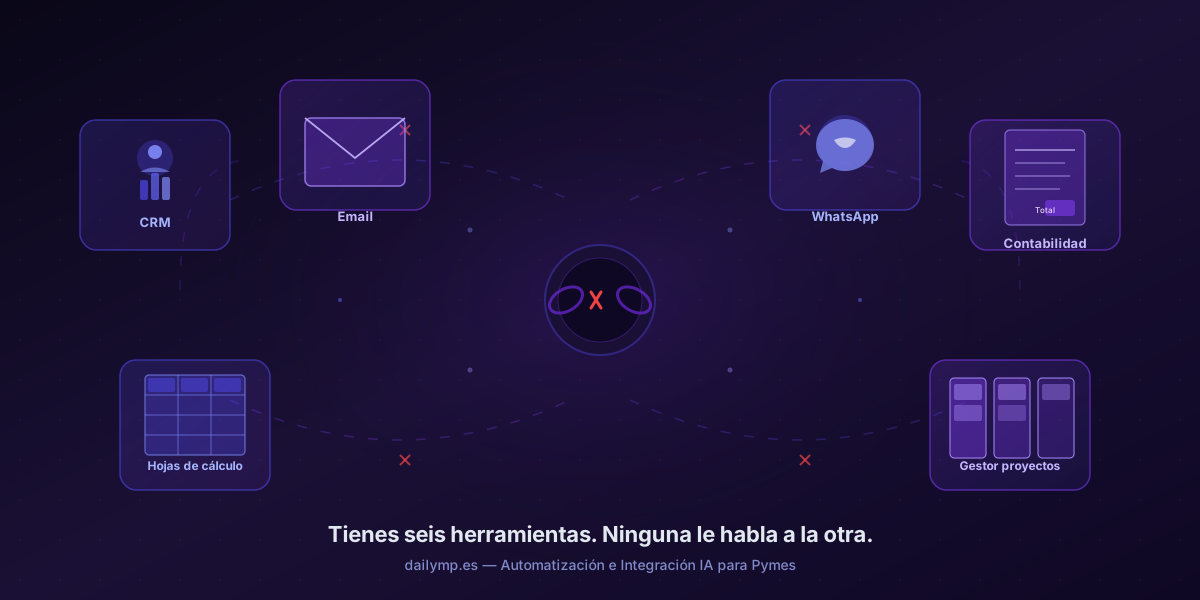
You Have Six Tools. None of Them Talk to Each Other.
It's midday. Someone on your team just handled a customer inquiry over WhatsApp. They take note. Open the CRM and type in the detail. Open email and send the confirmation. Open the spreadsheet and update the row. Open the accounting software and log the progress. Open the project manager and move the card.
Four minutes to process a single interaction. Repeated twenty, thirty, forty times a day.
Nobody calls it a problem. They call it a "process."
The Tool Stack Nobody Ever Connected
Most businesses with 10 to 50 people end up with a set of tools that grew without a plan. A CRM added when the first clients arrived. Accounting software the bookkeeper required. A "temporary" spreadsheet that's been running operations for three years. A business WhatsApp because that's where clients write. Corporate email. A project manager someone on the team asked for.
Each tool on its own island. None of them talking to the others.
What nobody accounted for is that someone — a real person, on a real salary — acts as the bridge between all of them. Copying information from one system to another. Updating two platforms with the same data. Making sure what happens on WhatsApp also lands in the CRM. That what gets signed in email shows up in the accounts.
That job gets called "staying on top of things." What it really is: human connector work. Work that adds no value. That creates errors. And that disappears the moment that person isn't there.
What You Lose Every Week Without It Showing Up in Any Report
Let's do the calculation almost nobody does.
If one person spends four minutes logging each interaction across different systems, and that happens forty times a day, that's 160 minutes daily. Nearly three hours. Across the week, that's over 13 hours spent moving data from one place to another.
At an average labor cost of €20 per hour, that's €260 per week. Over €13,000 per year in work that builds nothing new.
But time isn't the only cost.
Data errors. When a human copies information between systems, they make mistakes. It's inevitable: an extra zero, a misspelled name, a figure from the previous client left in the template. Every error has consequences: a wrong quote, an invoice with incorrect data, a decision made on outdated information.
Decisions based on data that's no longer accurate. If the CRM and the spreadsheet don't match, which one is right? Usually nobody knows for certain. Decisions get made based on whichever version someone updates more often — which isn't always the correct one.
Dependency on the person who "knows where everything is." In most businesses there's someone who knows the system from the inside. They know which spreadsheet holds which data, which column maps to what, why there are two versions of the same document. When that person is gone — holidays, sick leave, or they simply move on — things fall apart within hours.
When Something Actually Goes Wrong
These are situations that happen more often than you'd think.
The quote with the previous client's details. Someone used last week's proposal as a template and forgot to change the name and terms. The client received it. Read it. Called confused. The relationship recovered, but the trust margin was never quite the same.
The invoice with the wrong price. Rates went up in January. Someone updated the accounting software but not the spreadsheet the sales team uses. For three months, quotes went out with the old prices. By the time invoicing came around, there was no easy way to fix it without friction with the client.
The lead nobody saw come in. A potential customer wrote on WhatsApp, asked about a service, left their details and waited for a reply. That message got lost between conversations. Nobody transferred it to the CRM. Nobody followed up. Three weeks later, the client signed with a competitor.
These aren't failures of the people involved. They're failures of the system. Or more precisely: the absence of one.
What Should Actually Happen (No Technical Jargon)
When information flows properly, this is what it looks like:
A client messages on WhatsApp → the message appears automatically in the CRM with their full history. Nobody has to copy it.
A quote gets signed → the invoice generates itself with the correct data. No copy-pasting between systems.
A new order comes in → the responsible team gets an immediate notification with everything they need. Nobody has to forward anything.
A detail gets updated in one place → it updates everywhere else. The CRM, the tracking sheet, the management report. All in sync.
Information moves on its own. The team stops acting as a bridge between tools and gets back to doing the work they're actually there for.
How We Do It With the Businesses We Work With
The first thing we look at when we start working with a company is not what tools they have. It's who acts as the bridge between them. Because that's the exact point where time leaks away, data gets messy and errors appear without anyone quite understanding why.
The process is straightforward:
First, we map which tools the business already uses and how information flows between them — or doesn't. Most of the time, the tools themselves are perfectly fine. The problem isn't the tool. It's that nobody connected them.
Second, we connect the information flows so data travels automatically from one system to another. No manual copying. No remembering to update the other place.
Third, we automate the repetitive steps: notifications, records, updates, confirmations. Tasks that someone does today because "someone has to" start happening on their own, at the right moment, with the right data.
The result is that the team gets real time back — hours that can go toward clients, toward projects, toward what actually matters. And errors from stale or miscopied data practically disappear.
No months of implementation. No ripping out all your tools overnight. No asking anyone to learn an entirely new system from scratch.
If you'd like to see how this works for a business like yours, you can read more on our AI Integration page or the AI Agents & Automation service.
Real Results
In businesses with 10 to 50 people, automating information flows between tools recovers between 5 and 15 hours per week per team. Those are hours currently spent copying data, updating two systems with the same information, or hunting down the right figure between different versions of the same file.
In cost terms, that's between €5,000 and €15,600 per year in work that stops making sense the moment the systems are connected.
The room for improvement isn't in hiring someone else. It's in stopping the manual work that can run itself.
If you recognize this pattern in your business, it's worth a conversation. A 30-minute call is usually enough to identify where the bottlenecks are and what can be fixed straight away.