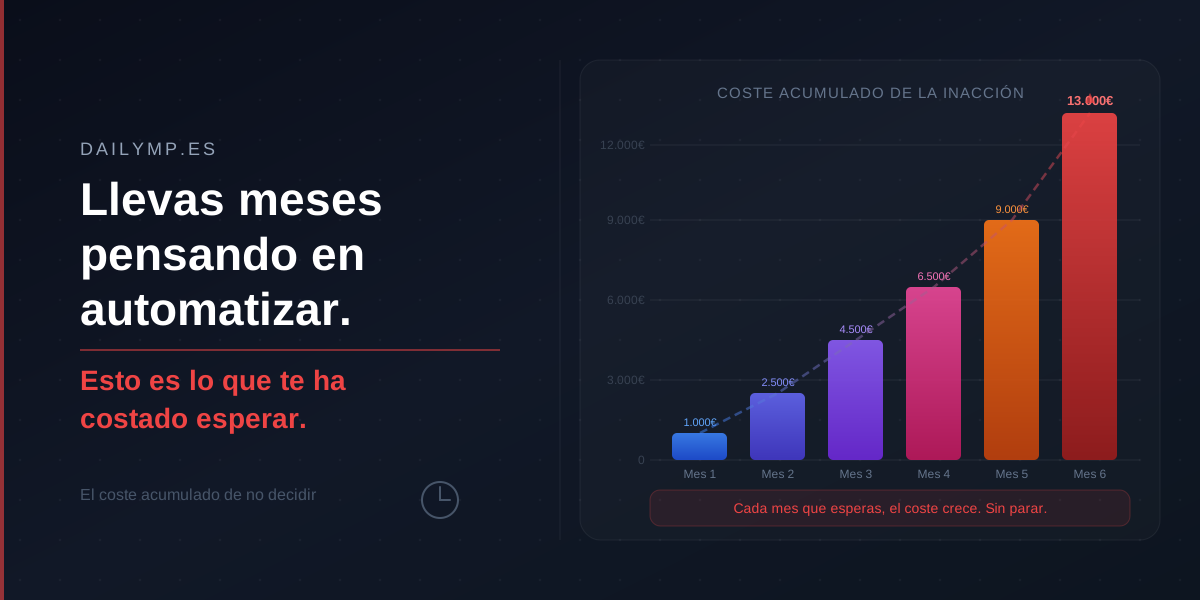
Months Without Automating: The Exact Cost of Waiting
Six months ago, something caught your attention.
Maybe it was a competitor mentioning how they'd cut down on manual work. A LinkedIn post that made you think. A tool demo that looked interesting but "wasn't the right time."
You made a mental note. "I'll look into it properly when things slow down."
Things didn't slow down. Six months passed.
What happened during those six months
Your processes kept running exactly as they were. The same person manually closing the billing cycle at the end of each month. The same delay between completing a project and sending the invoice. The same follow-ups that didn't happen because the team didn't have bandwidth.
No disaster. No improvement either.
That's the problem.
The calculation no one has done for you
Let's look at the numbers for a common scenario.
A service business with 25 active clients. Billing is handled manually: someone reviews each project's status, generates the invoice, sends it, logs the payment, and chases the ones that are overdue. Each client takes between 90 minutes and 2 hours per month.
That's between 37 and 50 hours per month spent purely on billing admin. At a cost of €20 per hour, that's between €740 and €1,000 per month on work that an automated system would handle on its own — in minutes, without anyone having to remember to do it.
Over six months: between €4,440 and €6,000.
But that number misses something important.
When billing is handled manually, cycles stretch out. Not because anyone wants to delay it — but because that person has other priorities and invoicing isn't urgent until it suddenly is. In many businesses, there's a 10 to 15-day gap between a project being delivered and the client receiving an invoice.
With an average invoice value of €3,000 per active client, that means up to €75,000 of delivered work is perpetually floating in limbo — completed, but not yet collected. Money that could be in your account but isn't.
That's not an error. That's how the manual system works.
The hire you paid for twice
There's another cost that almost no one calculates.
When the workload grew, the obvious solution was to bring someone in to help with admin. A part-time hire, or extra hours for someone already on the team, to absorb the administrative volume that wasn't getting done.
That decision has a real cost: salary, taxes, onboarding time, weeks before the person is fully autonomous. Between €1,200 and €1,800 per month, being conservative.
Over six months: between €7,200 and €10,800.
With that same budget, it would have been possible to automate the processes that person is now doing by hand. A system doesn't take holidays. It doesn't have off days. It doesn't need three weeks to adjust every time something changes.
That hire wasn't a mistake — it was the most logical decision with the information available at the time. The problem is that automation never made it onto the table as a real alternative.
What your competitors are gaining while you wait
This is the cost that appears in no spreadsheet.
If a competitor automated their operations six months ago, they've had six months of running with less manual overhead. Their margins are better. They can take on more volume without expanding the team. They respond faster. They close proposals more efficiently.
Six months of operational advantage is real time. It shows up in well-served clients, faster quotes, quicker billing, and a team that isn't constantly stretched thin.
Every month you don't automate is another month of advantage for whoever already did.
That gap doesn't close overnight. It closes by automating — starting today, not next month.
The real reason you haven't decided yet
It wasn't budget. It wasn't technical complexity. It wasn't lack of information.
It was something simpler and more human: automating didn't feel urgent.
The current problems weren't blocking the business. Everything was working. The team was managing. It took effort, but it worked.
The mistake is equating "it works" with "this is the best way to operate." They're not the same.
A business running on manual processes isn't broken. But it's leaving margin on the table every single week. And that margin has a name: time, money, and competitive advantage that doesn't come back.
Deciding to automate isn't a technical decision. You don't need to understand how AI works to implement it in your business — just as you don't need to understand accounting to work with an accountant. You need to know what you want to work better, and hand it to someone who builds it.
That's exactly what we do at DAILYMP with process automation: we identify which parts of your business are consuming time without generating equivalent value, and we build the system that fixes it.
If you want to understand how this fits into your current operations, you can see what AI integration looks like for businesses like yours.
Real results
The businesses we work with that came to us after months of "I'll think about it" share a very specific reaction within the first few weeks of the system running:
"Why didn't we do this sooner?"
Not because the process was complicated. But because when systems run on their own and the team stops doing mechanical work, the difference is immediate. In the hours. In the pace. In how it feels to work there.
The time already spent can't be recovered. But the next month can be completely different from the last.
The best time was six months ago. The second best is now.
If there's a process in your business you've been meaning to improve for months, the problem isn't that the timing isn't right. It's that no one has put the decision in front of you clearly.
This is that moment.
In 30 minutes, we identify which process is costing you the most right now — the one consuming the most time without generating equivalent value — and I'll tell you specifically what can be automated and what result you can expect. No commitment. No jargon. An honest conversation about your business.