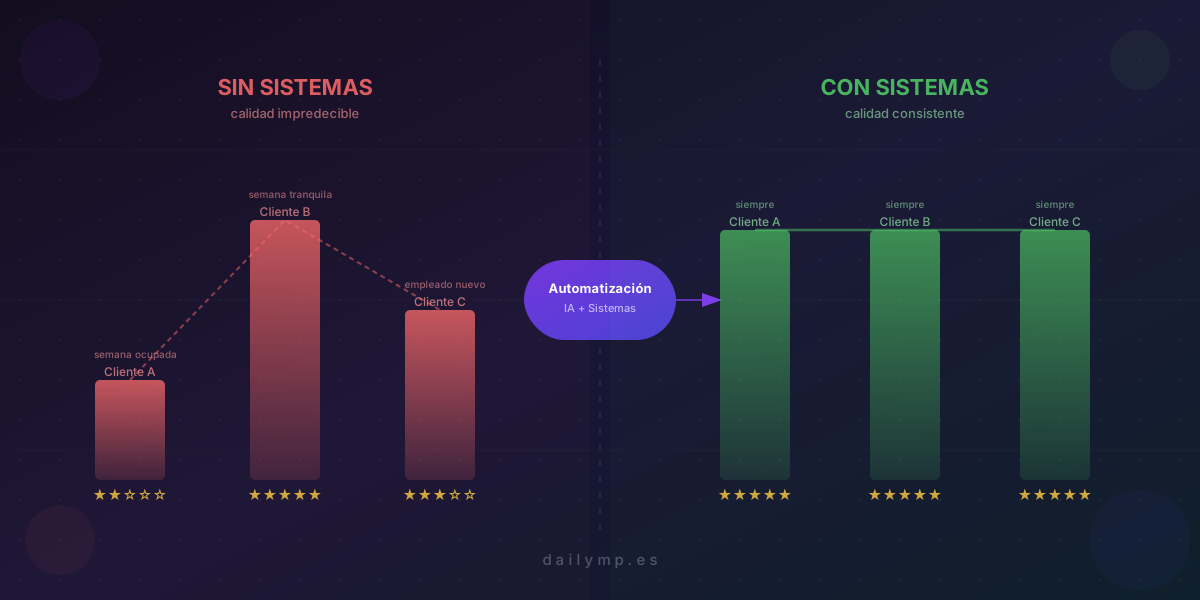
Your Business Doesn't Always Deliver the Same. Clients Notice.
Two phone calls, same week.
The first: "Really happy with the work. Everything on time, always kept in the loop, no surprises."
The second: "It was fine… we had to follow up a bit toward the end, but it worked out."
Same team. Same prices. Same people. Different project, different timing — completely different experience.
There was no serious mistake in the second project. Deadlines were met. The final delivery was correct. But the experience felt different: less communication, less proactivity, less sense that someone was actively on top of things.
Which of those two clients is going to recommend the business?
When Quality Depends on the Day
In most small businesses, the quality of what gets delivered isn't constant. It fluctuates. Not because the team is bad — but because the outcome depends on variables nobody controls systematically.
It depends on who's available. The client who came in when your best person had bandwidth received a thorough onboarding: three meetings, a prepared presentation, weekly check-ins. The one who arrived two weeks later, during a crunch period, got a generic email and "we'll sort out the details when we kick off."
It depends on the time of month. The week before the monthly close, the team is running on minimum — responding to the urgent, keeping things moving. The following week, more room to breathe: time to think ahead, to go the extra mile, to do things well. The client who arrived in week one and the one who arrived in week two experienced different companies.
It depends on whether someone remembers. The update the client was expecting on Tuesday goes out Thursday because it wasn't written down anywhere and got lost in the rush. The follow-up that should have happened at fifteen days happens at twenty-five, when it's lost part of its value.
It depends on who holds the context. If the person who manages that account is traveling, whoever takes the call has to piece things together from scratch. The conversation feels different. The client senses it even if they don't say so.
None of this is a serious error. But it adds up. And what adds up is a business that doesn't feel the same to everyone on the receiving end.
What Clients Don't Tell You
When a client has an inconsistent experience, they rarely raise it directly. No formal complaint. No email of concern.
They just start comparing. They remember that time everything was seamless and wonder why this time felt different. They start thinking about getting a quote from someone else next time, just in case. And when that moment comes, they don't remember any specific problem — just an accumulated sense that "it used to be better" or "I'm honestly not sure I'd do it again."
Client loss from inconsistency is silent. No clear reason. No specific incident. Just a client who was yours and then wasn't, and you never quite understood why.
The most frustrating part: it's completely predictable. Not bad luck, not bad intentions. It's the direct result of having processes that depend on people instead of systems. And it has a solution.
What Consistently Excellent Businesses Do Differently
There are businesses that, when you hire them again, feel exactly the same as the first time. Not better, not worse — consistently good. Punctuality, communication, delivery quality: all predictable.
They don't have an extraordinary team. They have systems that ensure certain things happen reliably, regardless of who's working that day.
- The welcome email goes out within 24 hours. Automatic.
- The weekly project status update lands on Friday. Automatic.
- The feedback request happens at 30 days. Automatic.
- The renewal reminder fires 45 days out. Automatic.
None of those things require someone to remember them. They don't depend on that week's workload. They don't change based on who's available. They happen because there's a process that runs them on its own, at the right moment, with the right information.
The client who comes in August receives exactly what the one in January received. That builds trust. And trust generates referrals.
What You Can Systematize Without Anyone Losing Time
When people hear "standardize processes," they picture procedure manuals nobody reads, checklists skipped under pressure, or coordination meetings that eat more time than they save.
That's not what works. What works is a process that doesn't depend on someone remembering it. One that's automated to run on its own, at the right moment.
With AI integration in your business processes, here are some things that stop depending on the human factor:
- New client onboarding: always the same rhythm, the same welcome messages, the same information gathering — regardless of who's handling it or what week it is.
- Follow-up communications: status updates go out when they should, not when someone remembers they should have sent them.
- Project checkpoints: the system knows what stage each client is at and acts accordingly — no one has to track this manually.
- Feedback and renewal requests: the process detects the right moment for each specific client and acts, with the context of that particular relationship.
- Escalation alerts: if something is running behind, someone on your team knows before the client has to ask.
People don't stop mattering. They stop having to remember all of these things — and focus on what actually requires human judgment: managing complex situations, making nuanced decisions, building the relationship.
The process automation agents we build at DAILYMP work exactly this way: they don't replace the team, they free them from the mechanical load so their work is consistently good, not randomly excellent.
Real Results
What we see consistently in process automation projects:
- Client perception improves without any change in the team — simply because communication becomes more regular and predictable, and clients stop having to ask what's happening.
- Internal coordination time drops when processes no longer depend on a specific person being available to act as the "bridge" between systems and tasks.
- Renewals and referrals increase because the client experience is more uniform — and a uniform experience builds the confidence to recommend.
The most common thing operations leads say after going live: "Finally, the business runs the same whether I'm there or not."
Which Process in Your Business Changes Depending on the Day?
Think for a moment. Is there any aspect of your client service that's excellent when everything's running smoothly and mediocre when you're under pressure? A communication that sometimes goes out perfectly and other times arrives late for no real justification?
That specific process — the one that just came to mind — is the first one worth looking at.
In 30 minutes we can walk through how it works today, what part can be systematized, and what impact that would have on your clients' experience. No commitment. No technical jargon. Just a conversation about how to make your business its best self consistently — not only when circumstances allow.