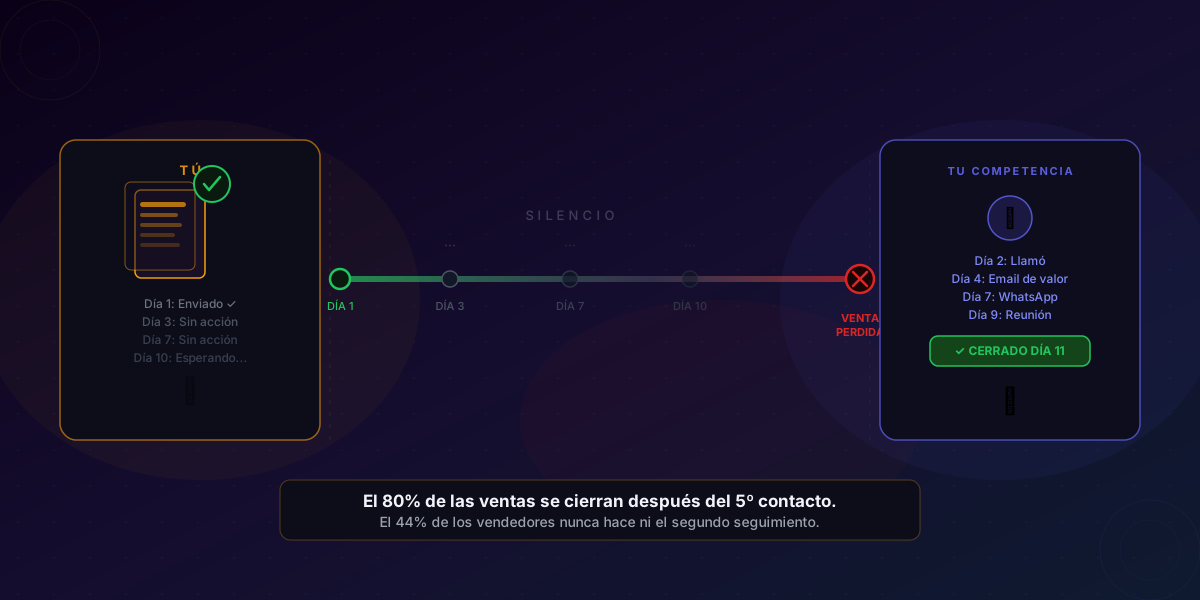
You Sent the Quote. Then You Did Nothing.
You spent two hours on that proposal. You made sure the numbers were right, added the case study that closed your last client, wrote a clear subject line. Sent it. Felt good about it.
And then... you waited.
Three days later, nothing. A week in, nothing. At ten days you thought about following up but there were five more urgent things on your plate. Besides — if they're interested, they'll reach out.
They won't. And there's a good chance they've already signed with someone who followed up first.
The Sale You Lost Without Knowing
There's a belief that runs deep in small and mid-sized businesses: if the proposal is solid, the client will come back. If there's genuine interest, they'll make the first move.
That belief costs deals every week.
Here's what actually happens: your prospect received your email on Monday. Tuesday they had three back-to-back meetings. Wednesday a fire broke out in their ops team. Thursday they started reading your proposal before their phone rang. By Friday they couldn't remember which folder they'd saved it in.
It's not that they don't want what you offer. It's that their days are as chaotic as yours. What doesn't follow up disappears from their attention — not from lack of interest, but from information overload.
Meanwhile, your competitor sent a WhatsApp on Wednesday, called Thursday, and had a meeting locked in by Friday.
The Numbers Nobody Acts On
One statistic has been true for decades and is almost universally ignored: 80% of sales happen after the fifth contact. And 44% of salespeople give up after the first.
In a small business, this plays out in a very specific way. You send twelve proposals this month. Two or three get a proper follow-up sequence. The other nine float in a grey zone — not won, not lost, just quietly forgotten.
What's the average value of one of those unclosed proposals? Multiply by twelve months. That's the real cost of having no follow-up system.
And the reason follow-up doesn't happen isn't that people don't care. It's that nobody has time to manually track twenty open conversations, remember where each one stands, and know what to say at the right moment.
Why Follow-Up Always Gets Left Behind
If you already know you should be following up but you're not doing it, that's not a discipline problem. It's a systems problem.
Manual follow-up fails for three specific reasons:
No single source of truth. Proposals go out by email, WhatsApp, PDF attachments. They live in different folders, different threads, in different people's heads. To know which ones are waiting for a response, someone has to manually check all of it.
No defined protocol. Do you email at day three? Call at day seven? What comes after the second touchpoint with no response? Without a clear process, every follow-up is improvised — and improvised tasks get postponed.
Fear of seeming pushy. There's a real reluctance to reach out twice in one week. The logic: "if I follow up again they'll think I'm desperate." So nothing happens. And the deal walks out the door.
What nobody tells you: most prospects don't experience consistent follow-up as pressure when it's done right. They experience it as professionalism.
What Changes When Follow-Up Runs Automatically
Picture this: every time you send a proposal, a process starts running in the background without you having to remember it.
Day three, the prospect gets a short note: "Just wanted to make sure the proposal arrived — happy to answer any questions." Two lines. Zero pressure.
Day seven, if there's no reply, something of value lands in their inbox: a relevant case study, an insight that connects to their specific situation, a question that reopens the conversation. Not "so, what's your decision?" Something that gives them a reason to think about your proposal again.
Day fourteen, with still no response, someone on your team gets a nudge to make a five-minute call. Brief, no sales script, just "any questions from your side?"
Day twenty-one, if silence continues: a graceful close. "We understand if the timing isn't right — we'll be here when it is." Ends the cycle without burning the relationship.
All of this runs automatically. Nobody has to remember, check lists, or schedule anything. The system knows exactly where each proposal stands and acts accordingly.
That's what we build at DAILYMP with our AI automation agents for sales and operations: systems that turn follow-up from something that depends on one person's memory into something that always happens, on time, every time.
Real Results
When we set up automated first follow-ups for businesses that weren't doing any, the most common outcome is this: 25–35% of "dead" proposals — ones that had been sitting without a response for over a week — come back to life on the first automatic touchpoint.
Not because the prospect had disappeared. Because nobody had reached out again. One well-timed message was enough to reopen the conversation.
The team doesn't have to do anything differently. They just respond when the prospect responds. The system handles the rest.
With AI integrated into your current tools, this can be live within the week — connected to your email or CRM, without disrupting how your team already works.
The Sale Doesn't Happen When You Hit Send. It Happens After.
A strong proposal is necessary. But the real work starts after you send it. Follow-up is where deals are won or lost — and it's exactly what gets neglected most in small businesses, because there's no system doing it automatically.
If you want to see how many open proposals you have right now that could still close with the right follow-up, we can review them together in 30 minutes and tell you exactly what to do next.