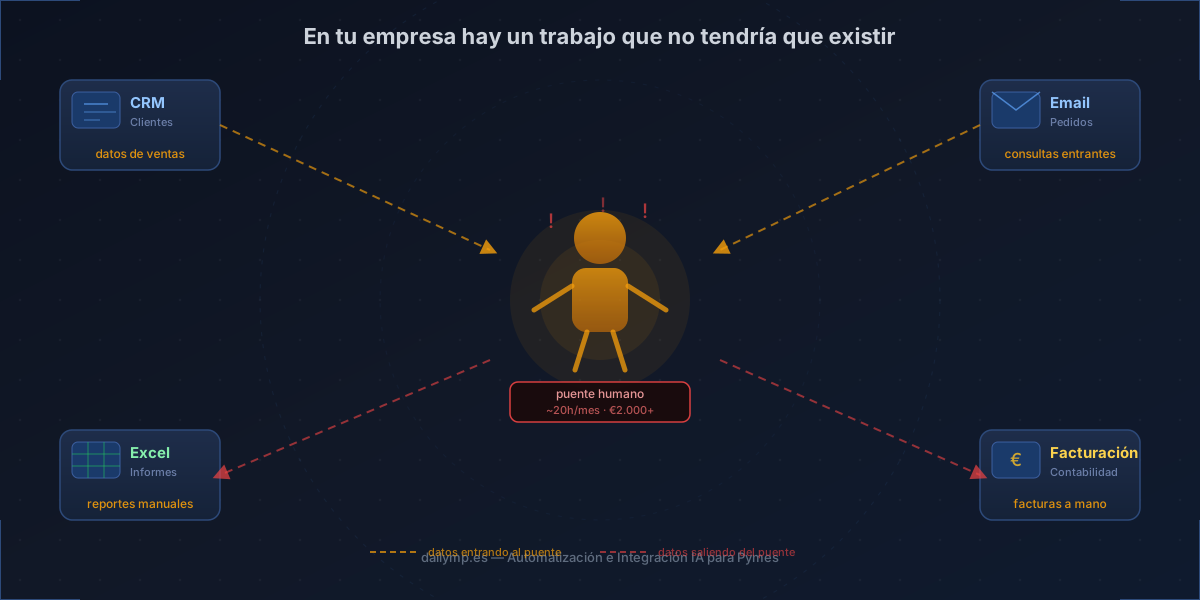
Your Business Has a Job That Shouldn't Exist
Every morning, in thousands of businesses, someone does the following:
Opens the management system. Downloads the daily report. Opens the spreadsheet. Copies the new rows. Pastes them into the right column. Checks the totals add up. Sends the result by email to the manager.
Forty minutes. Every single day. For the past two years.
Nobody explicitly asked them to do it. It happened gradually: when the systems didn't connect, someone had to bridge the gap. And that someone is still the bridge today — because it works, because nobody has time to change it, and because if they don't show up one day, everyone notices.
This isn't a made-up scenario. It's what happens in most businesses with between 10 and 50 employees — different names, different systems, same pattern: a human being acting as the connection between tools that don't talk to each other automatically.
The job nobody puts on the org chart
It doesn't appear in any job description. Nobody was hired for this. But it exists, and it consumes real time.
It goes by different names depending on the company:
- "The one who prepares the Monday Excel with the orders"
- "The one who updates the CRM from the web form submissions"
- "The one who enters invoices into the accounting system"
- "The one who cross-checks the sales system with logistics"
In every case, the work is essentially the same: take data from one place, do minimal processing, and put it somewhere else. Nothing is created. No judgement is applied. Data is simply moved from one system to another because the systems don't do it themselves.
And that work has a cost that almost nobody has calculated — because it's spread across tasks that seem normal, between people who "do a bit of everything," and in hours that are never labelled as "data transfer."
Three layers of cost that appear on no report
The first layer is time. If someone spends an hour a day moving data between systems, that's over 200 hours per year. At €20 per hour, that's over €4,000 a year in work that creates zero new value for your business. If the process involves more than one person — and it often involves two or three — that number multiplies directly.
The second layer is errors. Every manual transfer introduces noise: a number copied wrong, a duplicated row, a field that doesn't match. Those errors aren't trivial. They have real consequences: an invoice with the wrong amount, an order processed twice, a report that's been wrong for weeks and nobody caught it because nobody checked the source.
The most dangerous error isn't the obvious one. It's the one nobody detects, that gets replicated into more decisions, and only surfaces when something really breaks.
The third layer is fragility. The process lives in one person's head. There's no documentation. What happens when they're on holiday? When they're unexpectedly off sick? When they leave and take half the operational knowledge with them?
Someone has to improvise, ask around, and rebuild the process from scratch. Until they're back or until someone new is trained, your operation limps along in a way nobody expected and nobody planned for.
What happens when the bridge breaks
Many companies don't discover how fragile their processes are until someone goes on leave or quits. That's when reality hits:
Nobody else knows how the process works. There's no documentation. The person who did it learned from the person before them, who also learned on the fly. The instructions are in an email from three years ago, or stored purely in the memory of someone who no longer works there.
When that happens, data stops being where it should be. Reports don't get generated. Records fall out of date. And someone on the team has to spend hours manually reconstructing what should happen automatically.
It's not a dramatic crisis. It's silent. But it has a real cost, and it repeats every time that "human bridge" becomes unavailable.
To grow, you need more bridges — or none at all
Here's the structural problem.
As your business grows, the volume of data that needs to move between systems also grows. If you currently process a hundred orders a month and want to handle two hundred, someone has to spend twice as long on that manual process. Or you hire another person to do it.
You're scaling the bottleneck instead of removing it.
And the bottleneck isn't the person. It's the design. You have tools that don't communicate, and the solution you chose was to put a human between them. That works up to a point. Beyond that, either you change the design or the cost grows alongside the business.
The alternative isn't replacing all your tools. It's connecting them so data flows automatically, without anyone having to step in.
The CRM that receives a form submission can update the spreadsheet automatically. The order that arrives in your sales system can generate the invoice without anyone copying it over. Data that needs to exist in two places can sync in real time, without errors, without anyone having to remember to do it.
Connecting two systems you already have — so data flows directly between them without going through a person — costs, in most cases, less than you spend in a single month on the time dedicated to that process.
How this works in practice
You don't need to change the tools you already use. Your team doesn't need to learn anything new. You don't need to hire anyone.
What we do at DAILYMP with AI integration is identify exactly which data moves manually in your business, between which systems, and how often. With that information, we build the direct connection: data flows automatically from source to destination, in real time, without human intervention.
The process that used to take someone forty minutes a day simply stops existing. Not because that person disappeared — but because their time is freed up for work that actually requires their judgement.
The automation agents we implement detect, process and synchronise data between the platforms your business already has. No migrations. No changing what works. Just connecting what's currently separate.
Real results
The system integration projects we deliver eliminate an average of 15 to 25 hours per month of "bridge" work between tools. The process that previously required daily human intervention runs automatically, in real time, with zero transfer errors.
The most common thing we hear a month in: "I can't believe we used to do this by hand."
Not because the process was complicated. But because nobody had stopped to question it.
The question worth asking today
What task in your business consists of taking information from one place and moving it to another?
That specific task — the one you just thought of — is almost certainly automatable. It doesn't require a large project or a system change. It just requires connecting what you already have.
If you want to know how many hours your business loses moving data between systems, and what it would cost to connect them, I can give you a concrete answer in 30 minutes.