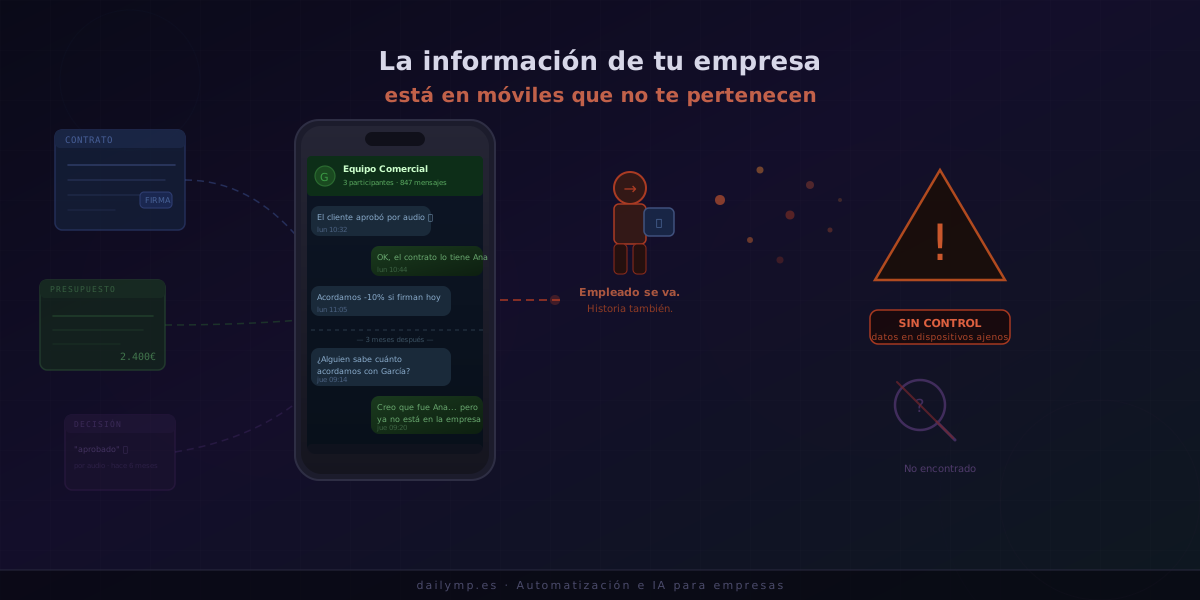
Your Business Data Lives on Someone Else's Phone
Mark has been with your company for three years. He knows the history behind every important client. He remembers how the terms were negotiated with last year's main supplier. He has the documents exchanged on his personal phone — in WhatsApp groups where things got approved via voice notes, files were shared, and deadlines were set that were never formally written down anywhere.
Last week he told you he's leaving at the end of the month.
And the first thing you think isn't how much you'll miss him. It's: where is everything he knows?
How much of your business information lives in WhatsApp right now
Do the exercise: open your active business WhatsApp groups and think about what's inside them.
There's one per project. One for the sales team. One with the main supplier. Several with clients. Some "temporary" group that's been active for two years. And the internal coordination groups where things happen without anyone recording them anywhere else.
Now think about what circulates in those groups:
- Decisions made via voice note that nobody transcribed anywhere
- Documents shared that no longer appear when you search, because WhatsApp doesn't index files by context
- Commitments and deadlines agreed in messages buried under the noise of other conversations
- Client relationship history that doesn't exist in any CRM because nobody transferred it
- Project context that only makes sense if you read the conversation from the very beginning
That information isn't in a company system. It's on the phones of the people who manage those conversations.
When that person isn't available — because they left, because they're on sick leave, because they're on holiday — that information simply isn't available either. There's no way to recover it. Full stop.
When it actually becomes a real problem
It doesn't need to be dramatic. It happens in completely routine situations.
When a key employee leaves the company. They leave the groups on their last day. The conversation history stays on their phone. The supplier terms they negotiated in November, the commitments they made to a client in March, the decision that got approved by voice note in that project group — gone with them. Best case, they tell you in the exit interview. Worst case, nobody thought to ask.
When a phone breaks or gets lost. It happens. And with it, access to groups, shared files, and conversation history. If that person was the group admin, recovery becomes even more complicated.
When someone is on extended sick leave. The rest of the team needs to know the state of things with a particular client. Who has that conversation? Who do you ask? In most cases, nobody has the full picture because they weren't in the group.
When you're looking for something said three months ago. WhatsApp isn't designed for searching business information. You can search by exact text if you remember the precise wording, but you can't search by client, by project, or by decision date. The information exists — somewhere in some message in some group — but finding it takes longer than just redoing it from scratch.
The legal issue nobody talks about
There's an angle most businesses ignore until it surfaces: GDPR.
When your team manages client conversations from their personal phones, that information is outside your company's control. It lives on private devices, in messaging apps that have no data processing agreement with your company, with no retention policy, no possibility of controlled deletion.
If a client exercised their right to have their data erased, could you say with certainty that you'd located all of it? Could you guarantee there's no file with their information sitting in some employee's WhatsApp?
This isn't an abstract threat. It's a concrete question that more and more businesses will have to answer.
What needs to work differently
I'm not saying you need to ban WhatsApp from your company. I'm saying that WhatsApp cannot be the only place where important information lives.
Here's what works differently in businesses that have this solved:
Decisions get recorded somewhere searchable. Not in a message buried between emoji reactions. In a system where anyone on the team can access it — with context, with a date, with who made the call.
Important documents belong to the company, not a phone. Contracts, approved quotes, supplier agreements: in a centralised, controlled place, accessible to whoever needs access.
Client history exists in a system. Not in the messages of the person who managed them. In a record that any colleague can check when that person isn't around.
Operational knowledge doesn't depend on someone's memory. Processes are documented. Recurring decisions have written criteria. The new hire can learn by reading, not just by asking around.
Doing this manually requires a discipline that almost never holds in practice. With workflow automation and AI-assisted management systems, information flows to the right places without anyone having to remember to put it there.
What changes when information belongs to the company
You don't notice the difference on day one. You notice it when these things happen:
Someone leaves and the next person can pick up exactly where they left off. No weeks of transition, no calls asking "how did you used to do this?", no history lost forever.
Someone is on sick leave and the team can keep working with the context they need. No waiting, no improvising, no bothering someone who's supposed to be resting.
A new team member starts with real access to the history of the projects they're inheriting. Not the summarised version that someone has time to explain.
You can actually take time off. Because what you know is available to others — not trapped in your WhatsApp conversations.
At DAILYMP we build the information infrastructure that lets businesses scale without knowledge getting stuck on people's personal phones.
If your teams coordinate over WhatsApp and there's important information there that shouldn't only be there, now is the time to change that.