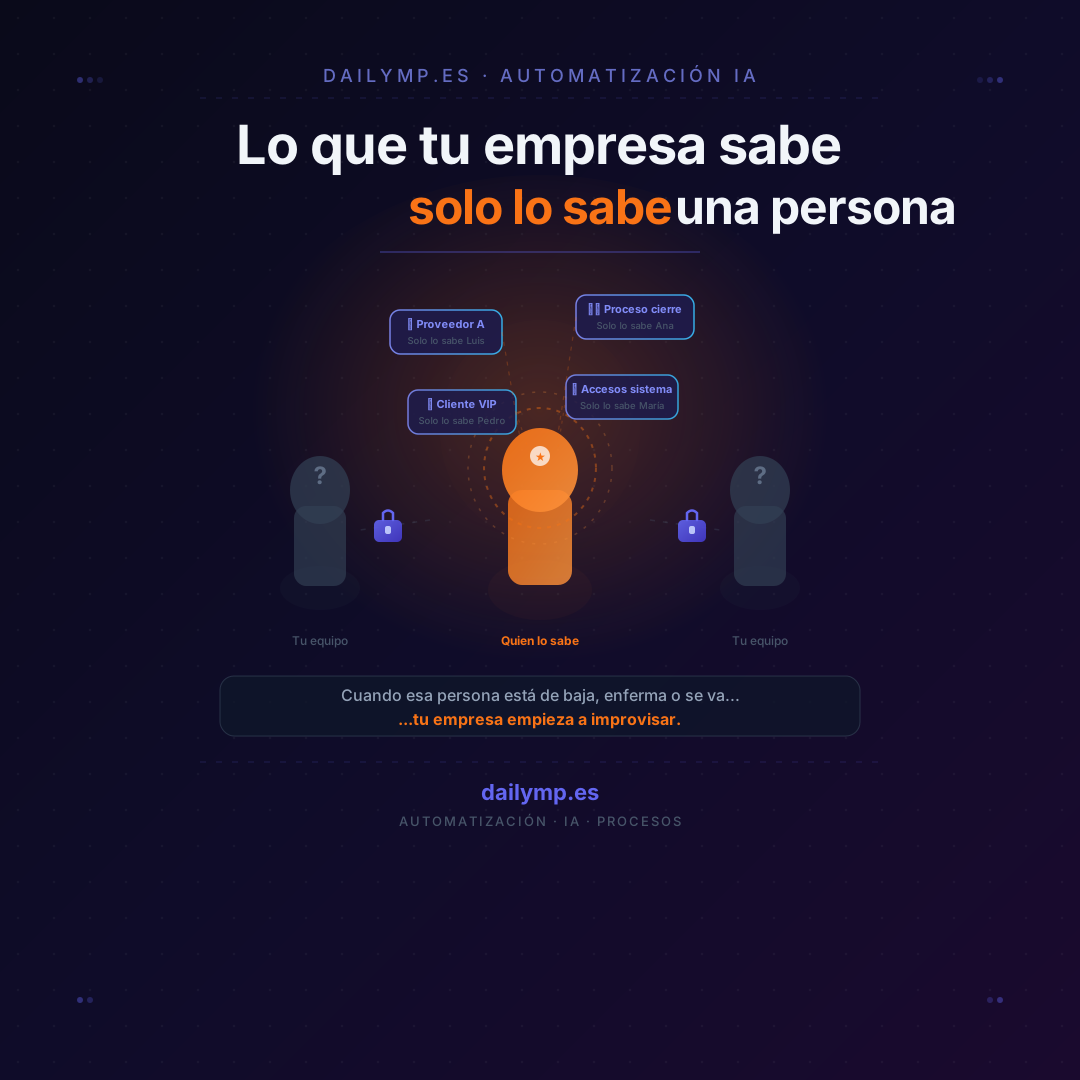
Your Business Knowledge Lives in Three People's Heads
It's Monday morning. Your operations manager calls in sick — 38-degree fever, not coming in.
No big deal, it happens. But at ten o'clock you get an email from your logistics provider asking who gives the green light for Thursday's delivery. You don't know the contact name. You don't know what terms they agreed on. You don't know if there's anything special about that shipment that needs attention.
So you call your sick employee. From her bed, with a fever.
And while you wait for her to respond, something uncomfortable hits you: that knowledge wasn't stored anywhere in your company. It lived in her head.
Your most valuable business asset isn't in any system
It works the same way in almost every small business. There are people who know things. Lots of things. Things that were never written down because there was never time, or because it always worked fine as-is, or because nobody thought it necessary.
What are the special conditions you negotiated with that supplier two years ago? Anna knows.
What's the exact process for closing the month's accounts without anything going wrong? Louis knows.
How do you handle that client who has their own deadlines and their own quirks? Peter knows.
Where are the login credentials for the old invoicing system you occasionally need to access? Maria knows.
Each person has their own island of knowledge. While everyone's present, it works. But the day one of those people is absent — sick, on holiday, on leave, or handing in their notice — that knowledge disappears with them.
What this is actually costing you in real money
Let's do a straightforward calculation.
If you have ten people in your company and an annual turnover of 20%, you're replacing two people per year. Each replacement carries a direct cost (recruitment, selection, onboarding) of two to four months' salary. But there's a cost nobody includes in that figure: the three months it takes a new person to perform at the level of the one who left, while the team absorbs the workload or processes get done slower and worse.
And that doesn't include what happens while someone is out due to illness or holidays. Meetings that can't happen. Decisions that get delayed. Mistakes made because someone did something from memory, without knowing exactly how.
A ten-person company with this problem loses, on average, between €400 and €800 per month in productivity lost to knowledge silos. It's not the most dramatic cost. It's the most silent one.
The call that should never have to happen
What reveals the problem most clearly isn't the big crisis. It's the small call. The one you make to someone who's off sick because "it'll only take a minute." The one you make to someone who no longer works for you because "you were the only one who knew how that worked." The one you make to someone on holiday because "it's urgent."
Every one of those calls is a signal: your company is running on knowledge it doesn't own. Knowledge stored in people, not systems. Knowledge that disappears when those people aren't there.
And if one day one of those people picks up their things and leaves for a competitor, or simply decides to close the laptop and never open it again... that knowledge is gone forever.
What companies that have solved this do differently
It's not about asking your team to "document more." That doesn't work. People don't document because documentation takes time, and time always has more urgent things to do.
Companies that have solved the trapped-knowledge problem have done it differently: they capture knowledge during the work process, not after it.
Instead of asking Anna to write a manual about how she closes the month, they connect the systems Anna uses — the ERP, the accounting software, the email threads with suppliers — to a knowledge base that builds itself. When someone asks a question about that process, there's an immediate answer. No Anna required.
This is exactly what we build at dailymp.es through our AI integration service: connecting the systems your company already uses and building an accessible knowledge layer on top. Not a manual. Not a wiki nobody updates. A system that learns as your company works.
In practice, this means:
- Anyone on the team can respond to a supplier question, even if they don't normally handle that account.
- When someone new joins, they can access the full context of each client from day one, without depending on someone walking them through everything.
- When someone leaves, their knowledge doesn't leave with them. It's already captured.
- When there's an internal question — "how do we handle this case?" — the answer appears in seconds, not twenty minutes of digging through emails.
The risk you probably haven't calculated
There's a scenario most businesses don't want to imagine, but it's worth having in mind.
Your key person — the one who knows the things — receives an offer today they can't refuse. Or has an accident. Or decides to take a sabbatical. Or simply reaches a point where they're done.
How long would it take your business to get back to normal operation? Weeks? Months? Are there things you simply wouldn't know how to do?
If the answer makes you uncomfortable, that's a signal.
A company's institutional knowledge — how it works, who's who, what's been learned over years of operation — is one of its most valuable assets. And most SMEs are leaving it completely unprotected, stored in people's heads rather than in systems.
The good news is this has a solution, and it's not as complex as it sounds. The tools to capture and make business knowledge accessible exist today, they integrate with what you're already using, and they don't require your team to change how they work.
Would your business survive if your key person wasn't there tomorrow?
If the answer is "I don't know" or "probably not for a while," that's exactly what we should talk about.
Not to build a three-year project. To look at what critical knowledge your business has trapped, in which people, and how to start freeing it so it's available for everyone.
Message me on WhatsApp and we'll figure it out together. No jargon, no commitment — just a real diagnosis of where the risk is in your business.