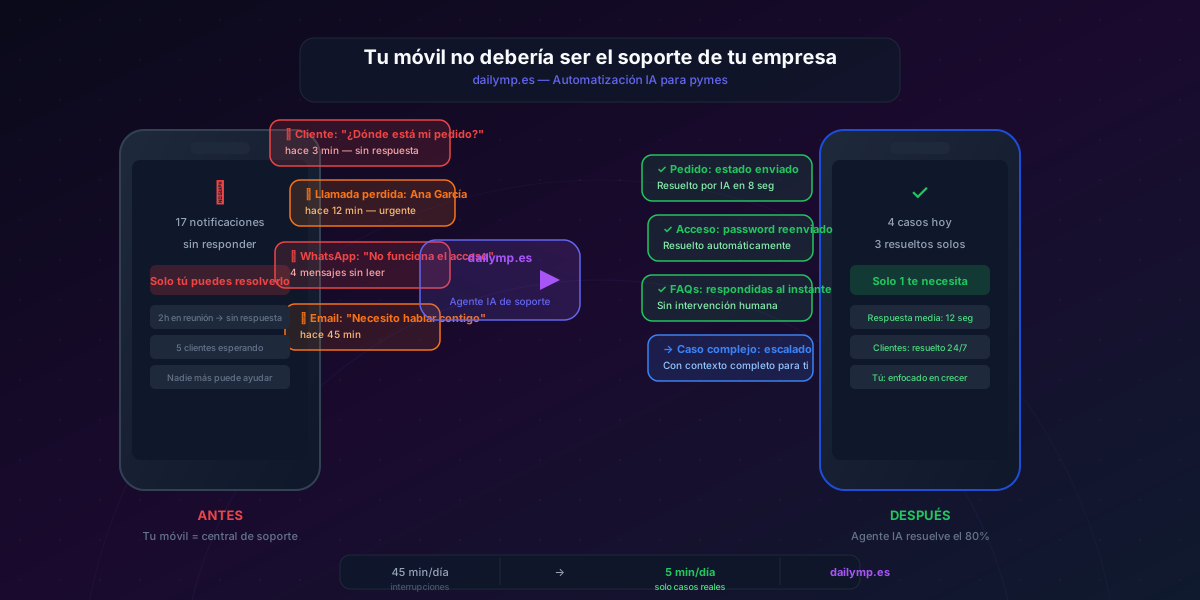
Your Phone Is Your Company's Support Desk
You're in a meeting. Your phone buzzes. A client. You step out, handle it — takes eight minutes. You come back. Lost the thread.
Forty minutes later it buzzes again. WhatsApp. A client with an issue from a delivery last week. You type a quick "on it shortly" and make a mental note to follow up after the meeting.
That's a normal Tuesday at your company.
Why Everything Ends Up on Your Phone
The instinctive answer: clients prefer dealing with you directly. They trust you. You know the most.
Maybe. But that's not the real reason.
The real reason is that your team doesn't have the tools, the context, or the authority to handle most issues without asking you first. When a client calls and the person who answers can't resolve it — what happens? Escalation. Always to the same place: your phone.
And clients learn. If the last two times they had a problem you solved it yourself, next time they'll come straight to you. Not because they're demanding. Because they learned it's the fastest route.
Result: you end up absorbing all the support pressure, even if you have a team that's supposed to handle it.
What It Actually Costs You (That Never Shows Up in a P&L)
Let's do the simple math.
Three support interruptions a day, fifteen to twenty minutes each — the call plus the time to refocus — and you're losing between 45 minutes and an hour a day acting as a human router for client problems.
That's 15 to 20 hours a month. Two full working days. Two days per month that generate no new business, advance no strategy, and exist purely to triage issues that often shouldn't reach you at all.
That's before accounting for the hidden cost of broken concentration. Every interruption pulls you out of deep work. Getting back takes another 15-20 minutes. With three interruptions a day, you can effectively lose your entire capacity for high-value work.
The Loop That Feeds Itself
The most frustrating part: it's self-reinforcing.
You solve problems → the team learns escalating is easier than resolving → clients learn you're the fast solution → more issues come straight to you → you solve them.
Breaking that loop takes more than willpower. You can tell your team to "handle more before escalating" — but if they don't have the information or tools to do it, they'll keep escalating. Because it's the responsible thing to do.
The problem isn't the people. It's that there's no system giving your front line what it needs to answer without you.
What Changes When There's an Intelligent System Behind Them
There are three types of requests that reach any service business:
The ones that always have the same answer. Order status, cancellation steps, where an invoice is, when someone arrives, what a contract includes. Questions with known answers that don't need human judgment. An AI connected to your systems answers these in seconds, around the clock, without anyone managing them.
The ones that need client data. Why was this charged? When does the contract expire? What did we agree last month? These need context, not judgment. An AI agent integrated with your management systems retrieves and presents that information coherently — no one needs to dig through anything.
The ones that genuinely need a human. Complaints with nuance, unusual situations, decisions requiring real judgment. These do need to reach someone. But they arrive with all the context already compiled, the client history summarized, the issue categorized. You're not walking into a call blind — you're walking in prepared.
The result: 70-80% of requests resolve without your involvement. The 20% that reaches you comes with context. Your team operates with more autonomy. And your clients get an immediate response instead of waiting for a gap in your calendar.
To see how a system like this applies to your type of business, take a look at how we approach AI integration for companies.
The Signals That Tell You It's Time
You don't have to hit a wall before acting. These are the signs the current model is already costing too much:
- You open your phone in the morning and there are client messages from the night before
- Your team forwards messages instead of answering them directly
- Clients ask for you specifically, not just for support
- You end weeks feeling like you handled a lot without advancing anything important
- When you take a few days off, support either collapses or you keep answering from wherever you are
If you recognize two or more of these, the problem isn't attitude or team quality. It's architecture. Your business needs a first-line system that handles what it can handle independently — and escalates intelligently when it can't.
What You Can Do This Week
The first step isn't technical. It's a list.
Look at the last fifteen or twenty issues you resolved directly. How many always had the same answer? How many required information sitting in a system that nobody retrieved? How many genuinely needed your personal judgment?
That list will give you the real percentage of interruptions that don't need to reach you. In most businesses we work with, that number sits between 60 and 80%.
From there, it makes sense to talk about what system to build, what to connect, and how to automate it. If you want to have that conversation, message me on WhatsApp and we'll look at your specific case together.
Your phone should be for building business. Not for putting out fires.