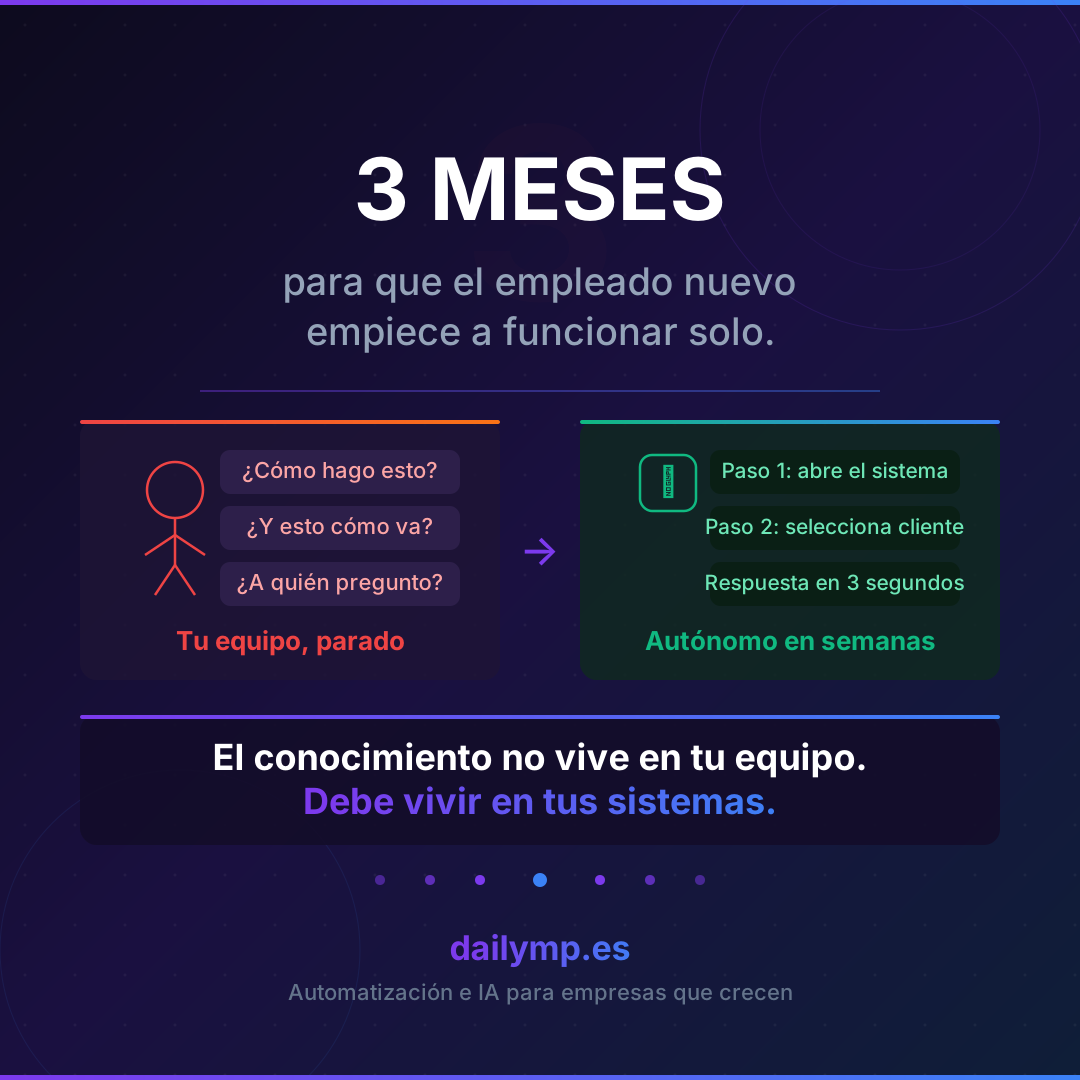
New Hire, 3 Months In. Still Asking the Same Questions.
The week Alex joined your company, Sarah stopped getting work done.
Not because she didn't want to. But because Alex didn't know how anything worked — and Sarah was the only one who did.
That's not Alex's fault. It's how almost every small business operates: knowledge lives inside people, not inside systems. When someone new joins, the experienced people have to stop what they're doing to teach them.
For months.
The real cost of bringing on a new employee (what nobody calculates)
You already know the salary cost. That's not the number people miss.
What most business owners and managers don't calculate is the hidden cost of everyone else's time.
If Sarah spends two hours a day answering Alex's questions for three months, that's roughly 130 hours of her time. Hours she's not billing, not selling, not doing the work she was hired to do.
How much is one hour of Sarah's time worth? Put it at €40, €60, €80 — whatever fits your business.
130 hours × €50 = €6,500 in invisible costs for every new hire. And that's when things go well.
If the onboarding drags on, or if Alex doesn't work out and leaves in four months, you don't recover that investment.
The underlying problem: knowledge is trapped in people
Why does it take so long for a new employee to be independent?
Because most of what they need to know isn't written down anywhere. It's in Sarah's head. In a WhatsApp thread from two years ago. In the spreadsheet that "makes sense once you see it". In the email from 2024 explaining the refund policy. In the conversation you had with the supplier last month.
Your company accumulates knowledge. But it has no memory.
Every time someone new joins, that knowledge is transmitted person-to-person — with all the room for error and all the time that implies. The system doesn't learn. Only the people learn. And when those people leave, the knowledge walks out with them.
What happens when the second one joins (and the third)
The first new hire feels normal. "That's just the ramp-up period."
The second too. "We have a lot to learn here."
The third is when you start seeing the pattern: this isn't a people problem, it's a systems problem.
It's not that new hires are slow learners. It's that your company has no mechanism to transfer what it knows. Every new hire starts from zero. The cost doesn't go down. The knowledge doesn't compound.
The difference between a company that transfers knowledge and one that doesn't
A business with well-built automation systems doesn't have new employees asking the senior staff. It has them asking the system.
What's the process for handling a client complaint? The system knows. What do we do when a client requests something outside the project scope? The system knows. What's the payment and installment policy? The system knows. Which supplier do we call when X fails? The system knows.
An AI assistant trained on your company's actual processes, policies, and common cases can answer 80% of the questions that currently land on Sarah. In seconds. Without interrupting her.
The remaining 20% — the edge cases, exceptions, decisions that carry real weight — those stay with a person. Because that's where human judgment actually matters.
What this looks like in practice
Not a 200-page employee handbook nobody reads.
An assistant that actually knows how to answer because it's been trained on your company's real knowledge.
The new employee joins. Instead of finding Sarah, they open the assistant and ask: "How do we handle a client complaint?" The assistant responds with the exact process, the tone you use, the steps to follow, and what to do if the client escalates. If there's a special case, it flags it. If the answer isn't there yet, it logs the question to improve the system.
- Week 1: the new hire handles standard situations without interrupting anyone.
- Month 1: they start contributing real work.
- Month 3: they're independent on complex cases.
Not three months to reach week four. Three weeks.
This is what companies achieve when they integrate AI as an operational tool, not a one-off experiment.
The calculation you need to do right now
How many new hires are you making this year? One, two, three.
Multiply that invisible cost — senior team hours spent teaching — by the number of people joining.
Now think about how long it currently takes someone new to be fully independent.
That number is the problem. And it has a solution.
If every new hire in your company means months of drag and thousands in lost senior time, let's talk on WhatsApp — in 30 minutes we'll look at what knowledge your company has trapped and how to unlock it.