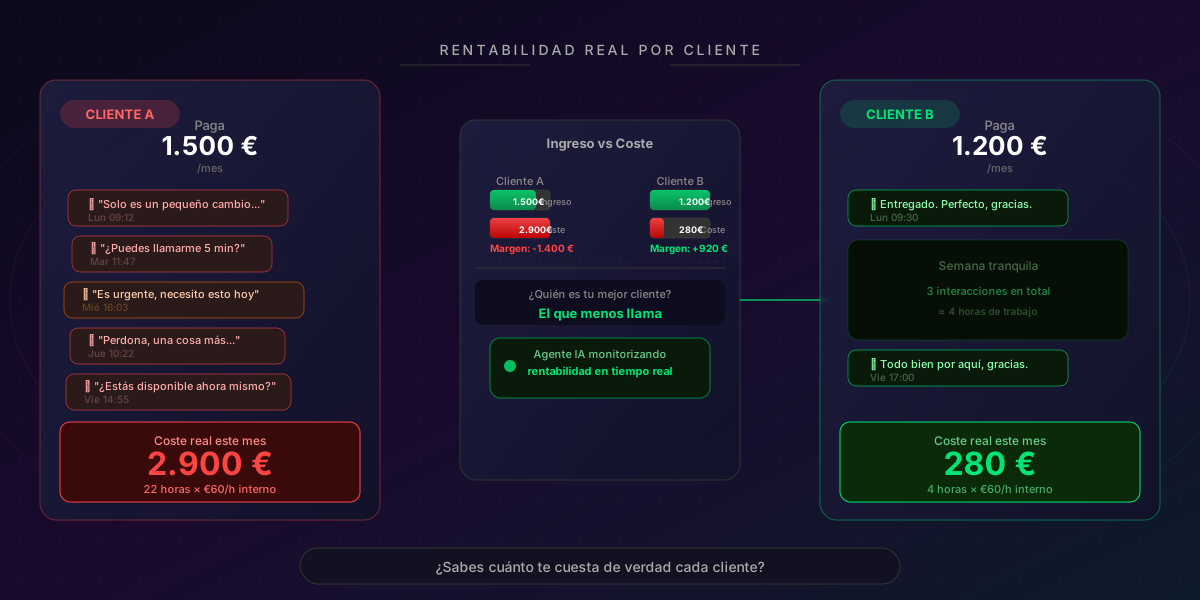
Some of Your Clients Cost More Than They Pay
You have a client paying €4,000 a month. Another paying €2,000. On paper, the first one is your best client.
But the first one calls every other day with urgent changes. Their invoices always have errors to fix. Three different people are CC'd on every email, each saying something different. The monthly "check-in meeting" runs three hours. And when something goes wrong, you hear about it first — directly from them.
The second pays within three days. Never calls unless necessary. When they have a question, they send it with full context. They've been with you for two years, no drama.
Which one is actually better for your business?
The Number Nobody Accounts For
Most companies rank clients by revenue. The one who pays most gets the most attention, the most flexibility, the most resources. Makes sense, right?
The problem is that invoice number doesn't include what it actually costs to serve them:
- The support hours your team spends each week
- Meetings that drag on without moving forward
- Last-minute changes that delay other projects
- Emails requiring three people to answer properly
- Miscommunications that turn into discounts, refunds, or unplanned extra work
- The mental energy consumed every time you see their name on your screen
All of that has a cost. And that cost appears on no invoice.
The Calculation Nobody Does (That Changes Everything)
Try this exercise. Pick a client who "takes up a lot of space." Now answer: how many hours did your team spend on them last month? Not just delivery hours — include support, management, revisions, clarifications, meetings, and unexpected issues.
If your internal rate is €50/hour (salaries, overhead, operating costs) and that client consumed 80 hours last month, the real cost of serving them is €4,000.
If they pay you €4,000... your actual margin is zero.
And if one day an issue they had monopolized two of your people for half a day, the margin went negative.
You're not making money from that client. You're losing it, with more work.
Client B, who pays €2,000 but only consumes 20 hours at €50/hour, leaves you €1,000 in real margin. They're twice as profitable as Client A. You probably don't know that.
Why This Happens Without You Noticing
It's not that the client is malicious or your team is inefficient. It's that there's no system automatically tracking how much time you spend per client and comparing it against what they pay.
Most SMBs keep rough time records per project — not per client. And those that do tend to analyze it once a year, at that review that always gets pushed to "when there's time."
Without data, everything seems normal. The client keeps paying. The team keeps working. No one raises a flag. Meanwhile, that client consumes a disproportionate share of your resources.
The most dangerous part: when the workload from that client becomes unsustainable, the typical reaction isn't to review profitability. It's to hire someone new — to keep losing money, now with an extra salary.
What Changes When You Have the Data
With real visibility into margin per client, you can make informed decisions instead of reacting to problems:
Adjust the price. If the real cost of serving a client exceeds the margin they provide, option A is updating the price to reflect what it actually costs to serve them. Some will accept it. Those who don't probably shouldn't be in your client portfolio.
Define service limits. How many support hours are included in each contract, what gets billed separately, and what doesn't. Many "expensive" clients aren't expensive by nature — they're expensive because nobody explained what they're actually paying for.
Invest in clients who deserve to grow. The most profitable client isn't always the biggest one. Sometimes it's the quiet one who's been with you for years, consumes few resources, and refers others without being asked. That client deserves more attention, more proposals, more relationship. They're the ones who actually sustain your business.
The AI automation agents for SMBs we implement at DAILYMP automatically track time per client, cross-reference that data with revenue, and generate a real profitability report every month — with no one needing to prepare it manually. Not to create tension with clients, but so the information is available before a problem becomes unsustainable.
If your company uses an ERP or business management platform, our AI integration service can connect time, project, and billing data directly so the analysis runs automatically.
A Test You Can Run Today
No tools. Nothing to install.
Pick your three highest-revenue clients. For each one, ask your team to estimate the total hours spent on them last month — everything: support, meetings, emails, revisions, unexpected issues.
Multiply those hours by what an hour of your team costs (salary + overhead + operating expenses).
Compare that against what you billed that client last month.
In 80% of cases, at least one of those three "big" clients has a real margin that will surprise you. And not in a good way.
With that number, you have the basis for a difficult but necessary conversation. Or the data to decide which client you want — and can afford — to dedicate more time to.
Not Every Client Is Good for Your Business
That has nothing to do with whether they're good people or whether the work is interesting. It's about the real numbers: the real margin, what's left at the end of the month when you count everything it cost to serve them.
The good news: with a system that automatically tracks and analyzes that data, it stops being a napkin estimate and becomes actionable intelligence. You know exactly which clients deserve to grow in your portfolio and which ones need to be renegotiated or let go — before the cost becomes unsustainable.