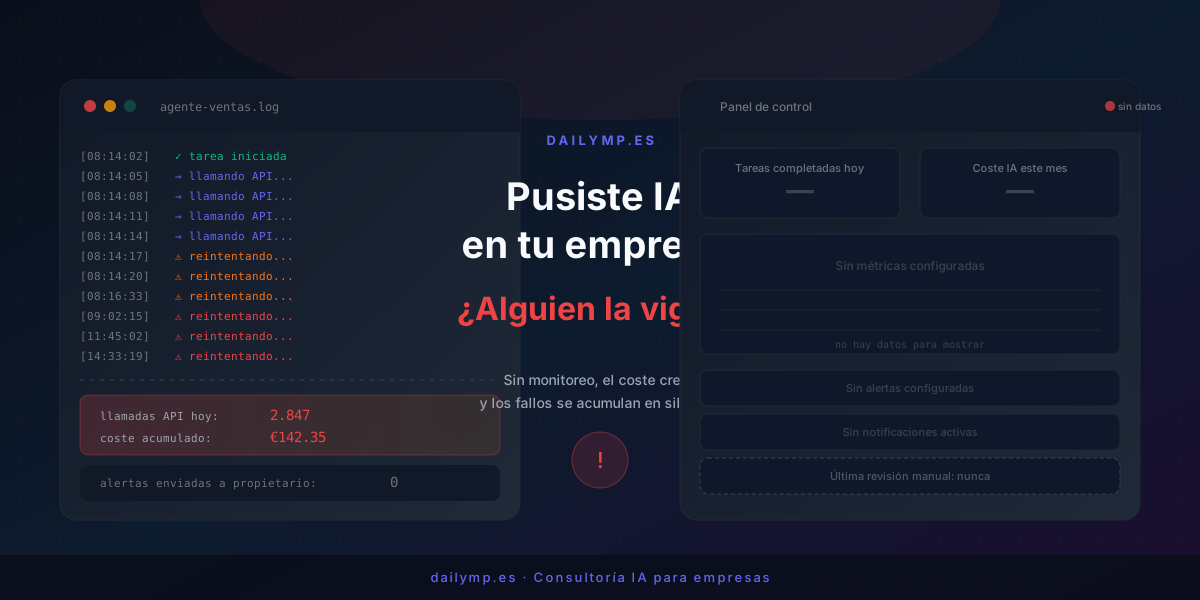
You Added AI to Your Business. Is Anyone Watching?
Six months ago, a logistics company hired someone to implement an AI agent that automatically processed orders every night.
The agent launched. It worked for two weeks. Nobody looked at it again.
When they reviewed the API invoice three months later, they'd paid €340 more than expected. The agent had been running the same order in a loop for weeks — never finishing, never failing visibly, never sending any alert. Just running. And billing.
The problem wasn't the AI. It was that nobody was watching it.
The "it's already working" trap
When you pay someone to implement an automation or subscribe to an AI tool, there's a specific moment when everything seems fine: the first tests work, the process launches, the team says "done."
And then… everyone forgets.
The automation fades into the background. Like the air conditioning — it's there, it does its job, and nobody thinks about it until it breaks at the worst possible moment.
The mistake is thinking an AI automation works like mechanical machinery: install it, switch it on, and it runs forever without maintenance. AI automation agents depend on external APIs that change, on data that can arrive in unexpected formats, on context that varies. Without oversight, the system that "works" may be doing the work incorrectly — or not at all — and you won't find out until the damage is done.
Three ways an unwatched AI costs you money
First: the API cost nobody reviews.
Every call to an AI model has a price. An agent processing 50 documents a day at €0.04 per call costs €2 daily: manageable. But if that agent loops and makes 500 calls instead of 50, you're paying €20 a day for work that never completes. That's €600 a month appearing on no report in your business, because nobody set up a spending alert.
Second: the tasks you think are getting done — but aren't.
The agent automatically confirms orders. Or so you thought. When a client calls asking about their order from three weeks ago and nobody has any record of it, you discover the automation stopped working after a format change in a confirmation email. Without monitoring, that failure accumulates for weeks. Now you have an angry client, an emergency manual process, and a trust gap that takes time to repair.
Third: decisions made on bad data.
If your AI generates automatic reports on sales, customer support, or inventory, and those reports have had incorrect data for weeks because something broke in the pipeline — you're making decisions based on information that doesn't reflect reality. You don't know that. You have no system alerting you that something's wrong. The consequences only appear when the gap between data and reality is impossible to ignore.
The difference between deploying AI and having AI that works
Many businesses confuse these two things.
Deploying AI is the first step: configuring the agent, connecting systems, running initial tests. It's necessary. But it's just the beginning.
Having AI that actually works requires an additional layer: knowing what the system is doing at every moment, getting an alert when something fails, seeing accumulated cost in real time, and having a clear process for when the agent needs human intervention.
Without that layer, you have a black box inside your business. It consumes resources and nobody knows exactly what it's doing inside.
The AI integration service I offer always includes that visibility layer. Not as an add-on — as a fundamental part of any implementation. Because an automation you can't observe isn't an asset. It's a liability.
Questions you should be able to answer right now
If you have any AI agent or automation running in your business, ask yourself:
- How many times did it complete its task correctly this week?
- What happened the last time it failed? How did you find out?
- What did it cost in API calls last month?
- Is there someone on your team who gets an alert if the system stops working?
If you can't answer any of those, you have a system with no visibility. That doesn't mean it's failing right now — but it means you won't know until it's too late.
What a well-implemented AI system includes
When I work with a company to implement automations, the final result isn't just "the AI doing something." It's a complete system that includes:
- Real-time metrics on how many tasks complete, how many fail, and how long each takes
- Automatic alerts when something falls outside normal parameters — before the failure impacts clients or operations
- Cost control per process: you know exactly what each automation costs, and can decide whether the return justifies it
- Activity log to audit what the system did, when, and with what result
This isn't complex technology. It's good implementation practice. The difference between something you switch off in three months and something that keeps running for years.
Real results
Businesses that implement automations with full visibility detect 80% of failures before they affect operations. Not because AI is infallible, but because they have the observability layer that alerts them in time.
An automation that saves 15 hours a week and can be measured isn't expensive: it's the most profitable investment an SME can make. One that can't be measured generates mistrust, and sooner or later gets switched off.
If you have AI running in your business and don't know exactly what it's doing, what it costs, and when it fails — that's fixable. And simpler than you think.