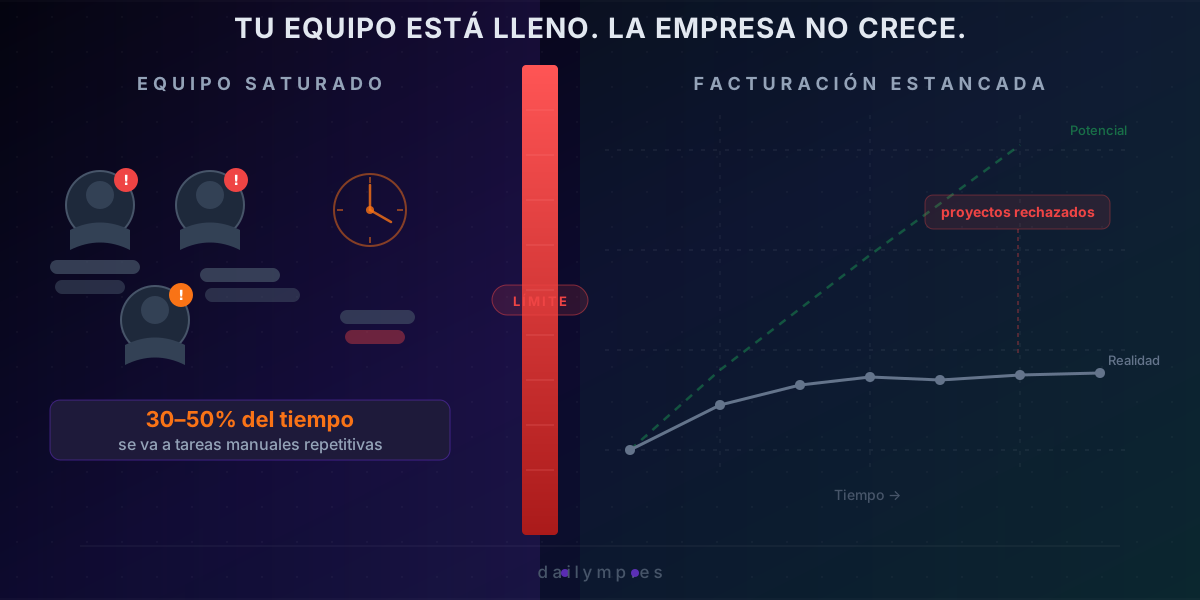
Your team is full but your business doesn't grow
There's a moment every business owner dreads.
A potential client reaches out — solid project, clear budget, ready to start. And you have to turn them down. Not because you don't want the work. But because your team is already at the limit.
It's a moment that should feel like validation — "there's demand for what I do" — but instead it just frustrates. You're leaving money on the table. And that client is going to call your competitor.
The problem isn't the market
Most businesses that have been running for three or more years don't have a demand problem. They have a capacity problem.
The phone rings. Quotes get requested. Existing clients come back with more work. But the team is already maxed out. Taking on a new client means either overloading someone who's already stretched, or hiring someone new.
And hiring has its own costs: time to recruit, time to train, risk of a wrong hire, fixed monthly payroll even when volume drops.
The result: many businesses stay at the same revenue level for years. Not because the market doesn't want more from them — but because they can't free up the capacity to serve more clients.
Where is all that time actually going?
Before thinking about solutions, it's worth being honest about what consumes the team's day.
In most small and medium businesses, a significant portion of working hours — between 30% and 50% — goes to tasks that repeat the same way every week. Some are unavoidable. Many aren't.
Answering the same questions over and over: timelines, pricing, availability. Different clients, same answers, every single day.
Manual follow-up on proposals: calling to check if the quote arrived, if there are questions, if they've made a decision. Without a system, someone does it from memory — or it simply doesn't happen.
Moving information between tools: from email to CRM, from CRM to spreadsheet, from spreadsheet to Monday's report. Someone copies it by hand because the tools don't talk to each other.
Constant internal coordination: "How's project X going?", "Has anyone spoken to client Y?", "Do you have the invoice for Z?" — conversations that happen because information isn't where it should be.
Each of these tasks looks small in isolation. Together, they can easily add up to 15 to 25 hours per week across the team. Hours that aren't going to work that creates value. And aren't going to the new client who's waiting for an answer.
Growing without adding headcount
When a business implements AI agents to automate operational processes, the first thing that happens isn't that work disappears. It's that existing work gets redistributed.
Common client questions get answered directly by the agent, in seconds, with up-to-date information from your business — without anyone having to write the same response for the tenth time.
Proposal follow-up happens automatically: if a client hasn't responded in three days, the system detects it and sends a timely reminder.
Information moves on its own between tools. The data someone used to copy manually from one system to another now flows automatically.
The direct result: the team gets hours back. Not to work less — to take on the client they previously had to turn down.
In practice, businesses that automate these operational layers typically discover they had hidden capacity for 20% to 40% more volume without adding a single person to the team.
The math that never shows up in your reports
If your business generates €120,000 per year and turns down 20% of incoming projects due to capacity constraints, that's €24,000 per year that never comes in.
It doesn't appear in any report. It's not a recorded loss. It simply never existed as revenue.
Now consider what happens when integrating your tools and automating repetitive processes frees up enough capacity to take on one or two more projects per month.
The cost of implementing that automation gets recovered in weeks, not years.
The difference between a business that grows and one that stays at the same revenue level for three years often isn't the difference between markets or teams. It's whether someone made the decision to stop doing manually what can be done automatically.
What doesn't change when you automate
Automating doesn't mean removing the human side of client relationships. It means that the parts of those relationships that don't require human judgment — answering a standard question, updating a status, sending a reminder — get handled by the system.
The parts that do require judgment — negotiating, solving a complex problem, making a strategic decision — stay with people. But those people now have time for them.
The new client you used to have to turn down can now come in. And the team can serve them without anyone working overtime.
If you're losing projects because your team can't take on more, tell me what's consuming most of your time. In 30 minutes I'll tell you what can be fixed immediately.