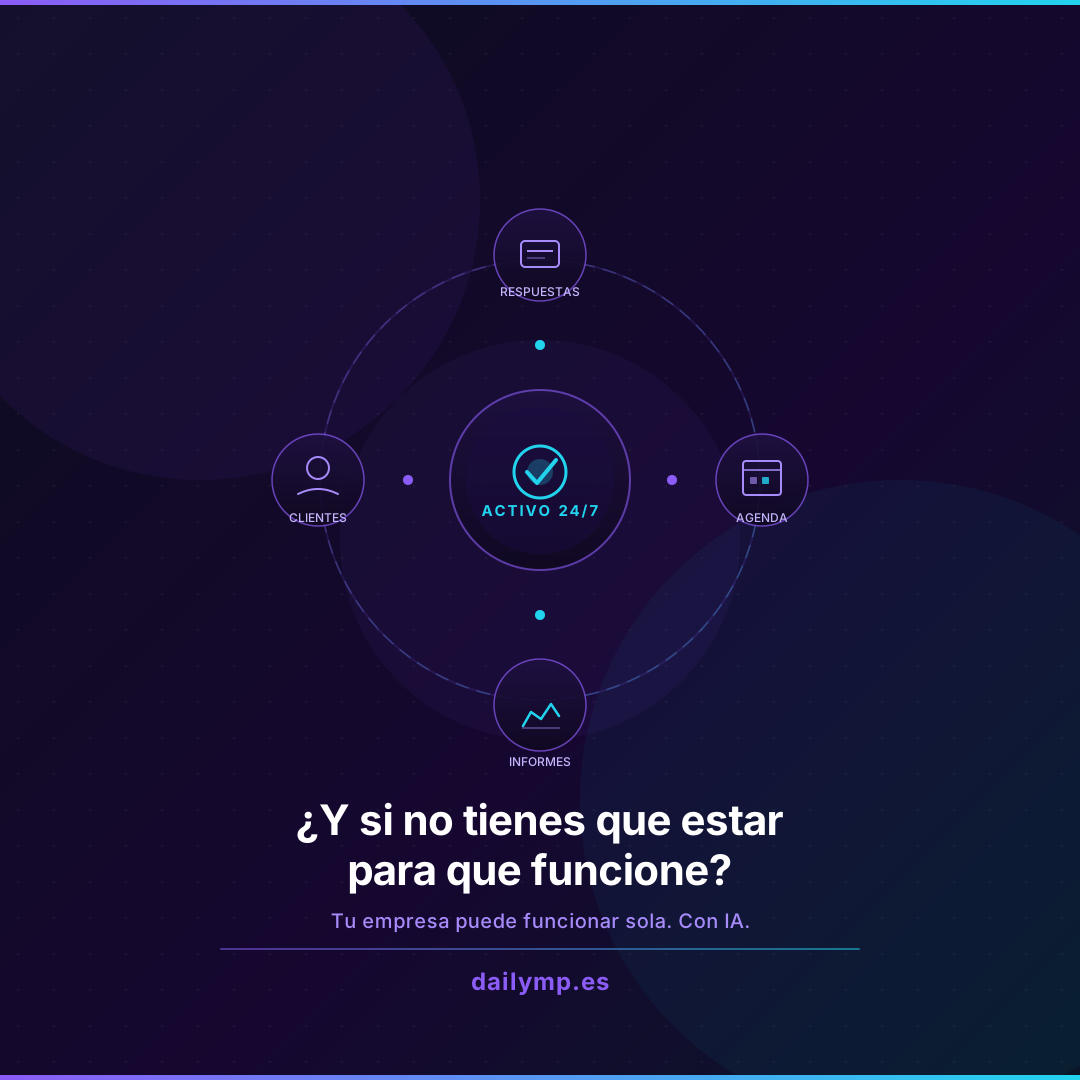
Your Business Stops When You Stop
When was the last time you took ten days off and didn't check your phone?
If you need more than three seconds to answer that, you've already found the problem.
It's not a matter of organization. It's not that you struggle to delegate. It's that your business is built in a way where you are a required part of the mechanism. Without you, the mechanism stops.
The business that only works when you're there
There's a very common pattern in small and medium businesses: the founder or lead person knows everything.
They know how to respond to clients when something goes wrong. They know what to prioritize when tasks conflict. They know which exception to make for which client. They know where to find information nobody else can locate.
And that knowledge lives in their head. Not in any system. Not in any written process. Not in any automation.
The result: every time that person steps away — on holiday, at a conference, in a three-hour meeting — things stop moving. Questions don't get answered. Decisions don't get made because nobody knows what the boss would do.
What it costs you to be in the middle of everything
When you're the bottleneck in your own business, there are three costs that rarely show up in any spreadsheet.
First: you can't scale. Every new client adds more load to you, not to your system. Ten more clients means you work ten times harder. That's not a growth model, it's a burnout model.
Second: you can't sell the business. Or if you can, it's worth much less. A business that depends on one person's knowledge isn't an independent asset — it's an extension of that person. Buyers know this.
Third: you can't rest. And rest isn't a luxury, it's a condition for making good decisions. When you've been holding everything together for years, the fatigue accumulates in ways you don't notice until it's already a serious problem.
Add up the minutes you spend every week on things nobody else in your company could handle. Answering client questions that any system would know. Reviewing and approving things that have clear criteria but need your sign-off. Resolving exceptions that are actually more frequent than the rules themselves.
That time has a cost. And it's usually far larger than it seems.
The three most common traps
After working with dozens of SMEs, the same traps come up every time.
Trap 1: you're the technical and commercial support for your clients. Clients ask, you answer. When there's a problem, they call you directly. When they want a status update, they message you. Not because there's nobody else, but because nobody else has the information or the criteria to respond well.
Trap 2: you approve things that could have automatic criteria. Quotes under a certain amount. Routine exceptions. Minor project changes. Decisions you always end up making the same way, but that nobody else can make because there's no documented process.
Trap 3: information lives in places only you know. In your inbox. In a document on your desktop. In a WhatsApp from three weeks ago. Whenever someone needs something, they ask you. Not because you're irreplaceable, but because you're the only available index.
What changes when you systematize
Systematizing doesn't mean hiring more people. It means building processes that don't depend on someone remembering to trigger them manually.
An AI agent for client support can handle 70-80% of routine questions without anyone having to write a reply. Not because the AI knows more than you, but because you already know the answers and can teach them once.
An automatic approval system can resolve routine exceptions based on criteria you define. Without anyone needing to ask your permission every time. With a full record of everything that happens, in case you need to review it.
A knowledge base connected to your tools can give access to information that currently only lives with you. A client's history. A project's status. The criteria for making a decision. All available to whoever needs it, whenever they need it.
None of this requires changing how your team works. What it requires is spending a few hours transferring what you know into a system that can act on that knowledge.
At DAILYMP, that's exactly what we do: we take the processes that depend on you, convert them into automated workflows, and connect everything to the tools your company already uses.
The goal isn't to make yourself redundant
The goal isn't for the business to run without you entirely. The goal is to be able to step away without something breaking.
So that when you're in a three-hour meeting, clients get a response. When you're on holiday, routine approvals don't pile up waiting for you. When you want to grow the business, growth doesn't depend on you personally working more.
That's what makes scaling possible — the work you already do today can multiply without you having to multiply along with it.
If you've been feeling like the bottleneck in your own business, in 30 minutes we can assess which parts are easiest to systematize and what impact it would have on your time.