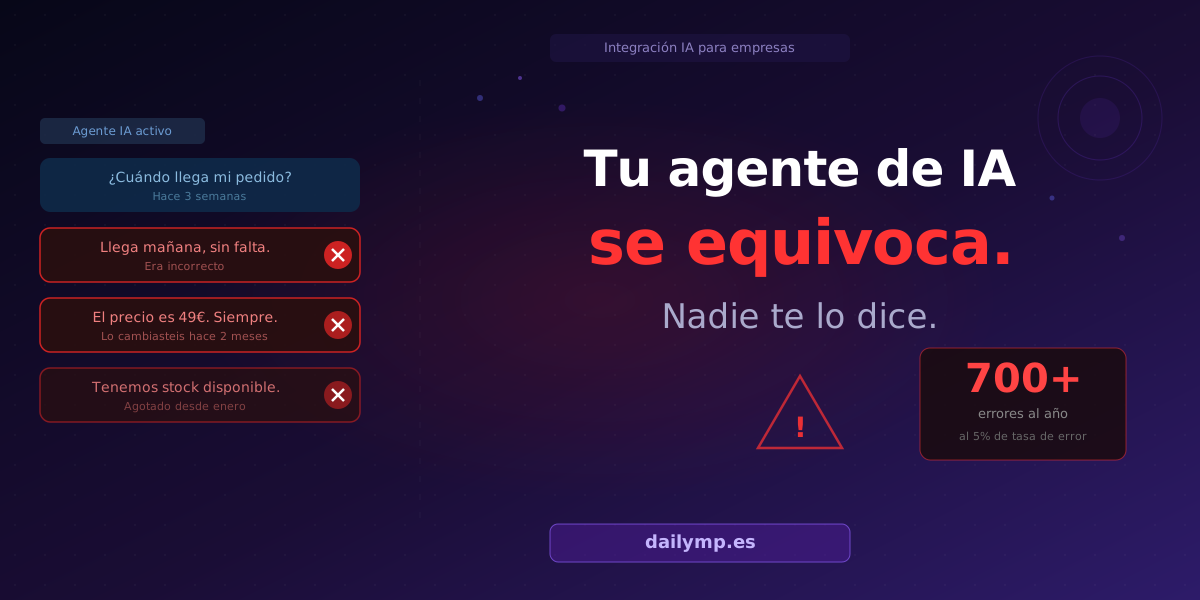
Your AI Agent Makes Mistakes. Nobody Tells You.
You set up an AI agent to handle client queries. You tested it. It worked. You moved on.
What nobody explained is that an AI doesn't keep "working" on its own.
Picture this: three weeks ago, a client asks your AI assistant about a product's availability. The assistant answers with total confidence. The answer is wrong — that item ran out a month ago. The client places the order. The problem lands with your support team. The client is annoyed. They don't come back.
That's the version where someone complains. Most clients just leave without saying anything.
AI Always Answers. Even When It Doesn't Know.
The language models powering business chatbots and agents have one specific behavior: they answer. Always. With confidence.
They don't say "I'm not sure" unless you've specifically programmed that behavior. Without it, your AI gives a definitive answer to every question — including questions it has no updated information to answer.
This isn't a flaw in the model you're using. It's how all AI systems work by default.
The result: your agent can give incorrect information about:
- Product availability (using data that's months out of date)
- Prices you changed but the AI doesn't know about
- Current policies, schedules, and promotions
- Technical specifications that have been updated
And it does so without hesitation, in the same tone it uses when it's right.
The Calculation Nobody Does
Let's run the numbers together.
If your AI agent handles 50 queries a day and makes mistakes on 5% of them:
- 2-3 wrong answers every day
- 60-70 wrong answers per month
- More than 700 per year
Of those, how many do you actually know about? The ones where someone complained loudly: maybe 5%. The rest are clients who got wrong information, didn't complain, and acted on it — or just left.
Most businesses only discover this problem when:
- A client complains loudly enough
- An employee spots something odd by chance
- Someone reviews conversation history while looking for something else
When did you last review the complete conversations your AI is having with your clients?
Why This Happens (and Why It's Not the Model's Fault)
An AI agent doesn't choose to give wrong answers. It generates responses based on what it knew when you last configured or updated it. If your prices changed three months ago but the AI was set up four months ago, it's working with outdated data.
The three most common failure modes:
1. Outdated information. Your AI knows what you told it when you set it up. Every day without an update, it drifts further from your business reality.
2. Untested edge cases. You tested the most common questions. But clients ask unusual things — combined queries, out-of-context requests, edge cases. When the AI doesn't know, it improvises — and improvising without guardrails is risky.
3. Overconfidence. Without a review mechanism, the AI returns its first answer without checking it. It doesn't ask itself "is this right?" unless it's built to do so.
What Changes With a Properly Built AI
A well-built AI system for business includes three things that quick solutions leave out:
Automatic review before responding. Before a response reaches the client, the agent evaluates whether it's consistent with business rules and up-to-date information. When uncertain, it escalates to a human.
Escalation path. When the AI isn't confident enough, it doesn't improvise — it says "let me connect you with someone who can help you better." This prevents errors from reaching clients.
Visibility into what's happening. You can see patterns of uncertain responses, queries generating low confidence, and unusual cases before they become problems.
With AI integration done right, your agent doesn't just answer — it answers well, or holds until a human can take over.
What It Costs You Not to Check
One wrong answer to the right client can mean:
- A cancelled order
- A refund for something never in stock
- A negative review
- A client who doesn't return — and doesn't tell you why
The cost doesn't show up on any spreadsheet. But it's real.
If you have an AI agent active in your business right now, the question isn't "is it working?" — you can see it's responding. The question is "how many mistakes is it making today, and who's being affected?"
If you can't answer that second question, you have a visibility problem.
How We Fix It
When I implement AI agents for businesses, I always include self-correction mechanisms, monitoring, and defined escalation paths. The goal isn't an agent that works on day one — it's an agent that keeps working reliably as your business changes.
If you already have an AI agent in your business and want to review how it's performing and what risks it carries, let's talk.
Want to review your case together?