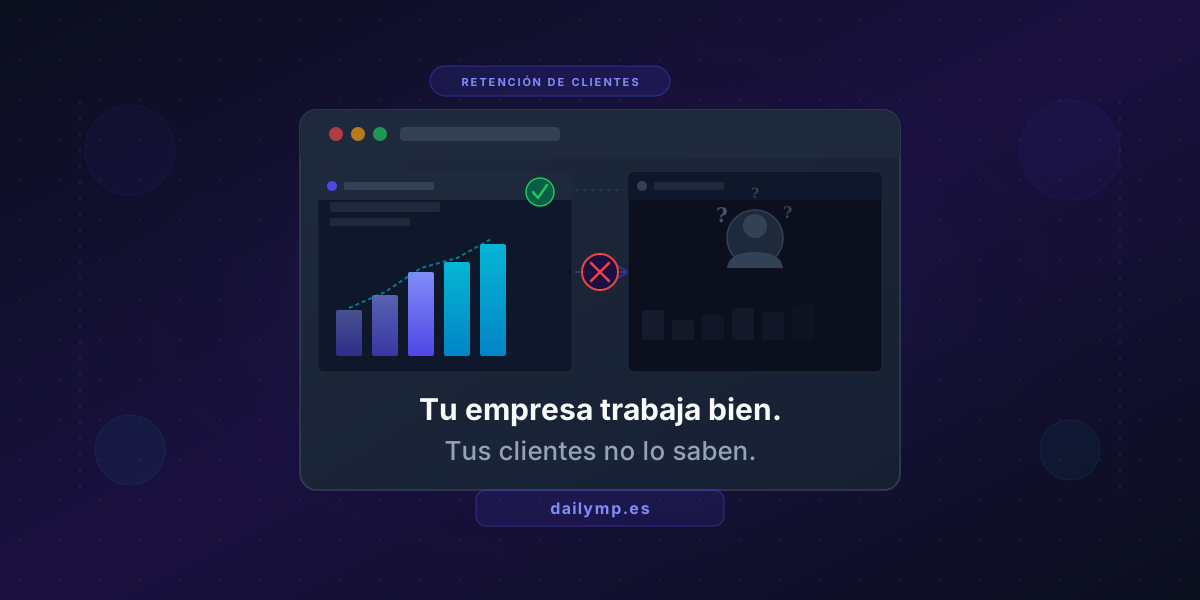
You Do Great Work. Your Clients Don't Know It.
You've been doing excellent work for a client for three months. The results are there. You know exactly what you've accomplished, how much has improved, what problems you've solved.
Next week the contract expires. You call to discuss renewal. And during that conversation you notice something uncomfortable: they're not entirely clear on what you've been doing these three months.
Not because you haven't worked. You've worked hard. But because nobody has kept them informed — clearly, regularly, in a way they can actually see and remember.
And in that moment, the price they're paying no longer feels as justified as it should.
Value that isn't communicated doesn't exist
There's a paradox in service businesses that costs renewals every month: clients sign up expecting results, but while your company delivers them, the client keeps going with their daily routine with no real visibility into what's happening.
Not because they don't care — because nobody updates them systematically.
The problem isn't a lack of results. The problem is a lack of communication.
When renewal comes, clients evaluate the perceived value across the entire contract period, not just the last few days. And if that perception was one of silence — of "I only hear from them when something goes wrong" or "I have to ask to find out how it's going" — the work you delivered weighs less than it should.
Retention isn't won on the last day. It's built every week.
What happens in a service business without systematic communication
The most common situation isn't companies doing bad work. It's companies doing good work and not communicating it. There are deliverables, progress, results — but the client sees them fragmented: they hear something when there's a highlight, then silence when the work is routine even if it's necessary.
Does this pattern sound familiar?
- The client receives a report when something notable happens, not on a regular schedule
- Progress updates go out when someone remembers, or when the client asks
- The monthly report, if it exists, someone prepares manually in a couple of hours by pulling data from three different tools
- When there's a status meeting, nobody remembers exactly what the last one covered
If a client has been with you for six months and can't answer in 30 seconds what has improved in their business because of your work, you have a communication problem. Not a results problem — a communication problem.
Why manual communication doesn't scale
The issue isn't that you don't want to communicate better. It's that doing it well manually costs real time:
- Preparing a monthly report: 1 to 3 hours per client
- With 10 active clients: 10 to 30 hours per month, just on reports
- With 20 clients: that number doubles
And that doesn't account for interim updates, responses to "how's this going?", ad-hoc reviews that come up because the client has no continuous visibility.
The result: you either dedicate enormous time to communication, or you sacrifice communication quality to free up hours. Most businesses choose the second option. And then they lose renewals without understanding why.
There's something that makes it worse: you don't know when the client starts to doubt. By the time the renewal conversation happens, the decision was already made in their head weeks ago. And there was no data on the table to change it.
What changes with automated communication
An AI agent connected to your working tools can do something that never scales manually: communicate consistently, regularly, and in a personalized way to each client — without anyone having to write it.
How does it work in practice?
The agent pulls data from the tools you already use — logged hours, completed tasks, outcome metrics, closed tickets, whatever matters for your business. It organizes it into a clear report, in the format you prefer, and sends it to the client at the agreed cadence: weekly, biweekly, monthly.
The client always knows what's been done. They always have visibility. And when renewal comes, there's nothing to convince them of — they've been seeing the value for months.
That's not just efficiency. It's a direct commercial advantage.
The effect nobody expects: fewer questions, more trust
When a client receives regular updates without having to ask for them, the entire relationship dynamic shifts.
They stop micromanaging because they don't need to. They understand your company is in control. Status meetings become more productive because they're not spent getting everyone up to speed — they're already up to speed.
And when someone at their company asks "is what we're paying worth it?" — they have an immediate answer: yes, and here's exactly why.
That's not a pretty report. It's the difference between losing a renewal and winning it.
Before your next renewal comes around
If you have active clients and no automated regular communication system, you're leaving money on the table at every renewal.
Not because you're doing bad work. But because that work isn't being seen.
At DAILYMP we build automated communication workflows that integrate with the tools you already use — without changing how your team works. You can see how we do it on our AI integration for businesses page.
If you want to understand what would work for your specific situation, let's talk directly: