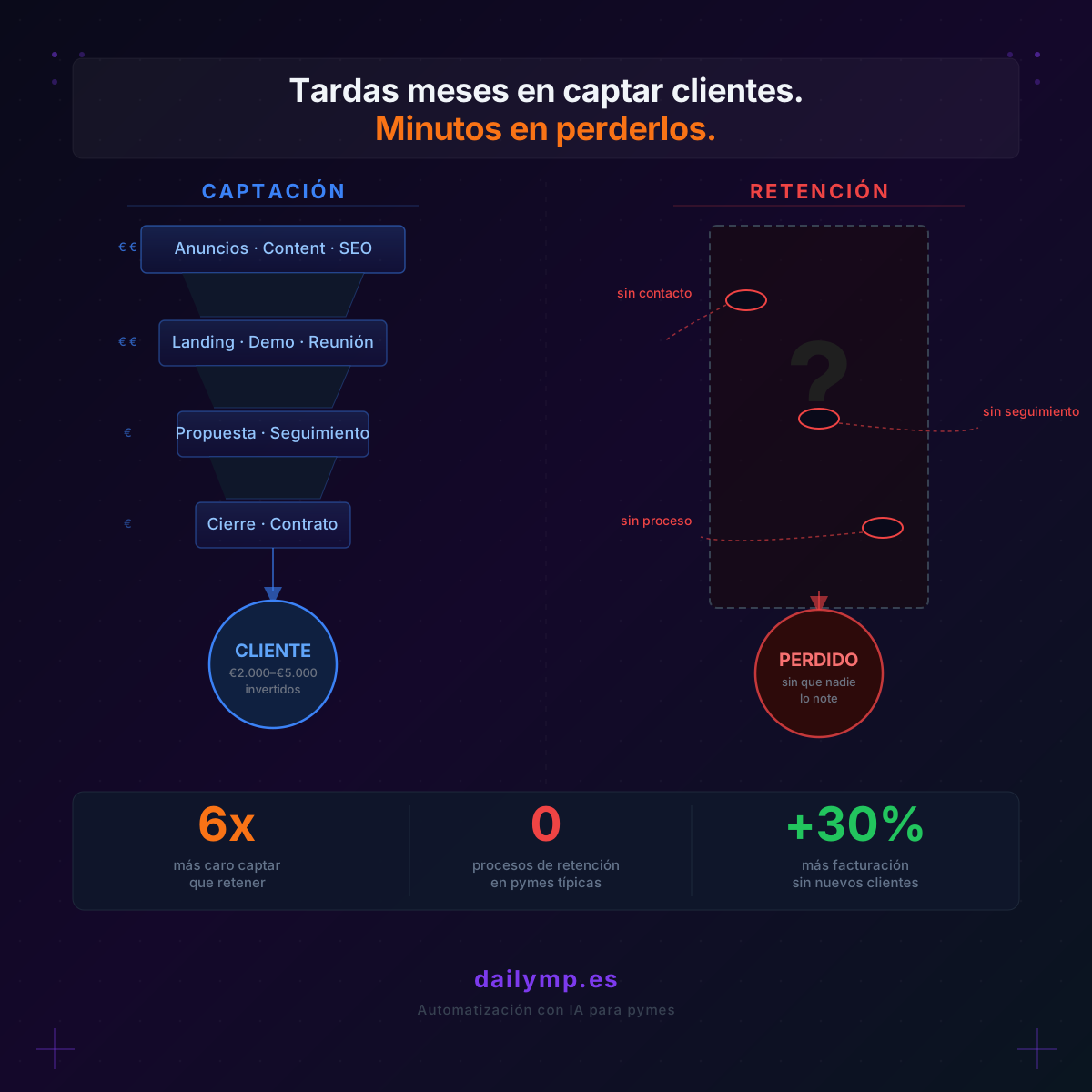
You Spend Months Winning Clients. Minutes Losing Them.
Do this math quickly: how much did your last client cost you to acquire? Ads, meeting time, proposals, calls, the demo you prepared on a Saturday. In a typical small business, that number lands somewhere between €2,000 and €5,000.
Now the second question: that client has been with you for six months. How many times have you proactively reached out to check how things are going?
If the answer is "when they called us" or "I think we sent a Christmas email," you're about to lose that client. And you won't know until it's already too late.
What happens when you have no retention process
Most small businesses have some kind of acquisition process: someone posts on social media, there's a website with a contact form, a salesperson follows up, a proposal goes out, the deal closes. It's not perfect, but it exists.
For client retention, however, the process usually looks like this: nothing.
This isn't negligence. It's that there was never time to build it. Acquisition has immediate pressure — no new clients, no business — while retention always seems like it can wait. Until a client billing €1,500 a month quietly stops without a word.
This is how most SMBs lose clients:
- The client works with you on a project. It goes well.
- Three months pass without anyone reaching out proactively.
- During that time, a competitor makes them an offer.
- The client accepts because they called first — not because they're better.
- By the time you find out, the contract is already signed.
No mistakes. No service failure. Just the absence of a process.
What that absence is actually costing you
There's a number that business consultants quote so often it sounds like a cliché, but it's real: acquiring a new client costs 5 to 7 times more than retaining an existing one.
In practice, this means: if you lose a client billing €1,000 a month, you need €5,000 to €7,000 in acquisition investment just to get back to where you were. Not profit — just breaking even.
And there's something worse than the financial cost. There's an invisible cost that almost nobody measures: the satisfied client who leaves quietly never referred you to anyone. Not because they didn't want to. But because in the six months they were with you without anyone reaching out, they never had the chance.
A client you actively nurture refers others. A client you only contact when there's a problem, doesn't.
The three warning signs of a client who's leaving (that nobody catches in time)
Churn — client loss — is rarely sudden. There are signals that build up weeks in advance. The problem is that without a system to catch them, nobody sees them.
First: the client takes longer to respond. Their emails used to arrive the same day; now they take three. This isn't a scheduling issue: they've started investing their attention elsewhere.
Second: their orders or service usage quietly drop. If you bill by volume or by project, some months they invoice less. Could be seasonality. Could be they're buying the same thing from another vendor.
Third: they stop asking questions. A client who trusts you and wants to keep working with you has doubts, asks for advice, consults you on things. When that flow of questions cuts off, it's because they found another source of answers.
None of these warning signs triggers an alert in a spreadsheet. None of them shows up in your CRM if nobody updates it. They disappear into the noise of daily operations until the client has already made their decision.
How a business with a retention process actually works
You don't need a ten-person customer success team. You need a system that does three basic things without anyone having to remember to do them.
Automated post-project check-in. When a project wraps up, the client gets a message 30 days later asking how everything is going. Not a ten-question survey: a short, direct message. Most people respond. And those responses say a lot.
Silence alert. If a regular client has gone more than 45 days without any interaction — no email, no call, no purchase — someone on your team gets an internal notification. Not to send an invoice: to reach out before the silence turns into churn.
Quarterly review. A 20-minute call every three months to understand how the client is doing, what's changed in their business, and what they might need that they're not currently buying. Not to sell them something — to understand them. The sale follows naturally.
This is exactly what we build with AI agents and automation for small businesses: workflows that do the follow-up for you, connected to your CRM or the tools you already use, without anyone having to remember to run them.
The calculation nobody does until it's too late
Say you have 20 active clients. If you improve your retention rate by just 10% — keeping two clients a year who would otherwise have churned — and each one bills €1,200 annually, that's €2,400 in additional revenue every year without spending a cent on acquisition.
If those retained clients stay for three years instead of one, the number triples. And if those satisfied clients refer even one new client per year, the effect compounds.
Businesses that grow sustainably aren't the ones that acquire the most. They're the ones that lose the least.
With AI integration into your business processes, we build the system that detects those churn signals before they turn into cancellations, and automates the outreach your team doesn't have time to do manually.
How many clients did you lose last year without knowing why? If you don't have that number clearly in mind, that's where to start.