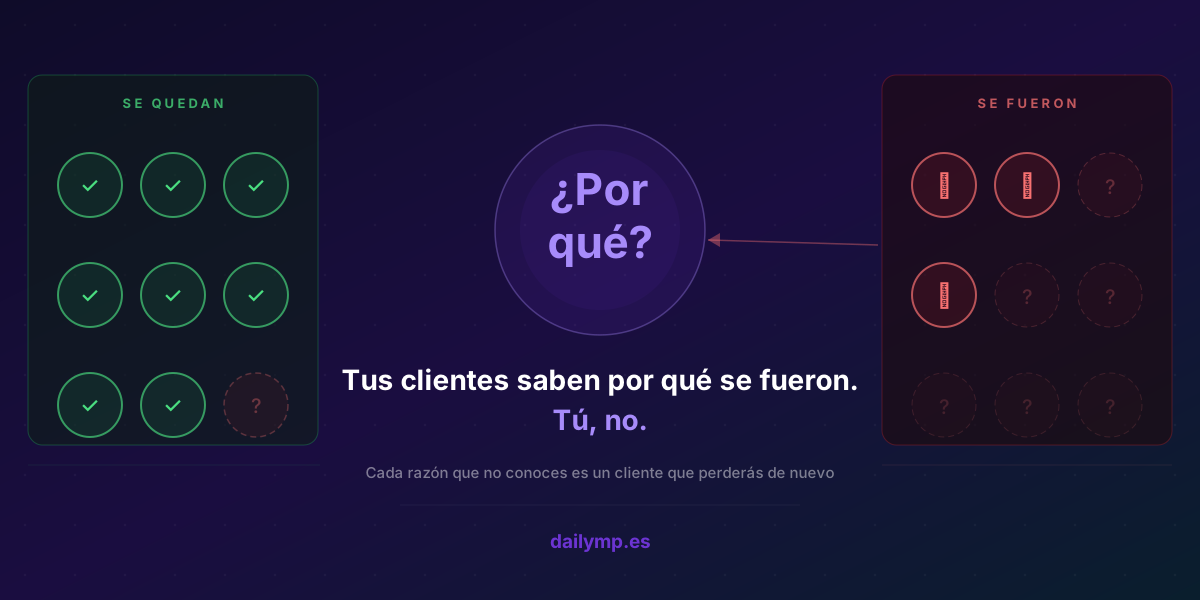
Your Clients Know Why They Left. You Don't.
Last month you lost a client.
Maybe you remember who. Maybe there was a final email with "we've decided to go in a different direction." Maybe they just stopped responding.
What you probably don't know is why.
And that's exactly the problem — not the fact that they left (that happens in every business), but that when it happens, the real reason leaves with them. Your company keeps making the same mistake with the next client, and the one after that, without ever knowing it.
What Happens Before a Client Says Goodbye
Nobody cancels overnight. The decision to leave builds over weeks, sometimes months. There's a moment when the client starts responding more slowly. Then they miss a meeting. Emails get shorter. Orders get smaller.
These are signals. They're happening in your business right now, with some of your current clients.
The problem is that without a system to capture and connect them, nobody sees them. Your project manager knows the last deliverable was eight days late. Your account manager knows the client hasn't opened their emails in two weeks. But nobody connects those two data points. By the time the client sends the formal notice, the decision was made two months ago.
How Much Money Is Behind This Problem
Let's do the quick math.
If you have 40 active clients and charge an average of €3,500 per year per client, you're managing €140,000 in recurring revenue. If you lose 15% of that base annually — a conservative figure for an SME without a retention system — you're losing €21,000 per year.
Not in one go. Silently. One client in January, two in March, one in May.
Now add the cost of acquiring new clients to replace them. Retaining an active client costs 5 to 7 times less than acquiring a new one from scratch. Lose six clients and replace them through active acquisition, and the real cost multiplies significantly.
And if you don't know why they left, you'll lose them again for the same reasons. The cycle repeats.
The Most Common Reasons Are the Easiest to Fix
When companies start systematically asking departing clients why they left — with automated exit surveys, structured follow-ups, data instead of guesswork — what they find is usually this:
- "You took too long to respond." Not hours. Days. And the competition responded same-day.
- "We didn't feel like a priority." Not a product complaint. A relationship complaint.
- "The price went up without a clear explanation." Transparency matters more than you think.
- "When there was a problem, we didn't know who to call." A clear point of contact is worth more than a full service catalogue.
None of these reasons require a revolution in your business. All of them can be solved with better systems and better processes. But only if you know about them.
A System That Warns You Before It's Too Late
The difference between businesses that retain clients well and those that discover churn in the cancellation email is that the former have built a relationship health monitoring system.
This isn't complex technology. It's about connecting the information you already have — unanswered emails, delayed projects, unresolved support tickets, late invoice payments — and having something analyse it and trigger an alert when a client starts showing warning signs.
That's exactly what we build at DAILYMP for clients in recurring service sectors: agents that continuously monitor the health indicators of each client relationship and trigger an action — an email, a task for the team, a scheduled call — when they detect something isn't right.
The team no longer has to manually remember to check when they last contacted each client. The system does it. When there's risk, it alerts. When a client leaves anyway, it automatically captures the reason so you don't lose the next one the same way.
If you want to see how this fits with your current systems, in AI Integration we connect these signals with whatever you're already using: your CRM, your project tool, your email.
What You'll Learn When You Start Asking
When businesses implement a system like this, the first thing they discover is that lost clients weren't inevitable — they were preventable.
There's a pattern in almost every churn case: the client tried to communicate that something wasn't working — through their behaviour, if not their words — and nobody caught it in time. Not because the team didn't care, but because there was no system watching.
Once that information flows, it improves everything: delivery processes, response times, price communication, post-sale follow-up. The clients who stay notice too.
Not Every Departing Client Comes Back
There's something retention systems can't return: the time that passed while the client was deciding to leave and you didn't know.
That's the time when you could have acted. When a call, an adjusted offer, or simply acknowledging there was a problem and committing to fix it would have changed the outcome.
Not every departing client comes back. But many of those who were close to leaving would have stayed if someone had paid attention in time.
Curious how many of your current clients are in the risk zone right now?
Message me on WhatsApp and let's talk. No cost, no commitment. In 30 minutes I'll tell you whether it makes sense to build something like this for your business and what data we'd need to get started.