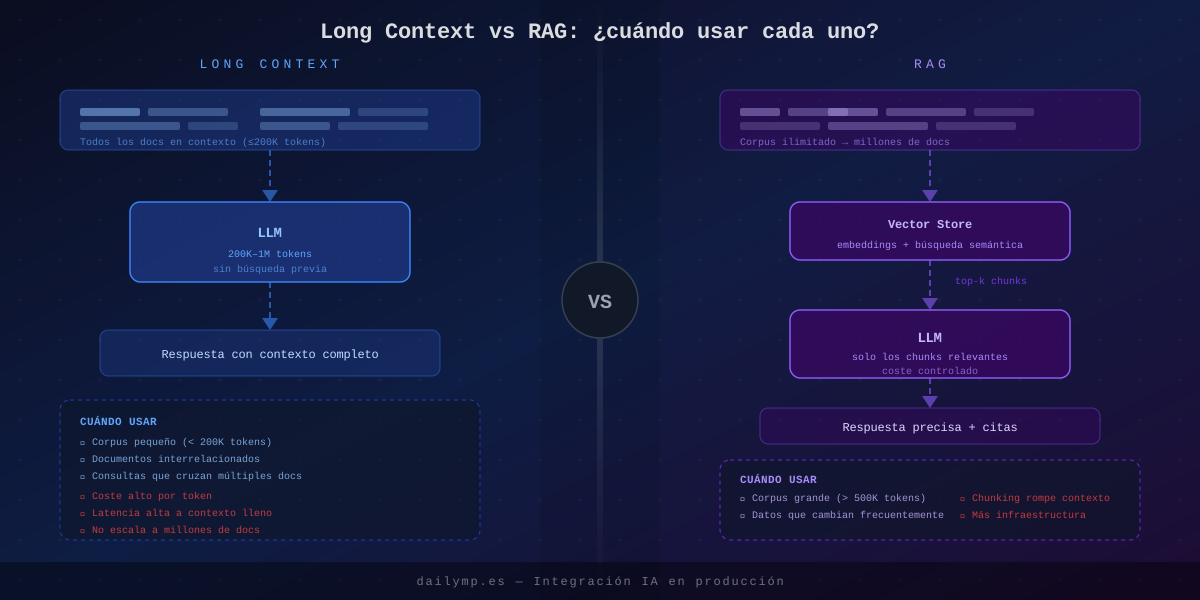
Long Context vs RAG: When to Use Each in 2026
You built the RAG pipeline because context was short. Now you have models with 200,000 tokens — some with a million. Do you still need the embeddings pipeline, the vector store, and the retrieval step?
The honest answer: sometimes yes, sometimes no. And choosing wrong isn't neutral. An unnecessary RAG adds latency, infrastructure cost, and an extra failure point. A poorly calibrated long-context window charges you in tokens what you could recover with ten lines of code.
This is the decision framework we apply when auditing agent architectures in production.
Why This Question Matters More Now
Until 2024 the choice was simple: models had 4,000 or 8,000 tokens of context. Fitting a knowledge base was impossible. RAG was the only option.
In 2026 the situation changed:
- Claude 3.x and 4.x: 200K token context
- GPT-4o and Gemini Pro: 128K–1M tokens
- Open-source models: Llama 3.1 with 128K
The practical consequence is that many systems running RAG today could be dramatically simplified if the corpus fits in context. But "fits" isn't the only criterion.
The Decision Tree We Use
Before writing code, answer these four questions in order:
1. How large is the full corpus in tokens?
If it fits in the model's context with margin (leave at least 30% free for the response and conversation history), long context is the first option to evaluate.
Rule of thumb: a 50-page PDF is roughly 20,000 tokens. 200 pages of technical documentation sits around 80,000 tokens. A mid-sized company knowledge base typically runs between 50,000 and 500,000 tokens.
2. How often does the data change?
If documents update in real time (prices, inventory, active contracts), long context requires rebuilding the context on every request. RAG lets you incrementally index only what changed.
3. How many concurrent queries do you expect?
A 200K token context costs more than a 4K one. At 100 requests/hour the cost is manageable. At 10,000 requests/hour, long context can run ten times the cost of RAG, because RAG only sends relevant chunks into context.
4. Do queries need to cross information from multiple documents?
This is where long context wins clearly. RAG's semantic search retrieves isolated chunks. When the right answer requires connecting data across three different documents, a model with full context does it better than one that received three disconnected fragments.
Long Context: When It's the Right Answer
Long context wins when:
- Small, stable corpus: product manuals, SLAs, internal documentation that rarely changes. Load it once into context and you're done.
- Queries requiring a global view: "Which contracts include a penalty clause for delays?" requires reading all contracts, not retrieving one.
- Teams without data infrastructure: if you don't have a vector store set up or time to maintain one, long context is a zero-component pipeline.
- Prototypes and MVPs: setting up RAG takes days. Long context takes minutes.
import Anthropic from "@anthropic-ai/sdk";
import { readFileSync } from "fs";

const client = new Anthropic();

async function queryWithLongContext(
  corpusFiles: string[],
  question: string
): Promise<string> {
  // Load all documents into a single context block
  const corpus = corpusFiles
    .map((f) => {
      const content = readFileSync(f, "utf-8");
      return `<document source="${f}">\n${content}\n</document>`;
    })
    .join("\n\n");

  const response = await client.messages.create({
    model: "claude-opus-5-5",
    max_tokens: 4096,
    system: `You are a specialized assistant. Answer ONLY with information present in the provided documents. If the information is not there, say so explicitly.`,
    messages: [
      {
        role: "user",
        content: `${corpus}\n\n---\n\nQuestion: ${question}`,
      },
    ],
  });

  return response.content[0].type === "text" ? response.content[0].text : "";
}
RAG: When It's Still Necessary
RAG is the right answer when:
- Large corpus: more than 300,000–500,000 tokens. Beyond that, the per-query cost of long context starts to become prohibitive.
- Frequently changing data: new clients, contracts signed every week, product catalogs that update continuously. Incremental indexing is far cheaper than rebuilding the full context.
- High query volume: with hundreds of concurrent users, RAG dramatically reduces cost per query by only sending relevant chunks into context.
- You need exact source citations: RAG retrieves chunks with source metadata. It's easy to return "per contract X, clause 4.2…". With long context you can ask the model to cite, but precision is lower.
The most common mistake we see in audits: teams building RAG for 50 internal documents that rarely change. They're paying for infrastructure they don't need.
You can see the chunking mistakes that silently break RAG pipelines in production in the article on RAG pipelines that fail in production.
The Hybrid Pattern: Best of Both Worlds
For medium-sized corpora (100K–2M tokens) with queries requiring cross-document reasoning, the pattern that performs best in production is the hybrid one:
- RAG retrieves the K most relevant documents (not chunks — full documents or long sections)
- Those documents are placed in full context for generation
import Anthropic from "@anthropic-ai/sdk";

interface Document {
  id: string;
  content: string;
  score: number;
}

async function hybridQuery(
  vectorStore: { search: (q: string, k: number) => Promise<Document[]> },
  question: string,
  topK = 5
): Promise<string> {
  const client = new Anthropic();

  // Step 1: RAG retrieves the most relevant documents
  const relevantDocs = await vectorStore.search(question, topK);

  // Step 2: full documents go into context (not just chunks)
  const context = relevantDocs
    .map((doc) => `<doc id="${doc.id}" relevance="${doc.score.toFixed(2)}">\n${doc.content}\n</doc>`)
    .join("\n\n");

  // Step 3: generation with rich context
  const response = await client.messages.create({
    model: "claude-sonnet-5-5",
    max_tokens: 2048,
    messages: [
      {
        role: "user",
        content: `Relevant documents:\n\n${context}\n\n---\n\nQuestion: ${question}\n\nAnswer based ONLY on the documents above. Cite the document id when you use information from it.`,
      },
    ],
  });

  return response.content[0].type === "text" ? response.content[0].text : "";
}
This pattern avoids bad chunking problems (the document arrives in full) and controls cost (only relevant documents enter context).
The Most Common Architecture Mistake
The problem we find most often: using RAG out of habit. The team sets up the vector store because "that's how it's done," without measuring whether the corpus fits in context.
The second most common mistake: using long context without cost controls. Sending 180,000 tokens on every request from a chatbot receiving 5,000 daily queries can cost ten times the budget.
The right decision requires measuring first: actual corpus size, update frequency, query volume, and per-response budget. From there, the architecture follows naturally.
If you're building an agent that needs to access internal documentation and aren't sure which pattern to use, at DAILYMP we do the architecture audit before writing code.
Conclusion: No Universal Answer
Long context didn't kill RAG. RAG isn't always the "serious" answer. The right architecture depends on corpus size, update frequency, query volume, and budget.
What is universal: choosing without measuring is expensive. The cost of three hours of analysis is always less than dismantling the wrong architecture three months later.
Building a document query system and not sure which pattern makes sense? Tell me the case — let's talk on WhatsApp and in 30 minutes I'll tell you what makes most sense for your situation.