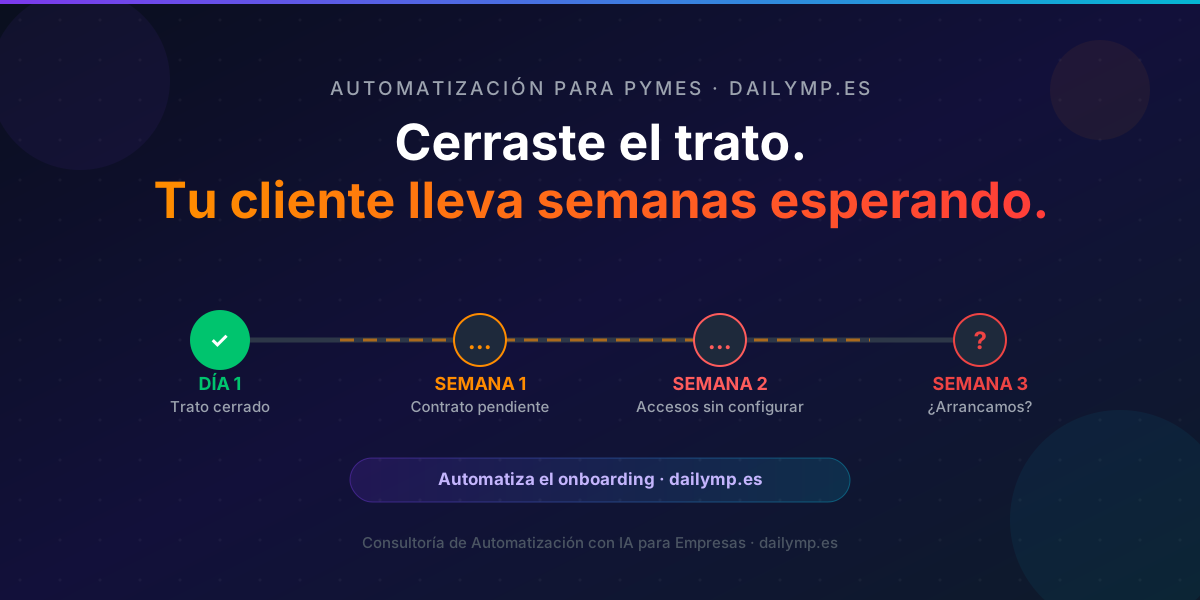
You Closed the Deal. Your New Client Has Been Waiting Weeks.
You signed the contract on Friday. The client was happy. You were happy. You mentally celebrated.
Monday came back with five urgent things on your plate. The following week you had a presentation. By the time you remembered to send the final contract for signature, four days had gone by. And since then, your new client has been waiting — with no clear idea of when the work they paid for actually starts.
What Actually Happens in the Days After Signing
Closing a deal feels like the end of the process. It isn't. It's the start of an obstacle course that most small businesses handle manually, step by step, whenever someone finds the time:
- The contract gets drafted and emailed (if you're lucky, same day)
- The client signs digitally — or prints, signs, scans, and sends back
- Someone manually sets up the client in your systems (CRM, project tools, access)
- You search for a time slot for the kickoff call
- A welcome email goes out with everything the client needs to know
Each step requires a person. And that person is already doing other things.
The result: something that could be done in hours turns into weeks.
What Your Client Experiences During That Wait
Your client's experience is very different from yours.
Day 1: They signed. They're excited. Expectations are high.
Day 4: Nothing else has come through. They start asking their team when things kick off.
Day 8: There's an email from you saying you'll "be in touch soon." The first-day excitement is already cooling.
Day 14: In their next team meeting, someone asks "how's that new vendor working out?" The answer: "still waiting."
When work finally starts, the client doesn't show up with enthusiasm. They show up already feeling like they had to chase you. The first impression has already been made — and it isn't the one you wanted.
What This Is Actually Costing You
The visible cost is easy to calculate: if you bring on three new clients per month and each manual onboarding takes two hours of coordination — contracts, access setup, scheduling — that's six hours a month on admin that doesn't need to exist.
The invisible cost doesn't show up in any report:
- Clients who start on edge are harder to retain. The first month sets the tone for whether they'll renew or quietly look for alternatives next year.
- Clients who sense disorganization from the start are more likely to question your pricing, your process, and your value.
- Clients who felt like they had to chase you mention it in reviews, or quietly share it with peers in their industry.
A single client who churns before the project even gets off the ground can far exceed the cost of automating the entire process.
How Automation Solves It
An automated onboarding process doesn't mean cold or impersonal. It means the mechanical parts run on their own, and you focus on what actually requires your attention.
Here's what can be automated:
Contract and e-signature: The moment a deal is confirmed, the system generates the contract with the client's details and sends it to be signed. No one has to prepare it manually.
System setup: Once the contract is signed, the client is automatically added to the relevant tools with the right access and permissions configured.
Welcome email: On the same day as signing, the client receives a personalized email with everything they need to know: what comes next, who they'll be working with, how to communicate.
Kickoff scheduling: A calendar booking link is included in the welcome email. The client picks a slot directly — no back-and-forth "when works for you?" emails.
Automatic follow-up: If the client hasn't booked the kickoff call after three days, the system sends a reminder. Without anyone having to remember.
All of this can be ready before Monday morning if you closed a deal the previous Friday. And for the client, the experience is completely different — they signed and within minutes everything was in motion.
If you want to see how this works in practice, AI Integration connects your existing tools so this process runs automatically from day one. And if your business still handles most processes manually, it's worth reading which processes to automate first to focus where the impact is fastest.
The Difference the Client Feels (and the One You Feel)
For the client, the message is clear: this business has its act together. They don't second-guess their decision. They don't have to chase anyone. They start with confidence.
For you, the message is equally clear: every new client follows the same process, regardless of whether someone had time that week. No "I forgot to send the access credentials." No kickoff meetings delayed three weeks because calendars were impossible to align.
Onboarding isn't an administrative chore. It's the first real experience your client has with you. If that experience means waiting two weeks with no news, you're starting at a disadvantage.
Do you have new clients coming in each month and the kickoff process is always a scramble? Tell me how you have it set up now and I'll tell you what can be automated without changing the tools you already use.