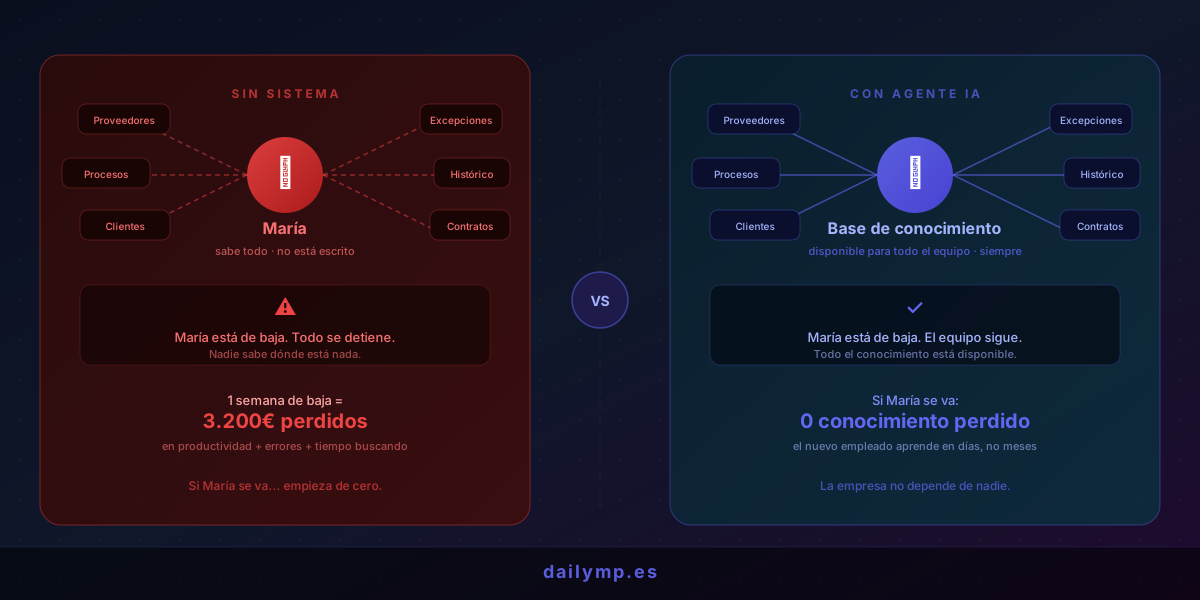
When Sarah's Out, Your Business Grinds to a Halt
There's someone in your company who knows how everything works.
They know which format Client A prefers for invoices. They know which supplier to call for urgent orders and have the number memorized. They know that international clients get a different billing process, and why. They know where the 2021 contract is that nobody digitized. They know the exact steps when a damaged order comes in.
None of it is written down anywhere. It doesn't need to be, because Sarah's there.
And the problem starts the day Sarah calls in sick.
What one week without Sarah actually costs
This isn't an exaggeration. It's a simple calculation.
When Sarah's out, everyone else takes twice as long to do what she does in half the time. Questions that normally go to her start bouncing around: emails, WhatsApp messages, back and forth between departments. Someone makes a decision without the right context. Someone else decides not to touch anything until she's back.
Urgent orders get delayed. A client calls and nobody can answer confidently. An invoicing error happens because no one knew about the exception that always applies to that client.
One week of absence from a key employee costs a small business between £2,000 and £4,000 — in lost productivity, mistakes, and the time the rest of the team spends searching for what Sarah would know in seconds.
And that's just one week.
The scenario nobody wants to calculate: Sarah leaves
Being out sick is uncomfortable. Resignation is a disaster.
When a key person leaves, they take years of accumulated knowledge with them. The client relationships they cultivated. The process shortcuts only they knew. The exceptions, the informal agreements, the "we always do it this way because of what happened with Acme back in 2022."
Their replacement takes three to six months to reach half their performance. During those months, someone has to cover. Clients notice the change. Mistakes that didn't happen before start happening.
The real cost of a key person leaving a 10-20 person business is £15,000–£30,000 when you add up recruitment, training, lost productivity, and the problems generated during the transition.
Nobody calculates it because it's spread across months, buried in salaries and other people's time.
Why the knowledge never gets documented
It's not that nobody wants to do it. It's that something more urgent always comes up.
Sarah is busy doing her job. She doesn't have time to write manuals. When there's time, it's always for something else. The processes keep accumulating in her head because it works, and because it works, nobody changes it.
Every time someone new joins, Sarah explains things in person. It works in that moment. But nothing gets recorded. The next time someone new joins, Sarah explains the same things again from scratch.
This has a name: key person dependency. It's one of the most common operational risks in small businesses, and one of the least managed.
How an AI knowledge base works
The solution isn't asking Sarah to sit down and write manuals for three weeks. That doesn't work.
What does work is a system that captures knowledge while Sarah works — passively:
- Extracts procedures from existing emails, chats and documents
- Organizes information so anyone on the team can access it
- Answers questions like Sarah would: "How do we invoice international clients?" → instant answer, based on what's always been done
- Updates automatically when processes change
The result: Sarah's knowledge moves out of her head and becomes available to the whole team. When Sarah's out, the team keeps going. When Sarah leaves, the new hire has access to everything they need from day one.
Not months of learning. Days.
If you want to see how this applies to your business, the AI agents and automation service includes this type of integration for teams that need to preserve and distribute operational knowledge.
Who is your company's Sarah?
Think about it for a moment.
Maybe they go by a different name. Maybe there are two or three different Sarahs, each with their own piece of knowledge. Maybe it's you — you're the one who knows everything and the team depends on you.
What would happen if that person wasn't available for two weeks starting tomorrow?
If the answer turns your stomach, the problem already exists. It just hasn't exploded yet.
The fix isn't complex or expensive. With the right AI integration, it can be in place within days — before it becomes urgent.
Let's talk before Sarah leaves and we have to build everything under pressure. Message me on WhatsApp →