You Run Out of Stock Right When You Need It Most
It's 11am on a Thursday. A regular customer walks into your shop or messages you on WhatsApp asking for your best-selling product of the season. You check the warehouse and there it is: zero stock.
The reorder was placed last week, but your supplier takes 10 to 15 days. Black Friday is two weeks away. And your customer just left to find the product somewhere else.
The problem with manual stock management
Most small businesses manage inventory in one of two ways: someone "roughly knows" how much is left of each thing, or someone updates a spreadsheet when they remember to.
Neither works when sales pace picks up — which is exactly when having stock matters most.
The cycle is always the same:
- Stock gradually drops over weeks
- Nobody sees it because there are no automatic alerts
- On the last day with product available, someone discovers it when a customer asks
- An emergency order gets placed, with rush shipping costs and delivery uncertainty
- During those 10–15 days of waiting, you lose sales that go straight to competitors
And it gets worse: during peak season, suppliers also face their own stock challenges. An emergency order in November can take longer than usual.
What a stockout actually costs (in real money)
Let's run the numbers most businesses never calculate.
If your best-selling product averages €200 per order and sells 3 units a day, one week out of stock is €4,200 in lost sales. Just that product. Just that week.
But the real impact goes beyond that one sale. When a customer can't find your product:
- In 40% of cases, they buy from a competitor and don't come to you first next time
- During Black Friday or Christmas, purchase urgency means they buy from whoever has stock, not from whoever has the best relationship
- For repeat customers, a stockout damages the trust that you'll always have what they need
The cost isn't just the lost sale. It's the long-term relationship that breaks.
The warning signs your stock management has a problem
Before a stockout happens, there are signals nobody catches in time:
- Inventory only gets updated when "someone remembers" or during the monthly count
- Purchase decisions are based on gut feel: "we probably need around X units"
- No system alerts you when a product drops below a minimum level
- Emergency orders are routine, not exceptional
- Your team discovers stockouts when a customer mentions it, not before
If you recognise two or more of these, your business is managing stock reactively — acting after the problem has already happened, not before.
How an AI agent solves this
An inventory management agent doesn't replace your current system: it connects to it.
If you use sales software, an ERP, a point-of-sale system or even a well-structured spreadsheet, the agent can read the data in real time and work with it.
What it does in practice:
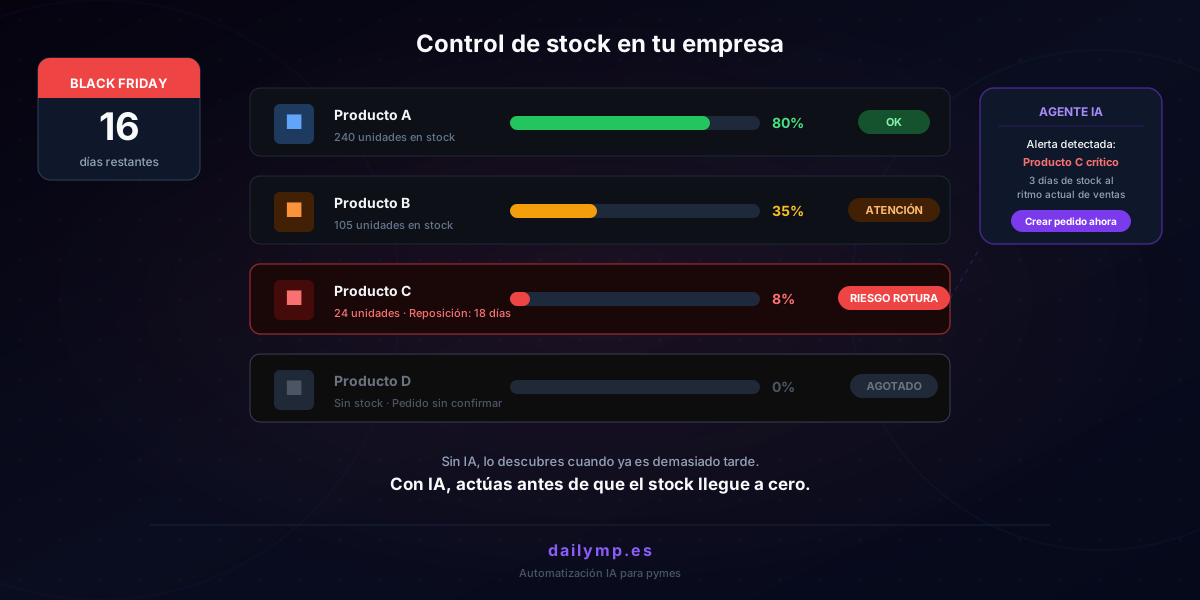
- Monitors stock levels for each product continuously, not just when someone looks
- Calculates the consumption rate based on recent sales, not rough estimates
- Forecasts when each product will run out if current sales continue at the same pace
- Automatically alerts you when a product is X days from running out, with enough lead time to place the order before it's too late
- With full integration: generates a draft purchase order that only needs your approval, not manual creation from scratch
The result: you stop discovering stockouts when it's already too late and start preventing them with enough time to act.
In our AI integration projects, the first thing we do is understand what inventory system the business already uses. In most cases, nothing needs to change — we just connect what's already there. For more complex scenarios — multiple warehouses, several suppliers, products with different reorder lead times — automation agents can handle that logic in a fully customised way.
November is the moment to do this
Black Friday is two weeks away. Christmas is six weeks out. These are the two seasons where stockouts have the highest impact, because demand rises, your competitors have their own supply issues and customers don't wait: they buy wherever the product is available.
Manual management works when the pace is steady. In peak season, the margin for error shrinks and the cost of a mistake multiplies.
If your business carries physical inventory and the control is manual, get in touch. In 30 minutes we can see whether it makes sense to connect what you already have to an automatic alert system before the peak season hits.