You've Paid for Marketing a Year. How Many Clients Did It Bring?
At the end of the month your agency sends the report. Eight pages. Impressions charts, reach bars, CTR is up 12%, engagement is looking good. Nice PDF, positive summary.
You read it. You nod. And somewhere the next day you realise you still don't know the one thing that matters: how many paying clients did that money actually bring in?
The question nobody answers
You've been spending money on ads, an agency, or marketing tools for months — maybe over a year. It could be €500 a month, could be €2,000. The number doesn't matter for this point.
The question is simple: of all the clients you closed in the last six months, how many came from each channel? What did it cost you to bring each one in?
That's called Customer Acquisition Cost, or CAC. It's the most important number in any business's marketing. And most small businesses don't know it.
Not because they don't want to. Because to calculate it you need to connect four things that live in four different places that nobody has ever connected:
- Google Analytics or equivalent: tells you how many people visit your site and where they come from
- Meta Business Suite: tells you how many people saw and clicked your Facebook or Instagram ads
- Your CRM or contact list: where you store leads who asked for information
- Your invoicing tool: where you can see who actually paid
Four systems. Four separate dashboards. And between them, a black hole where the data you need to know if your marketing is working disappears.
What's probably happening without you knowing
Without that connection, there's a pattern that repeats across many businesses:
You have one channel that brings lots of visits or clicks but very few paying clients. It looks great in the report, but it costs you money with no return.
And you have another channel — maybe SEO, maybe client referrals, maybe a specific type of content — that brings fewer visits but much higher conversion. That's where your business engine actually is.
The problem is you don't know which is which. So you keep investing in both equally, or in whichever one looks better in the report, even if it's not the one that converts.
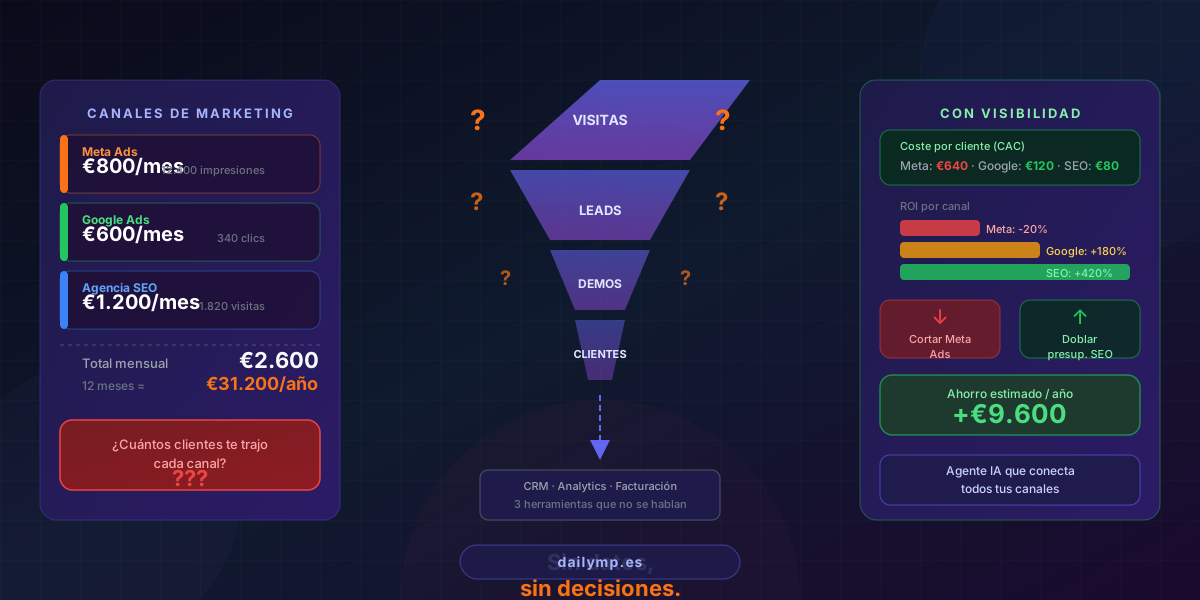
Concrete example. Imagine you spend €800/month on Meta Ads and €600/month on Google Ads. Over a year that's €16,800. If I ask you at year end how many clients you closed thanks to Meta and how many thanks to Google — can you tell me?
If the answer is "roughly" or "I think Google works better but I'm not sure", you're making €16,800 investment decisions in the dark.
The calculation that changes everything
CAC isn't a complicated metric. It's a division:
Money spent on a channel ÷ Clients that came from that channel = Cost per client
If Meta costs €800/month and brings you 1 new client on average: your Meta CAC is €800. If that client pays €400 for your service: every euro you put into Meta gives you back 50 cents. Negative.
If Google costs €600 and brings you 5 clients: your Google CAC is €120. If those clients each pay €400: every euro you put into Google gives you back €3.30. Positive.
Same budget, completely different result. And without connected data, you're putting equal effort into both.
This kind of visibility is exactly what we build at DAILYMP with the AI marketing and SEO agent: not just automatic posting, but the connection between what gets published and what actually converts.
Why nobody measures this even when they want to
It's not lack of motivation. Connecting those four systems manually takes time you don't have, technical knowledge you probably don't want to learn, and the discipline to do it every month without letting it slip.
Marketing agencies have their own metrics. They measure what makes them look good: impressions, reach, clicks, engagement. That's not dishonest — it's just what their tools can measure. What converts to a paying client lives in your CRM and your invoicing tool, which they don't see.
The result is a gap between what marketing measures and what the business actually needs to know.
You can see in detail how AI integration works with your existing business tools: the goal is exactly this — making the data you already have start talking to each other.
What changes when you do have the data
When you have CAC by channel, marketing decisions become straightforward:
- If Meta costs €640 per client and Google costs €120, you cut or reduce Meta and move that budget to Google.
- If SEO takes longer but each SEO client costs €80, you invest more in content and positioning.
- If referrals from existing clients have a CAC of €0 (because they're free), you build a system to generate them actively.
No need for a marketing degree. You just need to see the number.
And with connected systems, that number can be available every week automatically: which leads came in, where they came from, how many closed, what each one cost.
How much have you spent without knowing it?
Do the exercise before reading further. Add up what you've spent over the last twelve months across ads, agency, and marketing tools. Add the new clients you've closed in that period.
Now divide.
If you can't do that division because you don't have the data broken down by channel, you already have your answer about whether you need this.
Many businesses discover when they do this for the first time that they're spending between 30% and 50% of their marketing budget on channels that don't convert, while the ones that do work keep getting the same investment as always.
Message me on WhatsApp and in 30 minutes we'll look at what data you have, what's missing, and what it would take to have that number clearly every week.
No need to change your agency or throw out your existing marketing. You just need to know which part of what you're doing is working — and which part isn't.