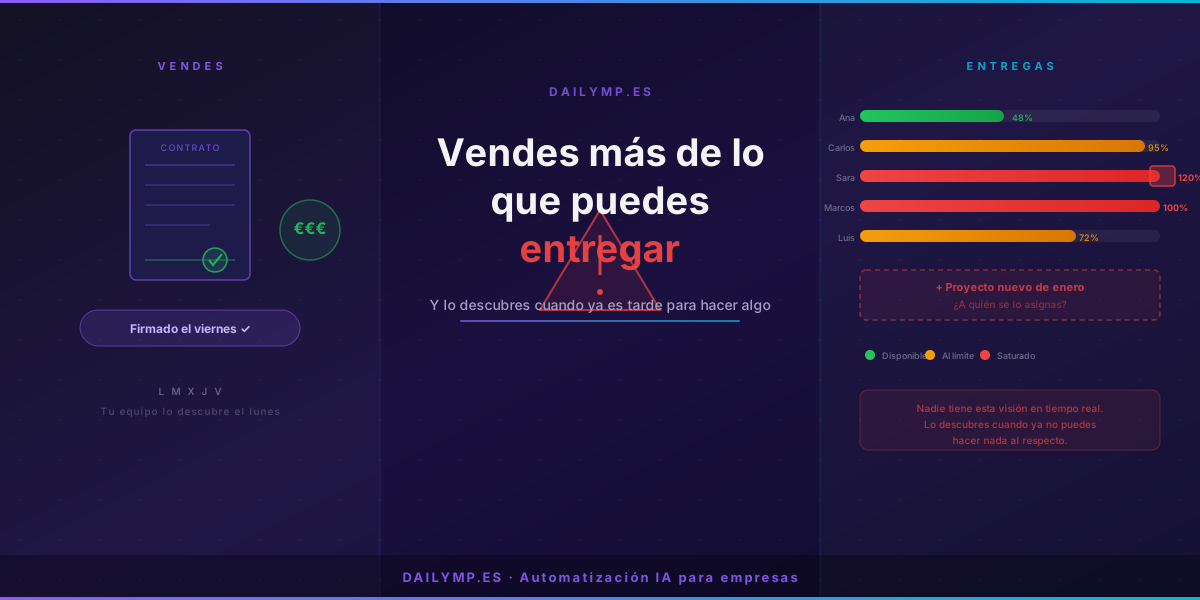
You're Selling More Than You Can Deliver
Friday: you close the best deal of the month. You sign, exhale, and head into the weekend feeling like things are finally clicking.
Monday morning: your team finds out they have a new project starting in January.
Nobody had the conversation beforehand. Nobody checked if there was room. Nobody knows exactly how many hours each person has committed over the next few weeks. It works because it always has — until it doesn't.
The problem isn't lack of work
Most small business owners I know don't have a demand problem. They have clients, projects, and opportunities. The problem is something else: they don't know in real time what capacity their team has to actually deliver what they're selling.
Each new commitment looks reasonable in isolation. Two weeks of work for Ana. A one-month project for Carlos. Something short-term for Sara. The problem surfaces when Ana, Carlos and Sara are already deep into existing commitments and nobody has the full picture.
The team's workload is scattered across:
- Emails and WhatsApp messages where deadlines were agreed informally
- Meetings that left no useful record
- The mental map of whoever leads each department
- A spreadsheet nobody has updated in three weeks
And so, without anyone making a consciously bad decision, the team reaches its limit. Not suddenly — gradually, week by week, until the Monday before a deadline someone says they won't make it.
What it's costing you that doesn't show up anywhere
This problem has a real cost, even if it never appears in your financials.
Late deliveries. Not because the team is slow or incompetent — but because when the project was accepted, there was no room for the unexpected. Clients notice. They don't always say it, but they remember.
Rushed work. When time runs short, quality suffers. Reviews that don't happen, details that get skipped, communications that fall behind. The client pays the same and gets less.
Burned-out team. A team that hits Friday after three weeks at capacity is not the same team that starts the next stretch with energy. Performance drops, errors go up, and turnover increases.
Deals you turn down out of fear. This is the one that hurts most and shows up least: when you have no data, instinct says no. But sometimes there's more capacity than it seems, and you lose projects you could have handled comfortably.
Add all that up and you're looking at somewhere between 15% and 25% of your revenue, conservatively.
Why the usual solutions don't work
The natural reaction is to install something. Trello, Asana, Notion, whatever. The problem isn't the tool — it's the model.
Task management tools track work at the task level. They're useful for knowing whether a specific task is done or not. They don't tell you whether Sara has capacity to take on three parallel projects next month.
Weekly standups have the same problem: they give you a snapshot of today that's already outdated by midweek. And they cost everyone's time to produce that snapshot.
Planning spreadsheets work well on the day someone updates them. They last exactly until that person has a rough week and stops updating them.
What's missing isn't another task tool. It's an aggregate view of load and capacity that updates itself, without anyone having to dedicate time to it.
What changes when you have real visibility
When an AI agent connected to your tools has access to your project system, it can answer the question that matters most at any point: how much can the team take on next month?
Not as a rough estimate. As data.
The agent cross-references each person's open tasks, committed deadlines, historical hours per project type, and the upcoming calendar. It tells you who has capacity, who's close to the limit, and how many hours of new work you can accept before compromising current deliveries.
What changes in practice:
- Before signing a contract, you have data. Not intuition — data. You know whether there's room for that January project or whether you need to negotiate timelines before closing.
- When someone gets sick or something unexpected comes up, the system alerts you before the problem reaches the client. You have days to reassign, not hours.
- At month close, you see which projects consumed more than expected and which consumed less. That feeds better estimates next time.
This doesn't require your team to change how they work or learn a new tool. The data infrastructure reads what already exists — your project system, calendar, the tools you're already using — and builds the visibility layer on top.
The difference between growing and choking on growth
Some businesses grow with clarity. At any point, they know what they're taking on, whether they can handle it, and what they'd need in order to handle more. They say yes when it's right and no when it isn't — and neither answer is a guess.
Other businesses grow in lurches. Every strong quarter is followed by a quarter of firefighting. The team hits its limit, quality slips, and the founder shifts from selling to managing crises.
The difference almost never comes down to the volume of work or the team's talent. It comes down to whether someone has the full picture or not.
Is your business making sales decisions based on real capacity data, or on intuition and hope?
If you want to see how this works for a company like yours, let's talk on WhatsApp. Thirty minutes to find out whether it makes sense for your team.