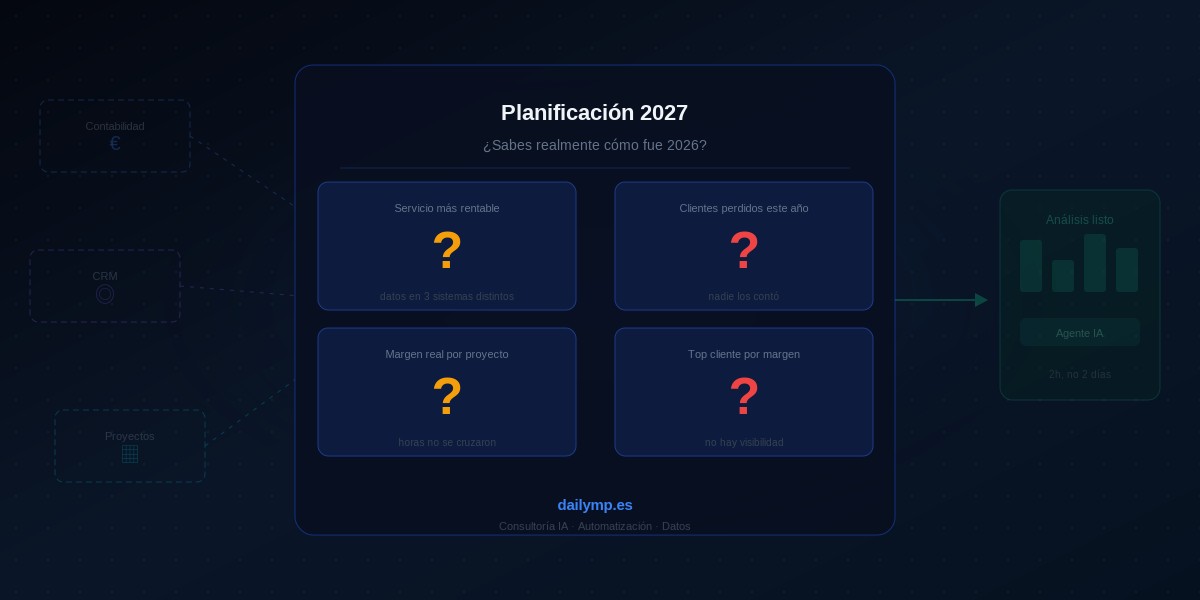
Planning Next Year Without Knowing How This One Went
December is almost here.
At some point in the next few weeks, you'll need to sit down and think about next year. What to sell, where to grow, where to invest. Maybe you'll call a strategy meeting. Maybe you'll open a new spreadsheet with an "objectives" tab.
Before you do any of that, answer one question: do you actually know how this year went?
Not roughly. With numbers.
What You Don't Know About Your Own Business
Most business owners go quiet when I ask these questions:
Which was your most profitable service this year? Not the one that billed the most — the one with the highest margin after subtracting team time and direct costs.
How many clients did you lose between January and now? Not just the ones who formally said goodbye. Also the ones who simply stopped buying.
What process ate the most team hours this year? Not the one that felt most chaotic — the one that consumed the most actual time.
Which three clients gave you 50% of your revenue? And do you know why?
If you can answer all four of those right now with real data, your business is in better shape than you think. If you have to say "roughly," "I think," or "we'd have to look it up" — you're about to plan next year on a foundation of guesswork.
Why You're Planning Blind
It's not your fault. Your data lives in five different places and nobody has time to bring it together.
Billing is in the accounting tool. Clients are in the CRM — or a spreadsheet, or two. Hours are in another tool, or in everyone's head. The real cost per project was never calculated properly, because by the time one project ended there was already another one waiting.
The result: every year you plan with the same four sources — what you remember, what you billed in gross terms, what you feel went well, and what went so badly you can't forget it.
That's not planning. It's intuition with a spreadsheet on top.
What It Costs to Plan Without Data
The cost isn't always visible, but it's there.
You invest in what feels like it's working, not what's actually working. If you don't know your most profitable service, you're probably putting time and money into the one that sells most — which isn't the same as most profitable.
You hire when you feel overwhelmed, not when data shows you need someone. The difference is months of salary paid too early, or months of chaos because you hired too late.
You renew the same tool and vendor contracts by inertia. Without seeing the real return on each line item, you can't know what's giving you value and what's a cost that keeps renewing because nobody questioned it.
And the hardest to see: you make growth decisions based on the story you tell yourself about the year, not the story the year actually had.
What Business Planning Should Look Like
A proper planning session should take two hours, not two days.
It should start with a year summary already prepared: clients won and lost, revenue by service line, real margin per project, team hours crossed with what got billed. With that data on the table, decisions become conversations — not debates over whether the numbers are even correct.
The gap between that scenario and yours isn't a question of company size. It's a question of having a system that takes the information you already have — scattered across different tools — and turns it into something you can read in ten minutes.
What an AI Agent Does With Your Business Data
This is exactly what AI-powered systems integration solves: connecting the tools you already use and making them talk to each other.
An AI agent connected to your accounting, your CRM, and your project tool can answer real questions:
- "Which was the most profitable client between January and October?"
- "Which service had the highest margin this quarter?"
- "How many clients who started in 2025 are still active today?"
- "How many hours did the biggest project of the year cost versus what got billed?"
You don't need a complex dashboard or a data analyst. You need something that connects the dots you've had separate for years.
What Changes When You Have the Data
Imagine walking into your December planning meeting with this already prepared: one page with the five numbers that matter most from your year — the real ones, not the approximate ones.
How many different decisions would you make?
This isn't a luxury for large companies. It's the minimum you need to stop repeating in 2027 the same mistakes you made in 2026 without knowing you were making them.
If you want to arrive at December with this year's analysis ready before you start planning next year, let's talk this week on WhatsApp.
Don't arrive in January still saying "I should know this and I don't."