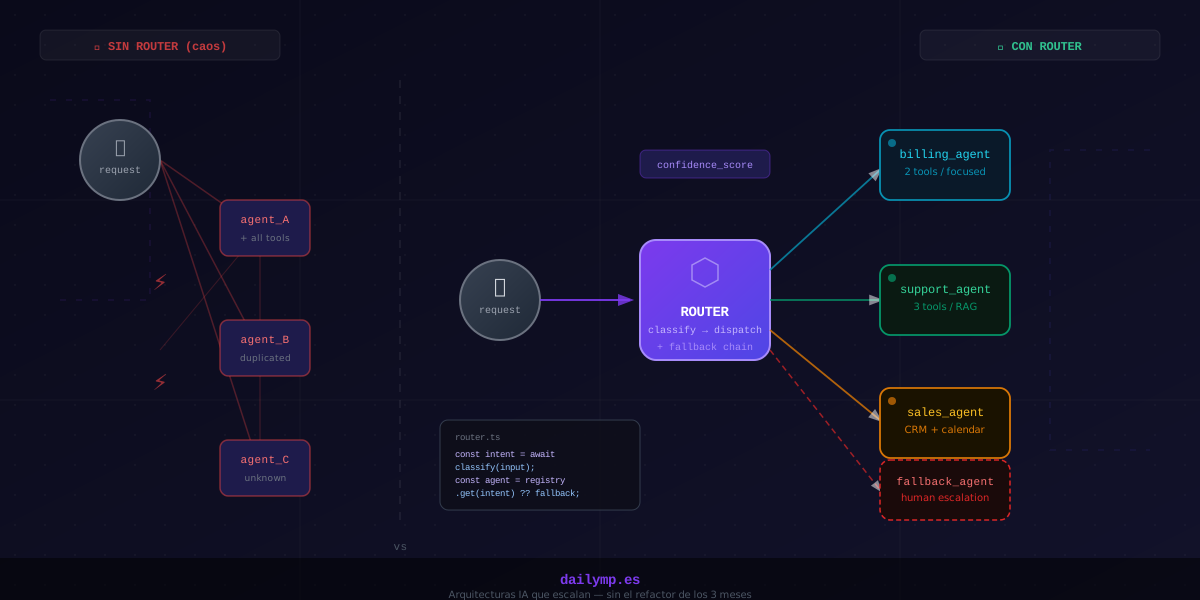
The Router Pattern for AI Agents: Scale Without Refactoring
Building the first AI agent is easy. Building the fifth is where everything breaks.
With a single agent, architecture barely matters: input goes in, output comes out. But as soon as different use cases appear — support, sales, billing, onboarding — someone has to decide which agent handles which request. Without an explicit architecture behind that decision, the project becomes technical debt from day one.
This is the routing problem. And it's why so many multi-agent projects pass the demo and fail in production.
Why Naive Routing Breaks Fast
When teams scale without planning routing, they fall into one of two traps:
The Swiss-Army Agent
The fastest solution: one agent with access to every tool. Pass it full context, give it twenty tools, and let the model figure it out.
What happens in production:
- Runaway costs: you're sending full context on every call even when the user just wants office hours.
- Tool selection hallucinations: the model picks the wrong tool more often as the tool catalog grows (covered in depth in the tool calling in production article).
- Impossible to test: you can't write deterministic tests for an agent that can do anything.
The Infinite If/Else
The second trap: a block of conditions at the entrypoint dispatching to the right agent based on keywords or hardcoded rules.
// The antipattern that looks reasonable at first
if (message.includes("invoice") || message.includes("payment")) {
  return billingAgent.run(message);
} else if (message.includes("help") || message.includes("error")) {
  return supportAgent.run(message);
} else {
  return genericAgent.run(message);
}
Works for three MVP cases. Once you have twenty use cases and multiple languages, it's unmaintainable. There's no fallback, no confidence score, and any linguistic variation silently breaks the routing.
The Router Pattern: Architecture That Scales
A Router is an explicit component whose sole responsibility is to classify incoming intent and dispatch to the correct specialized agent. It executes no business logic, makes no external API calls — it only classifies and delegates.
Request → Router → [ BillingAgent | SupportAgent | SalesAgent | FallbackAgent ]
The key: the Router is stateless, testable, and has a single responsibility. Each specialized agent has its own reduced toolset, its own system prompt optimized for that domain, and its own escalation logic.
Minimal TypeScript Implementation
// types.ts
type Intent = "billing" | "support" | "sales" | "unknown";

interface RouterResult {
  intent: Intent;
  confidence: number; // 0-1
  reasoning: string;
}

interface AgentRegistry {
  [key: string]: (input: string, context: Context) => Promise<AgentResponse>;
}
// router.ts
import Anthropic from "@anthropic-ai/sdk";

const client = new Anthropic();

async function classifyIntent(input: string): Promise<RouterResult> {
  const response = await client.messages.create({
    model: "claude-haiku-4-5-20251001", // fast, cheap model for classification
    max_tokens: 256,
    system: `Classify the user's intent into one of these categories:
- billing: questions about invoices, payments, subscriptions, pricing
- support: technical issues, errors, configuration, usage help
- sales: product interest, demos, pre-sales questions
- unknown: anything else or ambiguous

Respond ONLY with JSON: {"intent": "...", "confidence": 0.95, "reasoning": "..."}`,
    messages: [{ role: "user", content: input }],
  });

  const text = response.content[0].type === "text" ? response.content[0].text : "{}";
  return JSON.parse(text) as RouterResult;
}

const agentRegistry: AgentRegistry = {
  billing: billingAgent,
  support: supportAgent,
  sales: salesAgent,
  unknown: fallbackAgent,
};

export async function routeRequest(
  input: string,
  context: Context
): Promise<AgentResponse> {
  const { intent, confidence } = await classifyIntent(input);

  // Low confidence → go to fallback directly
  if (confidence < 0.7) {
    return agentRegistry.unknown(input, context);
  }

  const agent = agentRegistry[intent] ?? agentRegistry.unknown;
  return agent(input, context);
}
Three immediate advantages: the classifier is testable in isolation, the confidence threshold is configurable without touching agents, and adding a new agent is one entry in the registry with no routing changes.
Deterministic vs. LLM-Based Router: When to Use Each
You don't always need an LLM to classify. The rule is simple:
Deterministic router (regex, keyword scoring, vector similarity):
- The intent catalog is fixed and known
- Classification latency matters (< 20ms)
- You want zero extra tokens for classification
- Use cases are predictable and well-bounded
LLM-based router (the Claude Haiku example above):
- Intents are ambiguous or expressed in free natural language
- Users write in multiple languages
- The intent catalog changes frequently
- You need the
reasoningfield for debugging or logging
In real projects, the standard is a hybrid router: first pass through a fast deterministic classifier (regex over obvious patterns), and if there's no high-confidence match, escalate to the LLM classifier. This reduces routing costs by 60-80% in production.
Most Common Router Implementation Mistakes
No explicit fallback. If the router doesn't know where to send a request, the default is either an error or silently using the generic agent. Always define a fallbackAgent that can escalate to a human. In DAILYMP's multi-agent service we cover when and how to handle that escalation.
No timeout on the classifier. LLM classification can stall. Without its own timeout, a classifier failure blocks the whole chain. Always add an AbortSignal:
const controller = new AbortController();
setTimeout(() => controller.abort(), 3000); // 3s max to classify

const response = await client.messages.create(
  { /* ... */ },
  { signal: controller.signal }
);
Router accumulating business logic. The Router only classifies and delegates. The moment it starts deciding "if premium user, send to agent X even if intent is Y", you've created a component nobody will maintain in six months. That logic belongs inside the agent, not the router.
No routing metrics. If you don't know what percentage of requests land in unknown, you don't know whether your classifier is working. Always log intent, confidence, and which agent ultimately handled each request.
Why This Matters for Your Architecture
The Router isn't an optimization component you add when you have time. It's the piece that determines whether your multi-agent system can grow from three to ten agents without a full rewrite.
Teams that skip this end up three months later with a 400-line entrypoint nobody wants to touch, duplicated agents doing similar things, and a system where every business change requires manual routing updates.
At DAILYMP we design multi-agent systems with this pattern from sprint one: explicit router, specialized agents with bounded responsibilities, defined fallback, and metrics from day one. The result is a system the team can maintain and extend without needing the original architect every time a new use case appears.
Got more than one agent in production and routing is an if/else nobody wants to touch? Let's talk and review your architecture together.