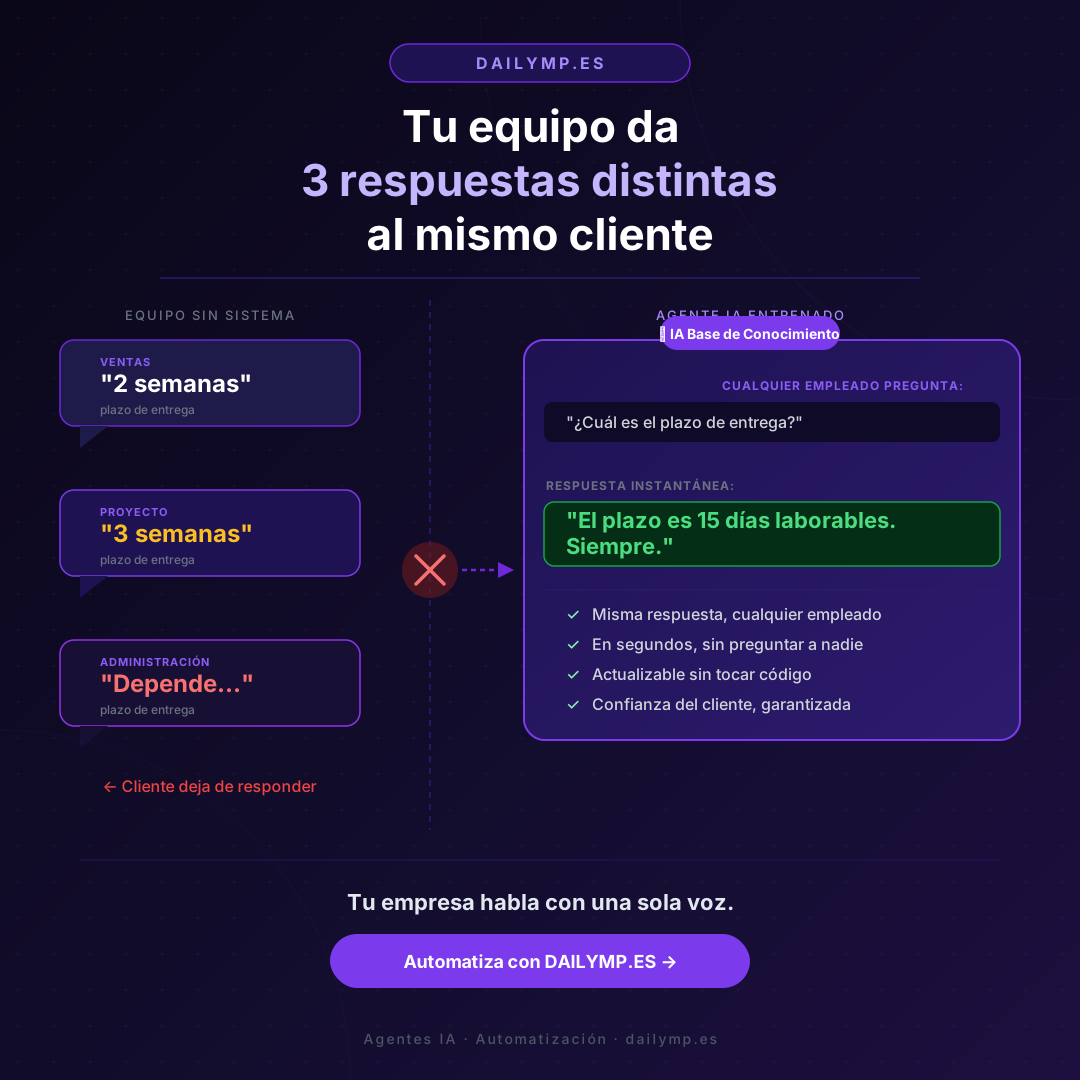
Your Team Gives 3 Different Answers to One Question
A potential client has been in conversations with your company for days. They talked to your salesperson, who said delivery takes two weeks. Then they emailed your project team — three weeks. Then they called your office to confirm before signing — "it depends on the volume, I'm not sure exactly."
The client didn't sign.
They didn't say why. They just stopped replying.
If this sounds familiar, or you suspect it happens without you knowing, it's not a training problem or a people problem. It's a systems problem. And it has a cost most businesses have never calculated.
Why your team doesn't give the same answer (and it's not their fault)
Ask someone on your team what the exact price of your most popular service is. Or how long a typical project takes. Or what happens if a client wants to cancel early.
If they have to think for more than five seconds, you've found the problem.
Your company's real information isn't written down anywhere specific. It lives across emails from two years ago, WhatsApp messages nobody archived, conversations from meetings that weren't documented, and the memory of whoever has been around the longest.
Each employee answers with what they remember. And what they remember is a version — not necessarily the current one.
When you onboard someone new, you explain things and hope they retain them correctly. When someone leaves, they take part of the knowledge that was never written down anywhere.
What inconsistent answers actually cost you
The damage isn't just the deal that doesn't close. It's the accumulation of signals your client receives.
When a client gets different answers from different people in your company, their conclusion isn't "they had an internal miscommunication." Their conclusion is: this company doesn't have things under control.
That's what they think. Even if they don't say it. Even if it's not entirely true.
Each inconsistent answer is a small crack in the trust you spent months building.
There's also an internal time cost: questions that bounce between people before reaching an answer, the employee who interrupts a colleague to ask something "they probably know," the ten-minute call to resolve a question that should have an instant answer.
If five people on your team interrupt each other three times a day to resolve internal questions, that's fifteen interruptions daily. Each one costs ten to twenty minutes of real focus. That's two to three hours of lost productivity every single day — with nobody tracking it.
The problem multiplies as you grow
With three people, information flows fairly consistently because you're all talking constantly. With ten people, there are already variations. With twenty, there are as many versions as there are people.
And every new hire learns from someone who learned from memory — not from documentation.
Remote work makes it worse: there's no desk next to yours where you can ask. You write a message, wait for a response, and often by the time it arrives the situation has already moved on.
Automating your internal processes isn't only for complex workflows. The first thing to solve is exactly this: giving anyone on your team access to the right information in seconds, without depending on another person being available.
What changes when your whole company gives the same answer
Imagine any person on your team can ask, right now, what the delivery timeline for your most common service is. Or exactly what your warranty covers. Or what your protocol is when a project runs late.
And the answer they get is the correct one. The same answer any other person in your company would give.
That's what an AI agent trained on your actual business knowledge does. Not a generic chatbot — a system that knows your prices, your processes, your policies, and your most common scenarios, and responds in seconds to any internal question.
What businesses notice when they implement this:
- New employee onboarding drops from weeks of shadowing to days of direct access
- More consistent client communication because everyone is working from the same source of truth
- Fewer internal interruptions because common questions resolve without needing to ask anyone
- Ability to scale without knowledge getting trapped in long-tenured employees
Integrating AI into your business processes doesn't require an in-house tech team or any understanding of how the technology works. It requires knowing what information your business needs to have available — always, for everyone.
If your team doesn't know what to answer, clients don't know why to choose you
Inconsistency in answers isn't just an operations problem. It's a positioning problem.
When your company speaks with one voice, it doesn't matter which team member talks to the client. The message is consistent. Trust builds on its own.
When it doesn't, every conversation is a roll of the dice.
That doesn't get solved with more training or more team meetings. It gets solved with a system that centralizes your knowledge and puts it within reach of everyone, exactly when they need it.
If you want to see how this works in a company like yours, reach out and we'll walk through it together.