What AI Can Do for Your Business (No Tech Skills Needed)
Forget everything you think you know about artificial intelligence.
The robots replacing employees. The systems that only engineers understand. The technology reserved for Google, Amazon, or large corporations. That's not what we're talking about here.
We're talking about something much simpler: the hours your business loses every week, the clients who leave without you realizing, and the things that could run on their own while your team focuses on what actually matters.
What AI Actually Does in a Business Like Yours
Artificial intelligence, in the context of an SMB, is basically this: a system that handles predictable tasks without anyone having to do them by hand.
It doesn't learn your entire business overnight or solve all your problems at once. But if your company has things that repeat themselves — answering the same messages, copying data from one place to another, reminding clients that a proposal is waiting — a significant part of that can stop being done manually.
Without you needing to write a single line of code. Without hiring a technical team. Without changing the tools you already use.
Four Concrete Things AI Solves Right Now
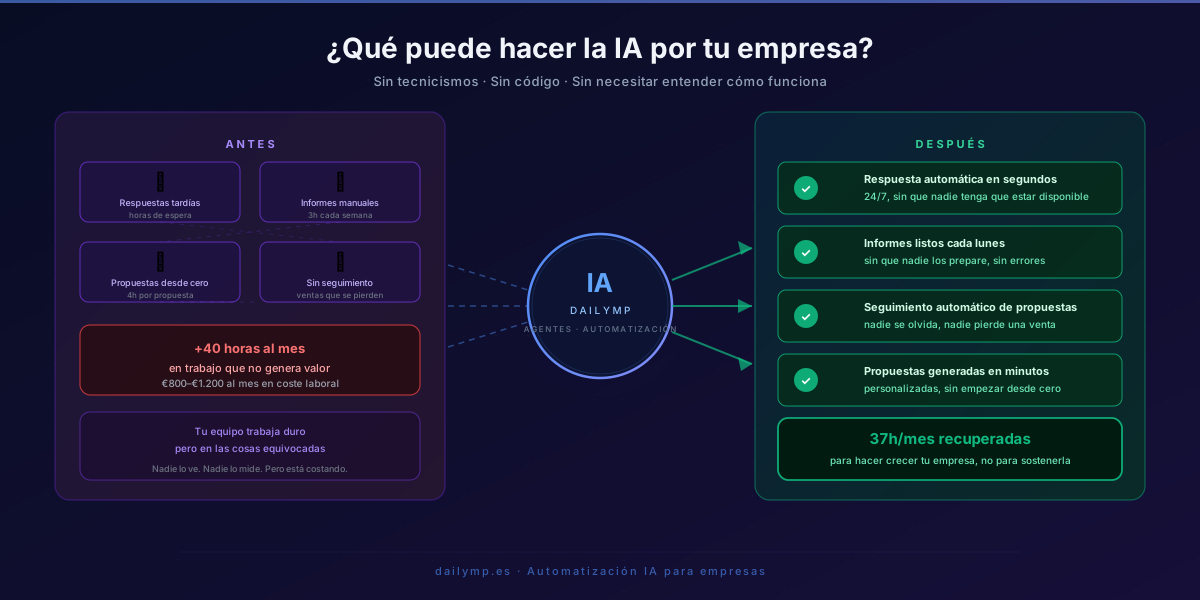
1. Responding to messages when your team can't
It's 9 PM. Someone visits your website, reads your services, has a question, and sends a message. Tomorrow at 9 AM, someone on your team sees it. By then, that person has already contacted three other companies.
An automated system replies within seconds. It mentions exactly what they asked about. It offers the next step. And you don't even notice, because you don't need to.
What changes: contacts that arrive outside business hours stop getting lost. And those that arrive during business hours too — because the system responds before your team has time to open their email.
2. The weekly report someone prepares by hand
Someone in your company, every Monday or every Friday, opens three or four programs, copies data, pastes it somewhere else, adjusts the format, and sends the report.
That takes two to four hours. Every week. Just to move information from one place to another.
A properly configured system can do that on its own. Without errors. Without anyone touching it. The report reaches whoever needs it, in the format you already use, before the workday begins.
What changes: those two to four weekly hours simply stop existing. The person who used to do it can spend that time on work that actually requires their judgment and expertise.
3. The follow-up nobody does because everyone's too busy
You sent the proposal. Ten days went by. Nothing.
It's not that the client isn't interested. They're busy — same as you. And whoever doesn't follow up disappears from their radar.
An automatic follow-up system contacts the client at three days. At seven days if there's no reply. At fourteen days, a final gentle contact. All in your company's tone, all personalized to the specific proposal that was sent. Your team only steps in when someone replies.
What changes: proposals that used to be sent and forgotten start generating responses. Not because the service improved — because something shows signs of life at exactly the moment the client needs it.
4. Proposals that always start from scratch
A new client comes in. You need to prepare a proposal. Someone finds the last one, adapts it, changes the client name, adjusts the numbers, checks for leftover data from the previous client, formats it, exports to PDF, and sends it.
Four hours for a document that's 80% identical to the previous one.
With a properly configured system, that proposal is generated in minutes from four or five data points. It's ready for a quick review and ready to go. Work stops starting from scratch every single time.
What changes: commercial response speed improves dramatically. Clients comparing multiple companies are more likely to choose you — not because you're better, but because you arrived first.
What You Don't Need for This to Work
This is where most business owners are genuinely surprised.
You don't need to know how to code. The systems we implement at DAILYMP don't require you to understand how they work internally. Only to know what you want them to do.
You don't need to change your tools. In most cases, we connect what you already have: email, CRM, WhatsApp, Google Sheets. AI integration with your existing systems is part of the process — not a problem you need to solve yourself.
You don't need a large-company budget. Automation projects for SMBs typically recover their investment in three to four months. There are options from limited-scope projects to full implementations, depending on what your business needs right now.
You don't need your own technical team. That's what we're here for.
How a Business Like Yours Gets Started
The first step is always the same: a conversation.
Not a technology presentation. Not a catalog of tools. A conversation about your business: which processes consume the most time, where clients are being lost, what your team does each week that they shouldn't have to do.
From there, we identify what has the most impact to solve first. We implement it. And in two to four weeks, something that used to take hours starts running on its own.
If you want to know specifically what could be automated in your company, tell me directly.