LLM Gateway in Production: The Proxy That Scales AI Agents
You have three services calling the Anthropic API. One for the customer support agent, one for the document classifier, one for the report generator. Each has its own API key, its own error handling, its own timeout. When Anthropic returns a 529 at 3pm on a Tuesday, all three fail simultaneously, in different ways, with different log formats, and nobody knows how much each one cost this month.
An LLM gateway solves exactly that. It's the proxy that sits between your services and LLM providers, centralising what you currently have scattered across dozens of callsites.
Why direct LLM calls don't scale
The first implementation always looks the same: you call anthropic.messages.create() from wherever you need it. It works for a while. The problem arrives when the system grows.
With direct per-service calls, four problems emerge that no retry loop can fix by itself:
- Siloed rate limiting: if the document classifier burns too much capacity, other services don't know until they also start seeing 429s. There's no coordination.
- No automatic fallback: if Anthropic has an incident, your service fails. There's no plan B baked into the architecture.
- Invisible cost per process: you know your total spend, but you don't know whether it's the support agent or the report generator that's driving it. You can't optimise what you can't attribute.
- Manual model rotations: switching from
claude-opus-4-7toclaude-sonnet-4-6in production means touching code and deploying multiple services.
What an LLM Gateway solves
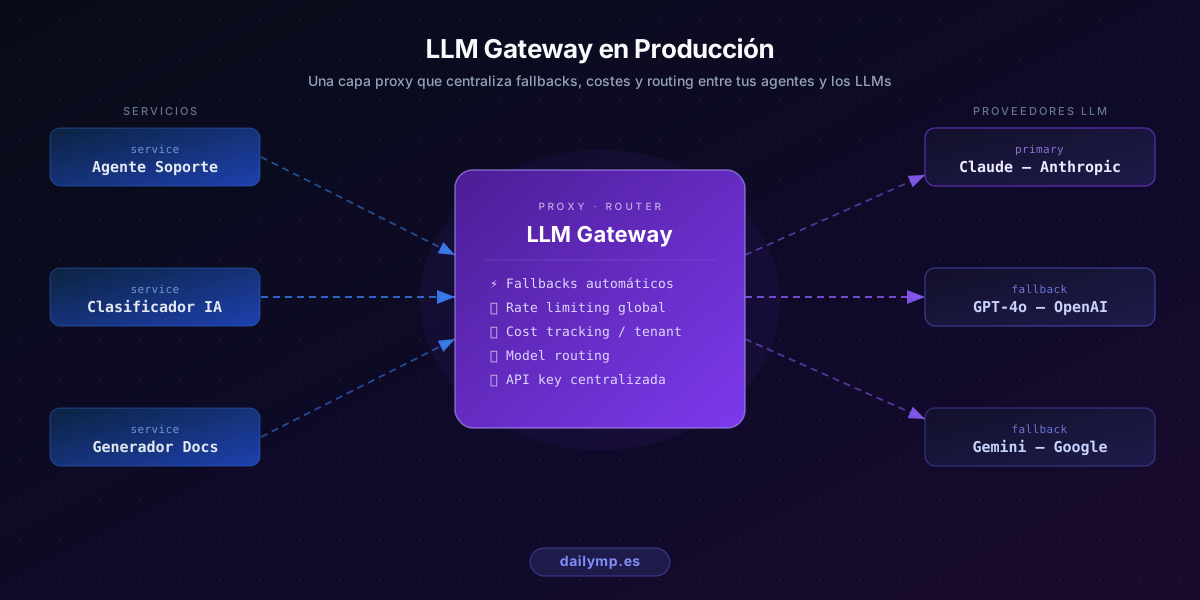
A gateway is an HTTP service that receives your completion requests, manages them centrally, and forwards them to the right provider:
Support Agent   ─┐
Document Classifier ─┤─▶  LLM Gateway  ─▶  Anthropic / OpenAI / Gemini
Report Generator ─┘
What you gain by adding this layer:
Automatic cross-provider fallbacks. If Anthropic returns a 529 or exceeds the configured timeout, the gateway retries with OpenAI or Gemini — your services never know it happened.
Global, coordinated rate limiting. The gateway controls tokens per minute centrally. The classifier can't eat the support agent's quota.
Cost tracking per service or tenant. Each request carries a header like x-service: classifier or x-tenant: acme-corp. The gateway logs token consumption per context. You can finally answer the question of what each process actually costs.
Declarative model routing. Simple classification tasks → cheap model. Complex document generation → powerful model. The logic lives in the gateway, not duplicated across every service.
Minimal TypeScript implementation
If you're already on Next.js, the fastest starting point is a route handler acting as a proxy:
// app/api/llm/route.ts
import Anthropic from '@anthropic-ai/sdk'

const client = new Anthropic()

export async function POST(req: Request) {
  const { messages, model, metadata } = await req.json()
  const service = req.headers.get('x-service') ?? 'unknown'
  const tenant  = req.headers.get('x-tenant')  ?? 'default'

  try {
    const response = await client.messages.create({
      model: model ?? 'claude-sonnet-4-6',
      max_tokens: 1024,
      messages,
    })

    // Centralised logging: tokens per service and tenant
    console.log({
      service,
      tenant,
      input_tokens:  response.usage.input_tokens,
      output_tokens: response.usage.output_tokens,
      model: response.model,
      ts: Date.now(),
    })

    return Response.json(response)

  } catch (err: any) {
    if (err.status === 529 || err.status === 429) {
      // Single point to implement fallback to another provider
      return Response.json({ error: 'overloaded', retry: true }, { status: 503 })
    }
    throw err
  }
}
All your services now call /api/llm instead of Anthropic directly. Immediate benefit: a single place to add logging, fallbacks and rate limiting without touching each individual agent.
LiteLLM: when the open-source solution makes more sense
For teams already handling real production load, LiteLLM ships all of this out of the box: HTTP proxy, support for 100+ models, budget limits per API key, database logging, and YAML-configurable fallbacks:
# litellm_config.yaml
model_list:
  - model_name: production-llm
    litellm_params:
      model: claude-sonnet-4-6
      api_key: os.environ/ANTHROPIC_API_KEY

  - model_name: production-llm      # same alias, automatic fallback
    litellm_params:
      model: gpt-4o
      api_key: os.environ/OPENAI_API_KEY

router_settings:
  num_retries: 3
  fallbacks: [{"production-llm": ["production-llm"]}]
  allowed_fails: 1
Your services call http://gateway:8000/v1/chat/completions with model: "production-llm". The gateway handles everything else.
When you need this (and when you don't)
If you have a single agent in production calling one provider, a gateway adds unnecessary complexity. You need it when:
- More than one service makes LLM calls
- You need cost visibility per tenant or per process
- You want to swap models without deploying every service
- You're in a sector where 99.9% availability actually matters
At DAILYMP, we add the gateway layer from the first sprint whenever a system has more than two agents. It looks like overhead in week one. Two months later it's what keeps the system alive when providers have incidents — and in 2026, with the traffic volumes they handle, that happens more often than the official status dashboards acknowledge.
If you want to see how this connects with AI agent observability and tracing, there's a natural pattern: the gateway is where you emit the events that the tracing system collects.
The architectural argument
An LLM gateway isn't premature optimisation — it's the separation of concerns that should be there from day one. Your business logic shouldn't know which provider is answering a request, how to handle a 529, or how to split cost across clients.
If you're building a multi-agent system and want the right architecture from the start, let's talk directly.