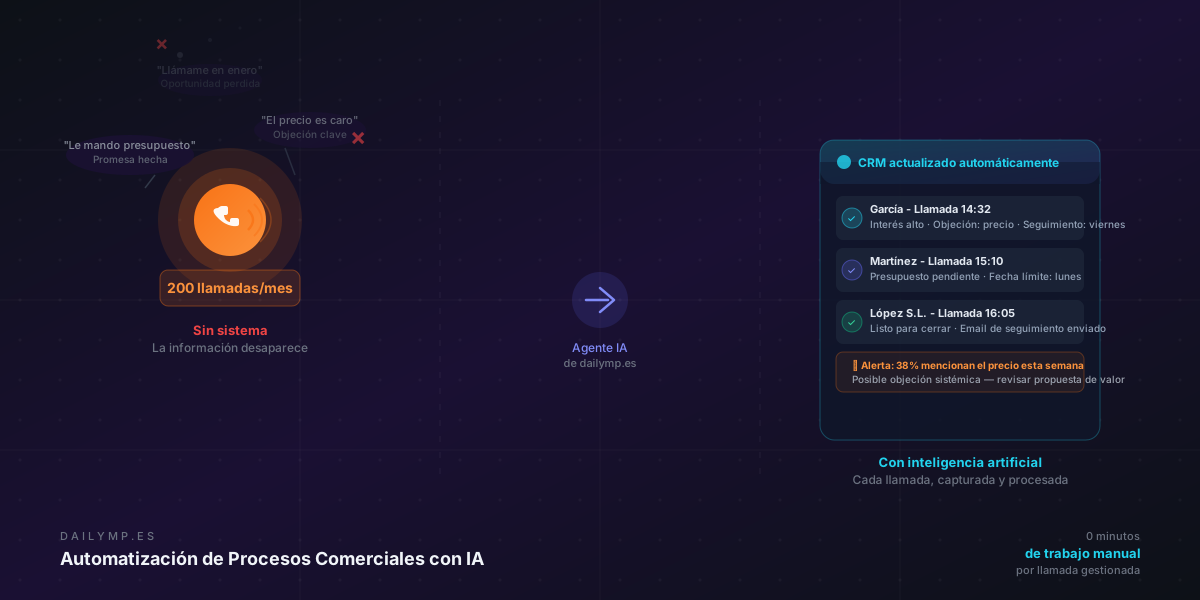
Your Team Makes 200 Calls a Month. Zero Are Recorded.
Your team spoke with thirty customers today. Sales calls, follow-ups, project updates. Half an hour here, ten minutes there.
What did they say? What did you promise? Who's ready to close and who's quietly shopping around?
You don't know. Because when the call ends, the information disappears.
Your business memory lives inside people's heads
In most small businesses, commercial knowledge lives in the head of whoever made the call. Not in the CRM. Not in any system. In the memory of a salesperson who that afternoon has six more meetings and by Friday can barely recall the details.
That has very concrete consequences:
- The client who called Tuesday phones again Thursday and has to repeat their whole situation from scratch.
- The objection that came up five times this week goes undetected because nobody wrote it down.
- The salesperson leaving in December takes with them twelve months of context on forty accounts.
Every call that ends without leaving a trace is a decision your business makes blindly.
The real cost of recording nothing
Quick math. If your team makes 200 calls a month and each one generates information that should be in the CRM — a note, a next action, a status change — and nobody writes it down, that's 200 follow-up opportunities depending entirely on someone remembering.
How many proposals get sent late because the salesperson forgot they'd promised one? How many prospects "lost interest" because you took two weeks to follow up on something they mentioned in passing — the exact thing that was the key to closing?
This isn't a motivation or discipline problem. It's a systems problem. No salesperson, no matter how talented, can run a call and simultaneously take complete notes, update the CRM, schedule the next action, and draft the follow-up email. That's too many things at once.
The result: the CRM is outdated, follow-ups slip, and customers feel like your business has no memory.
If this is already happening, the article Your CRM Has Been Empty for Months. You Know It. explains exactly why it happens and what's at the root of it.
What the customer experiences
When a customer calls back about the same issue and the person answering knows nothing about the previous conversation, what they feel isn't neutral. They feel like they don't matter. Like they're a ticket number.
And that customer doesn't complain. They don't call to tell you they're frustrated. They just start looking at alternatives. One day they don't renew. Or they take your competitor's offer — the one who had all their context ready because they had a system.
The problem isn't a difficult customer. The problem is that your business relies on individual memory instead of building its own institutional memory.
The solution: an agent that listens, notes, and acts
This is mature technology, not science fiction. Today you can do exactly the following:
- Automatically transcribe every call (with the proper legal consent, which is straightforward to set up).
- Extract what matters: what the customer asked for, what was promised, what objection came up, what the next step is.
- Update the CRM without human intervention: the agent writes the note, changes the lead status, and schedules the reminder.
- Generate the follow-up email: the salesperson reviews it and sends it with one click, without writing it from scratch.
- Detect patterns: if 40% of calls this week mention pricing, the system flags it immediately — not at month-end.
The salesperson leaves the call and all they have to do is hang up. The system handles the rest.
At DAILYMP we build these kinds of agents integrated with the CRM and tools you already use — without changing how your team works.
What changes when this is running
First, customer context is always available. It doesn't matter who picks up the phone: they have the full history in front of them. That makes customers feel like they matter, not like a case number.
Second, follow-ups actually happen. Not because someone remembered, but because the system scheduled them automatically and sends the alert.
Third, you start seeing patterns that were previously invisible. Which objections repeat. Which times of month customers are most receptive. What calls that convert to closed deals have in common.
With the same salespeople, making the same calls, you get different results because the work from each call is no longer lost.
The moment to act is before someone leaves
Most businesses realize they have this problem when a key salesperson quits. That's when they discover forty accounts lived in that person's head and now they have to start over with each one.
Don't wait for that moment. The information being generated right now in your calls has real value. The system to capture it takes days to set up, not months.
Want to see how it applies to your sales team? Write to me and we'll look at it together.